When does a Treasury bill beat a CD after state income tax?
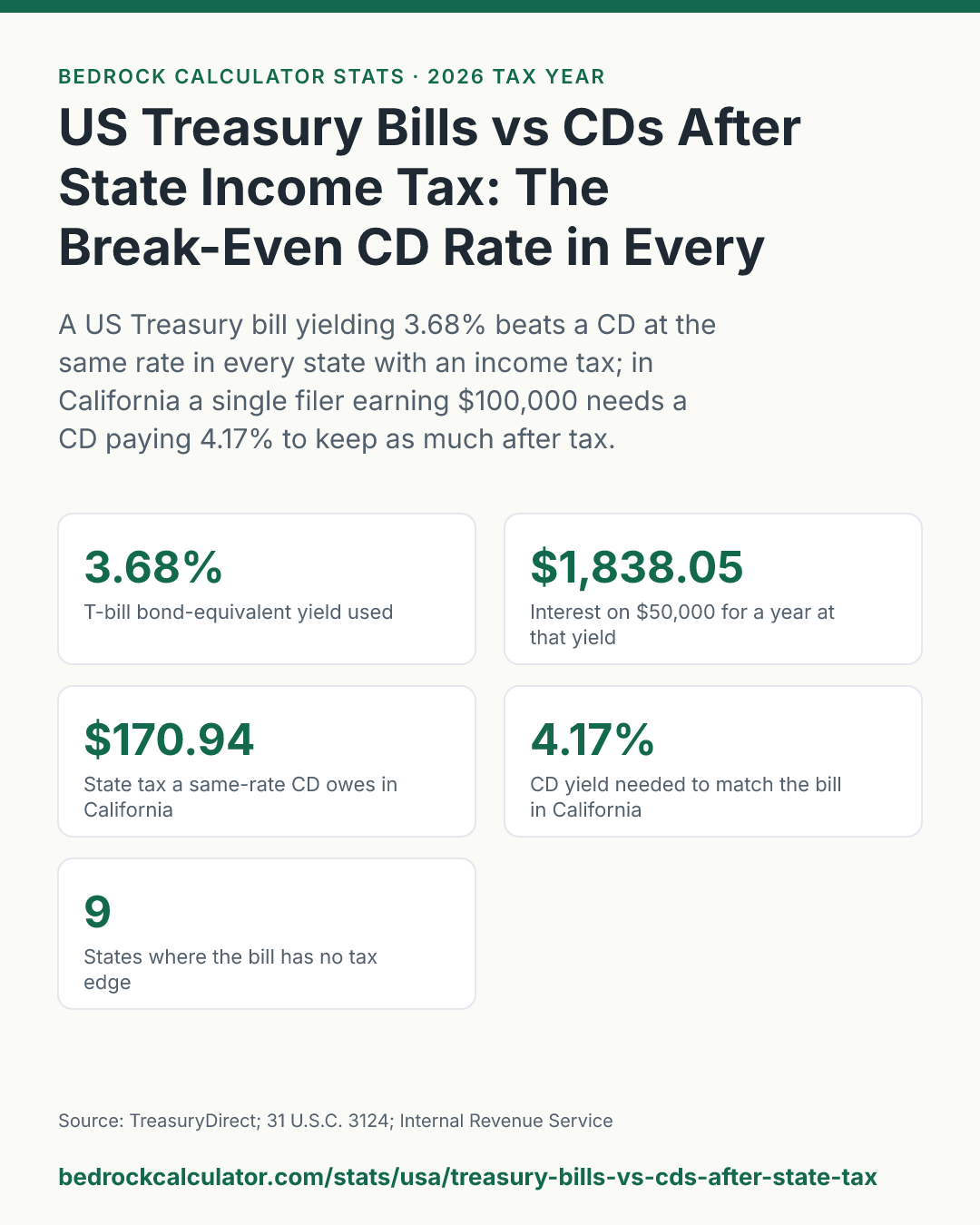
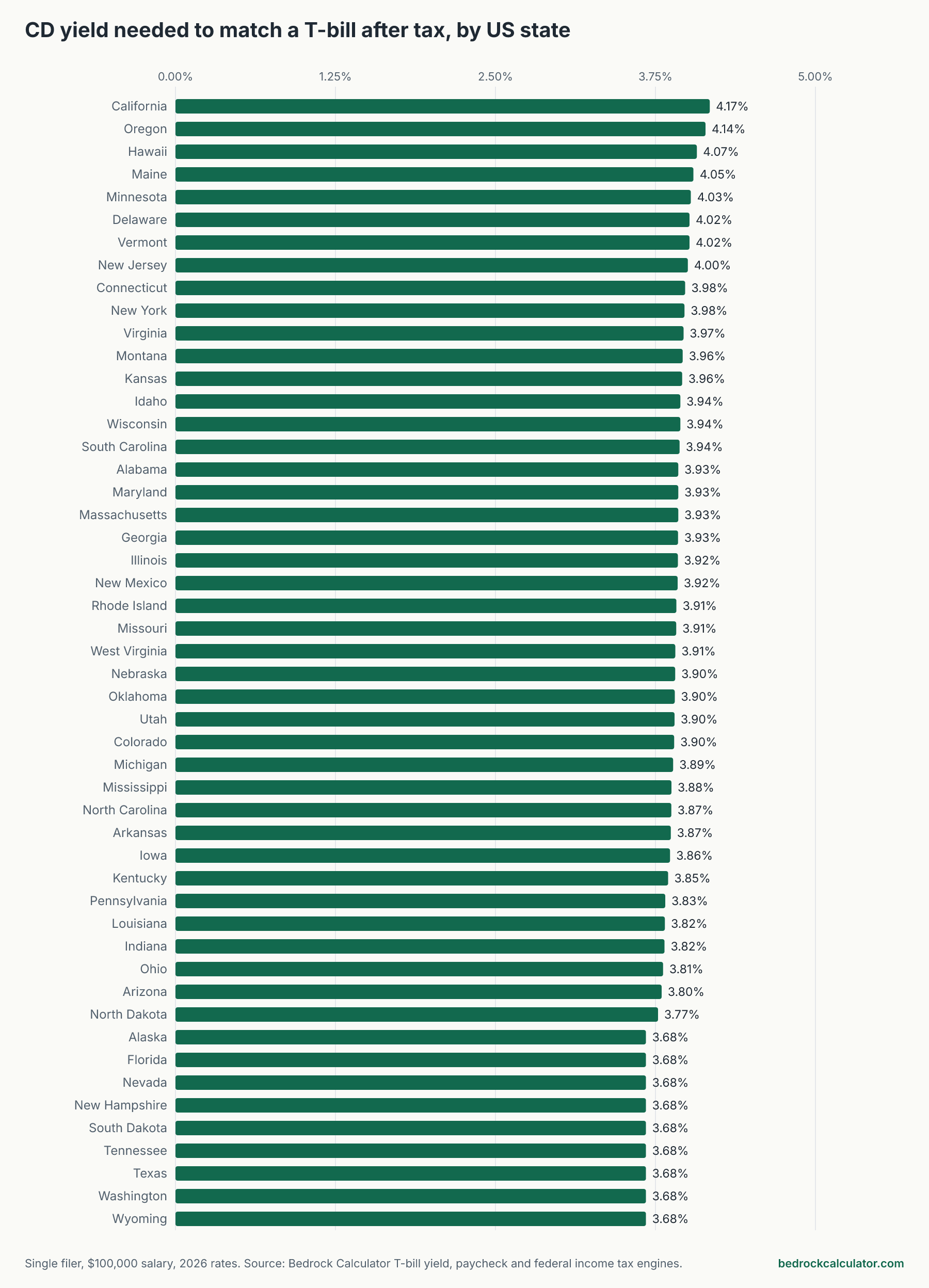
A T-bill beats a CD at the same yield wherever your state taxes the CD interest, because states can't tax T-bill interest. For a single filer earning $100,000, a T-bill yielding 3.68% is worth as much as a CD paying 4.17% in California, 4.14% in Oregon and 3.93% in Illinois.
Illinois is a typical US state with an income tax. A Treasury bill and a bank CD can quote the same yield and still leave you with different money for exactly this reason.
In the 9 states where the paycheck calculator charges no state tax on this income, there's no tax edge at all. A CD at 3.68% and a T-bill at 3.68% leave you with the same after-tax income.
Why T-bill interest skips your state tax
Federal law says states and their cities can't tax interest on US government debt. TreasuryDirect, the Treasury's own site, puts it plainly: federal tax is due on T-bill interest, but it's exempt from state and local taxes. Bank CD interest gets no such break. Your state treats it like any other income.
The IRS taxes both the same way, as ordinary income. So the whole difference between the two comes from one line on your state return.
How we worked out these numbers
Every figure here comes from calculators on this site. Nothing was typed in by hand.
- The T-bill yield. We ran the Treasury bill yield calculator for a 26-week bill (182 days) bought at $9,820 per $10,000 of face value. Its bond-equivalent yield is 3.68%. That's the yield to compare with a CD, because it's figured on what you pay and annualized over 365 days, unlike the lower discount yield quoted at auction.
- A year of interest. We put $50,000 to work at that yield for a year, which comes to $1,838.05. That assumes you roll the bill over at the same rate, which won't happen exactly in real life.
- The state tax. We ran the paycheck calculator for a single filer at a $100,000 salary in each state, then again with the $1,838.05 added, and took the difference in state income tax. That's what a CD paying the same yield would owe, and what the T-bill avoids.
- The federal tax. We did the same with the federal income tax calculator. The interest adds $404.37 of federal tax, or 22.0% of it, whichever product you pick.
- The break-even CD yield. With both taxes known, we found the CD yield that leaves the same after-tax income as the bill: the bill's yield times one minus the federal rate, divided by one minus the federal and state rates together.
Every state, side by side
Sort by any column. The middle column is the dollar amount a same-rate CD would cost you in state tax each year on $50,000 of savings.
T-bill vs CD after state income tax, by US state (2026)
Download CSVSingle filer, $100,000 salary, $50,000 invested for a year at the T-bill yield. State tax from the paycheck calculator on the extra income; no local income tax.
| California | 9.30% | $170.94 | 4.17% |
| Oregon | 8.75% | $160.83 | 4.14% |
| Hawaii | 7.60% | $139.69 | 4.07% |
| Maine | 7.15% | $131.42 | 4.05% |
| Minnesota | 6.80% | $124.98 | 4.03% |
| Delaware | 6.60% | $121.31 | 4.02% |
| Vermont | 6.60% | $121.31 | 4.02% |
| New Jersey | 6.37% | $117.08 | 4.00% |
| Connecticut | 6.00% | $110.28 | 3.98% |
| New York | 5.90% | $108.44 | 3.98% |
| Virginia | 5.75% | $105.69 | 3.97% |
| Montana | 5.65% | $103.85 | 3.96% |
| Kansas | 5.58% | $102.56 | 3.96% |
| Idaho | 5.30% | $97.42 | 3.94% |
| Wisconsin | 5.30% | $97.42 | 3.94% |
| South Carolina | 5.21% | $95.76 | 3.94% |
| Alabama | 5.00% | $91.90 | 3.93% |
| Maryland | 5.00% | $91.90 | 3.93% |
| Massachusetts | 5.00% | $91.90 | 3.93% |
| Georgia | 4.99% | $91.72 | 3.93% |
| Illinois | 4.95% | $90.98 | 3.92% |
| New Mexico | 4.90% | $90.06 | 3.92% |
| Rhode Island | 4.75% | $87.31 | 3.91% |
| Missouri | 4.70% | $86.39 | 3.91% |
| West Virginia | 4.58% | $84.18 | 3.91% |
| Nebraska | 4.55% | $83.63 | 3.90% |
| Oklahoma | 4.50% | $82.71 | 3.90% |
| Utah | 4.45% | $81.79 | 3.90% |
| Colorado | 4.40% | $80.87 | 3.90% |
| Michigan | 4.25% | $78.12 | 3.89% |
| Mississippi | 4.00% | $73.52 | 3.88% |
| North Carolina | 3.99% | $73.34 | 3.87% |
| Arkansas | 3.90% | $71.68 | 3.87% |
| Iowa | 3.80% | $69.85 | 3.86% |
| Kentucky | 3.50% | $64.33 | 3.85% |
| Pennsylvania | 3.07% | $56.43 | 3.83% |
| Louisiana | 3.00% | $55.14 | 3.82% |
| Indiana | 2.95% | $54.22 | 3.82% |
| Ohio | 2.75% | $50.54 | 3.81% |
| Arizona | 2.50% | $45.95 | 3.80% |
| North Dakota | 1.95% | $35.84 | 3.77% |
| Alaska | 0.00% | $0.00 | 3.68% |
| Florida | 0.00% | $0.00 | 3.68% |
| Nevada | 0.00% | $0.00 | 3.68% |
| New Hampshire | 0.00% | $0.00 | 3.68% |
| South Dakota | 0.00% | $0.00 | 3.68% |
| Tennessee | 0.00% | $0.00 | 3.68% |
| Texas | 0.00% | $0.00 | 3.68% |
| Washington | 0.00% | $0.00 | 3.68% |
| Wyoming | 0.00% | $0.00 | 3.68% |
California tops the list because its rate on this slice of income is the highest, at 9.30% of the interest. A CD there needs about 0.50% more yield than the bill just to break even. Oregon and Hawaii follow at 4.14% and 4.07%.
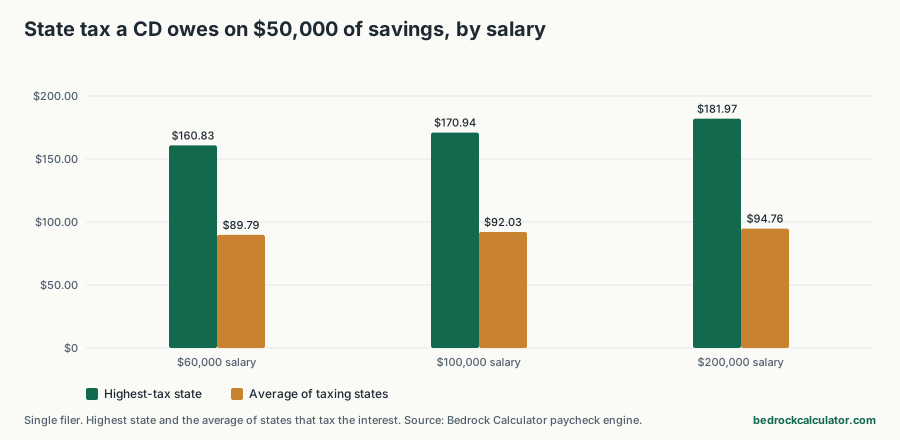
Across the 41 states that tax the interest, a same-rate CD costs an average of $92.03 a year in state tax on our example. That's real money, but notice its size. On $50,000 the gap is a few hundred dollars at most, not thousands. The bill's tax edge matters most when you're holding a large cash pile in a high-tax state.
The states where it makes no difference
Alaska, Florida, Nevada, New Hampshire, South Dakota, Tennessee, Texas, Washington, Wyoming don't tax this interest in the paycheck calculator, so the bill has nothing to offer on tax there. If you live in Texas or Florida, pick between a CD and a T-bill on yield, term, and how easily you can get your money out early.
One caution: this group comes from the paycheck calculator's state schedules, which tax wages and other ordinary income. It doesn't check special state taxes on investment income, so if you live in one of these states and your return has a separate investment-income line, confirm with your state revenue department.
Why a bigger paycheck widens the gap
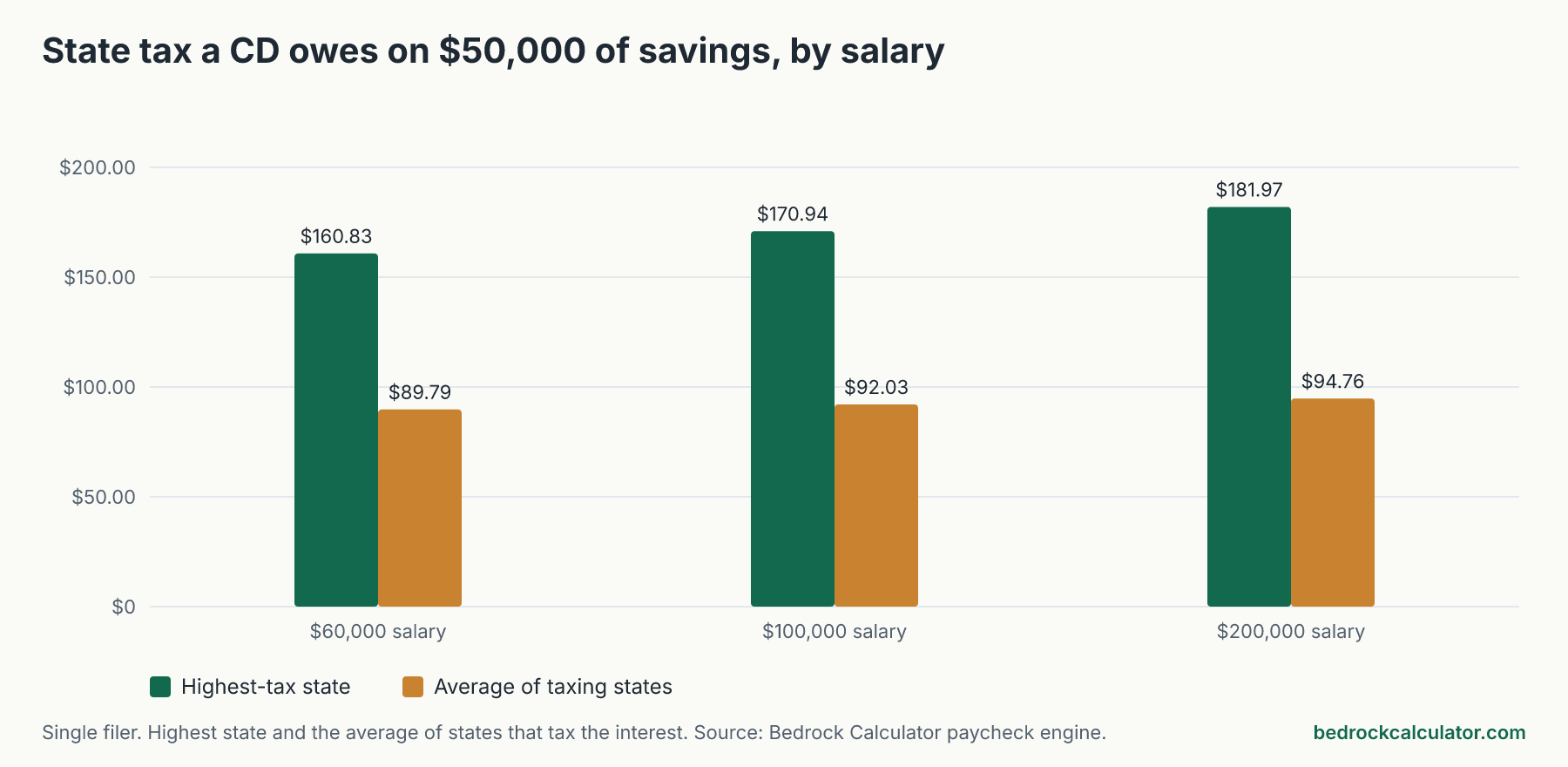
State income taxes are mostly graduated. The more you earn from your job, the higher the bracket your interest lands in. In the highest-tax state, the state tax on the same $1,838.05 of interest is $160.83 at a $60,000 salary, $170.94 at $100,000 and $181.97 at $200,000, where Oregon takes the most. For the average taxing state it moves from $89.79 to $94.76. Flat-tax states charge the same share at every income, so their bars don't move.
What this leaves out
These figures compare the two products on tax alone, and the calculators behind them have limits worth knowing.
- Local income taxes. The paycheck calculator applies only the state schedule. If your city or county taxes income, as New York City does, a CD's real disadvantage is bigger than shown, because the T-bill escapes local tax too.
- State-specific deductions and credits. The state tax is the state's rate schedule applied to wages plus interest. A state that treats interest differently from wages, or gives credits we don't model, could change the figure.
- Itemizing. We assume you take the standard deduction. If you itemize and deduct state income tax on your federal return, the state's bite is a little smaller and the break-even CD yield a little lower.
- Compounding. CDs quote an APY that includes compounding. A T-bill's bond-equivalent yield doesn't compound. For one year the difference is small, but it isn't zero.
- Rates move. The bill price is an example we chose. T-bill rates change at every auction, and you'll be rolling into whatever the next one pays. A CD locks a rate for its full term.
- Early access. You can sell a T-bill before maturity at the market price, which might be a gain or a loss. Cashing a CD early usually costs a penalty. Neither is modeled here.
Run your own numbers
Start with the Treasury bill yield calculator and enter the price and term of the bill you're looking at to get its bond-equivalent yield. Then check your state's rate on extra income in the paycheck calculator by running your salary with and without the interest. If you're comparing a set of CDs with staggered terms instead, the CD ladder calculator shows what a ladder earns. And if you hold municipal bonds as well, our page on municipal bond tax-equivalent yield works through the same question for tax-free bonds.