What is a municipal bond's tax-equivalent yield in your bracket and state?
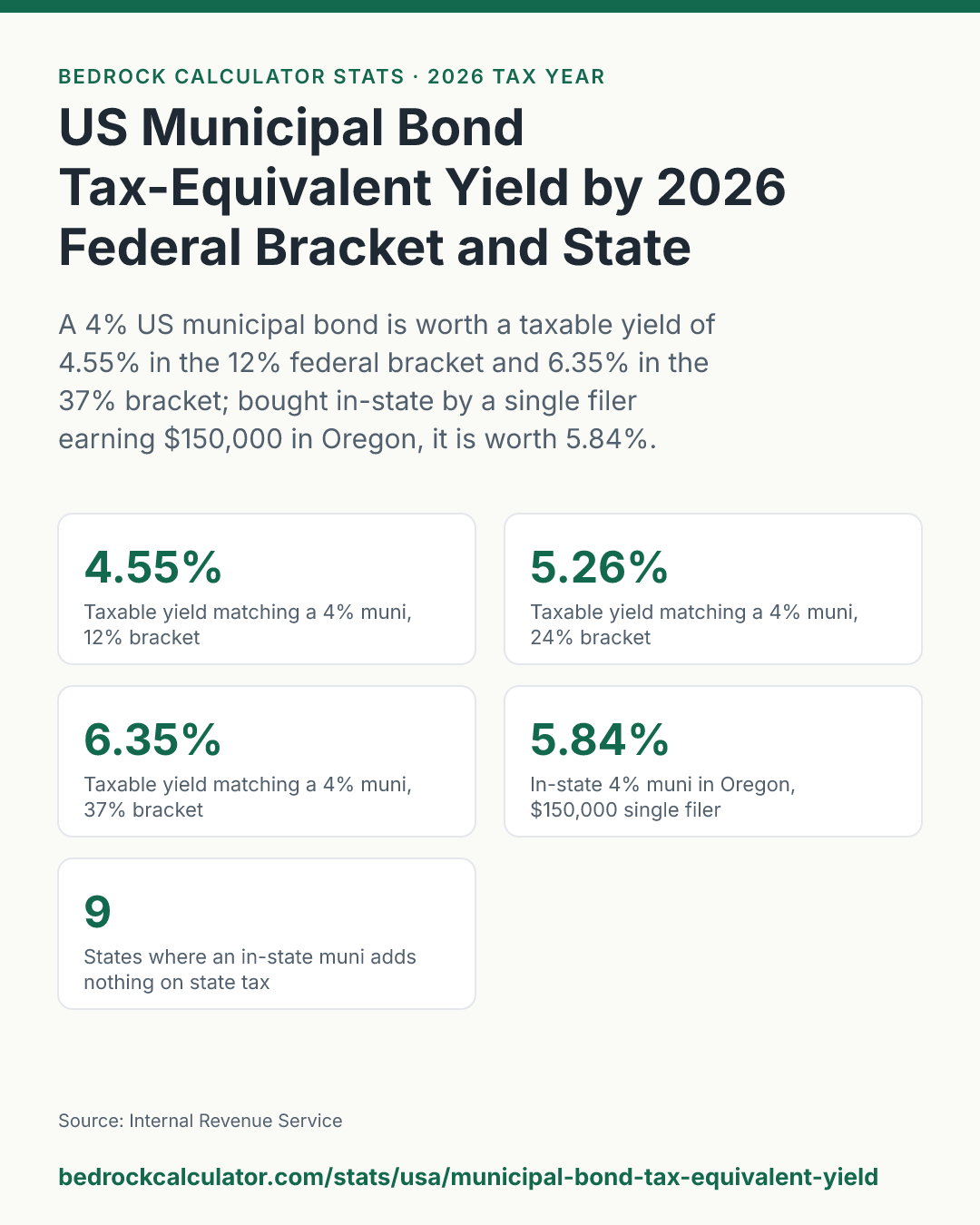
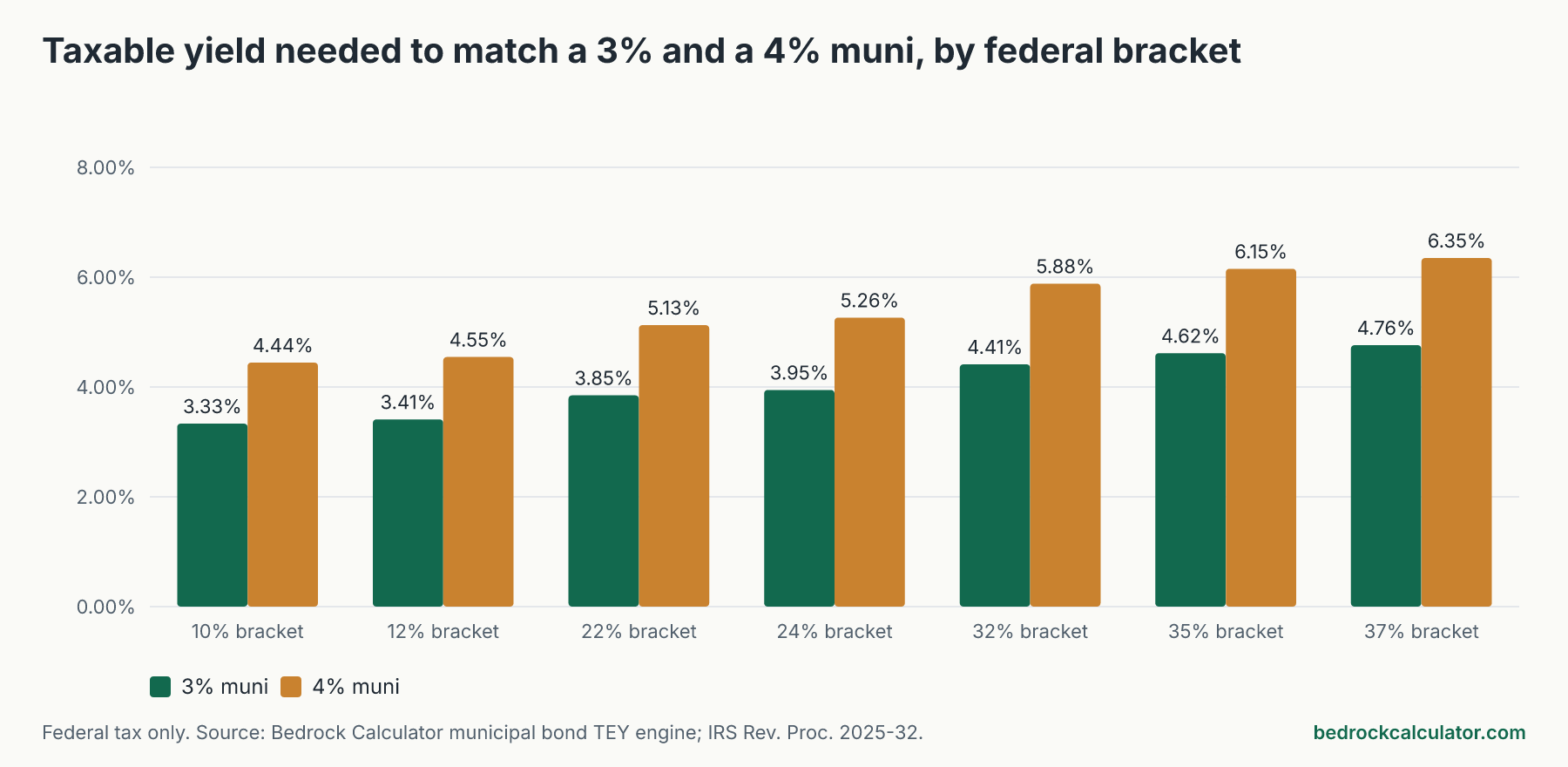
A municipal bond's yield looks low until you remember the IRS doesn't tax it. Counting federal tax alone, a 4% muni is worth the same as a taxable yield of 4.55% if you're in the 12% bracket, 5.26% in the 24% bracket and 6.35% in the top 37% bracket for 2026.
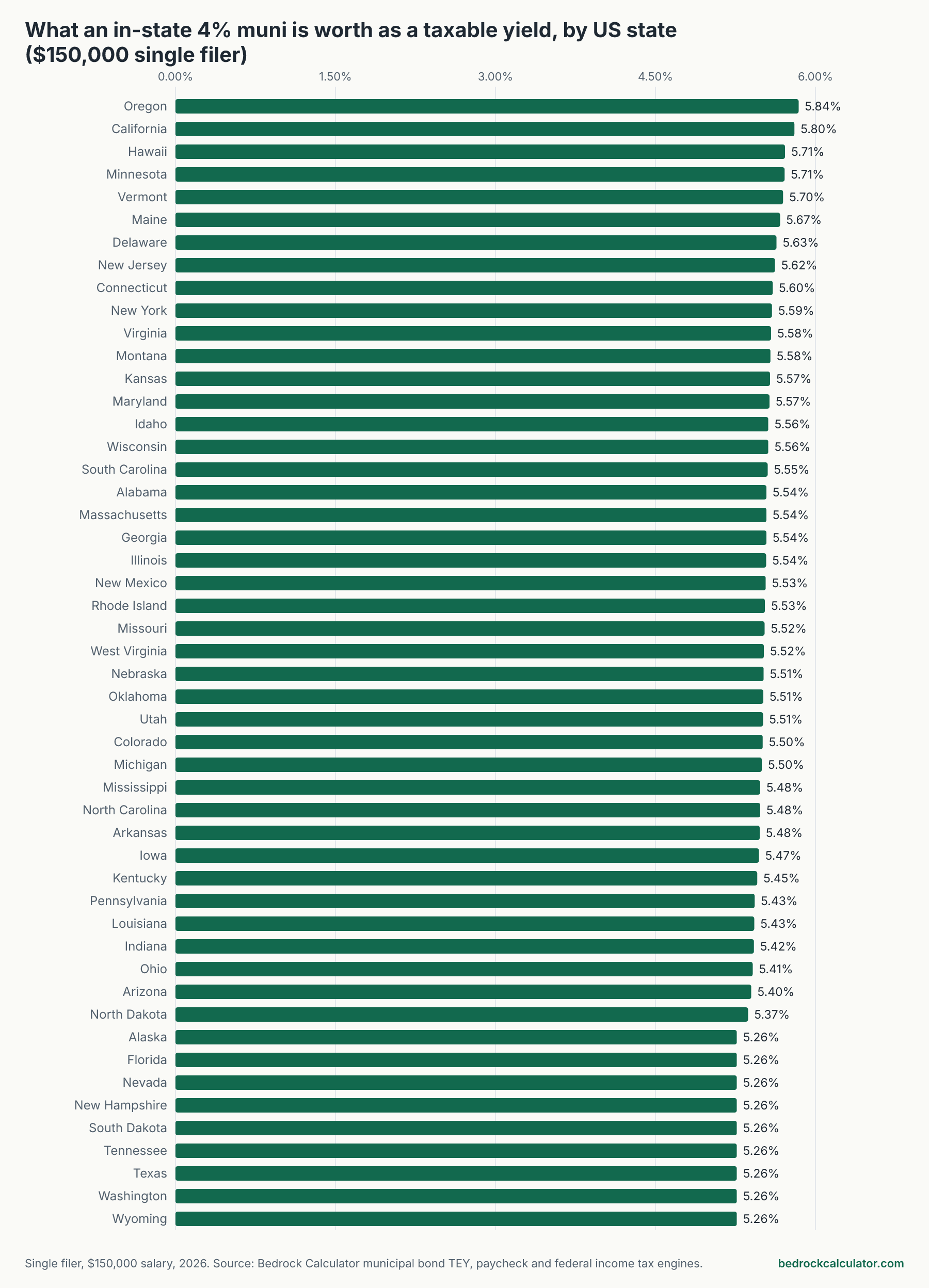
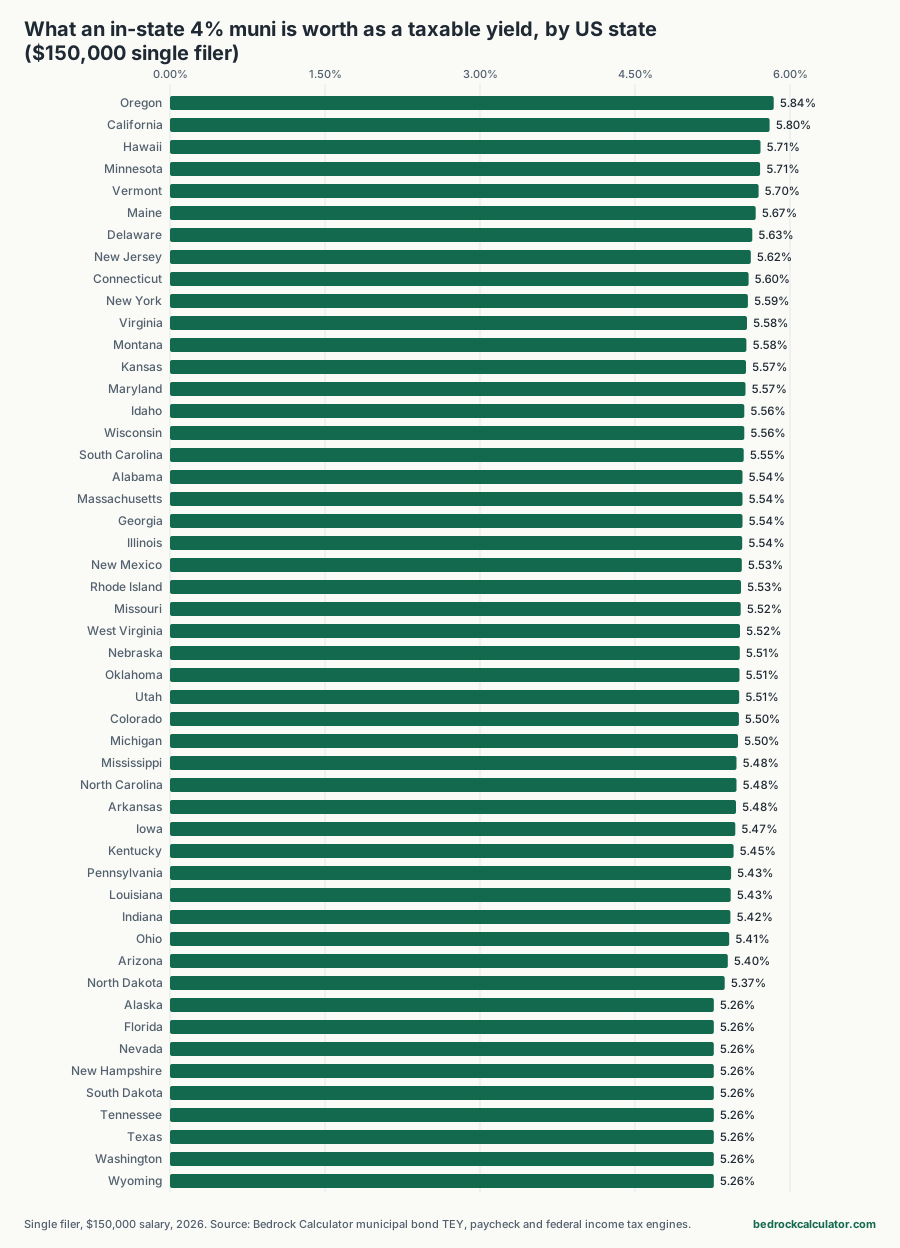
Buy a bond from your own state and the state tax break stacks on top. For a single filer earning $150,000, an in-state 4% muni is worth 5.84% in Oregon, 5.80% in California and 5.51% in Nebraska, the middle of the list.
What tax-equivalent yield means
Tax-equivalent yield, or TEY, answers one question: what would a taxable bond, CD or Treasury have to pay to leave you with the same income after tax as this muni? The formula is the muni's yield divided by one minus your tax rate. The higher your rate, the more a tax-free dollar is worth, so the same muni is worth more to a high earner than to someone in a low bracket.
That's the whole reason munis suit some people and not others. In the 12% bracket a 4% muni only needs to beat 4.55% from a taxable bond. In the 37% bracket it needs to beat 6.35%. Same bond, a gap of 1.80% in what it's worth to you.
How we worked out these numbers
Every figure comes from the municipal bond tax-equivalent yield calculator on this site.
- By bracket. We ran the calculator at each 2026 federal bracket for munis yielding 3%, 3.5% and 4%, with the state rate set to zero. The gross incomes where each bracket starts come from the 2026 federal tax table, adding the standard deduction of $16,100 for a single filer or $32,200 on a joint return.
- By state. For a single filer earning $150,000 we measured the tax rate on extra income rather than looking it up. We ran the federal income tax calculator and the paycheck calculator with and without $1,000 more income and divided the extra tax by $1,000. That gives a federal rate of 24.0% and each state's own rate. We fed both into the muni calculator for a 4% bond.
The calculator combines federal and state rates as the federal rate plus the state rate times one minus the federal rate. That formula assumes you deduct state income tax on your federal return. If you take the standard deduction, your true combined rate is a little higher than the one shown, and so is the muni's real worth to you. So the state figures here lean slightly conservative.
The 2026 federal brackets, side by side
Sort by any column. The two income columns tell you roughly which row is yours if your only deduction is the standard one.
Municipal bond tax-equivalent yield by 2026 federal tax bracket
Download CSVFederal tax only (state rate set to zero). Gross income where each bracket starts assumes the 2026 standard deduction and no other deductions.
| 10% | $16,100 | $32,200 | 3.33% | 3.89% | 4.44% |
| 12% | $28,500 | $57,000 | 3.41% | 3.98% | 4.55% |
| 22% | $66,500 | $133,000 | 3.85% | 4.49% | 5.13% |
| 24% | $121,800 | $243,600 | 3.95% | 4.61% | 5.26% |
| 32% | $217,875 | $435,750 | 4.41% | 5.15% | 5.88% |
| 35% | $272,325 | $544,650 | 4.62% | 5.38% | 6.15% |
| 37% | $656,700 | $800,900 | 4.76% | 5.56% | 6.35% |
A single filer moves from the 22% to the 24% bracket at about $121,800 of gross income and into 32% at about $217,875. That jump to 32% is where munis start to look much better: a 3.5% muni is worth 4.49% in the 22% bracket and 5.15% in the 32% bracket.
How much your state adds
On federal tax alone, a 4% muni is worth 5.26% to someone in the 24% bracket. Everything above that line in the chart comes from the state exemption. Oregon leads because the paycheck calculator puts its rate on this slice of income at 9.90%, for a combined rate of 31.52%.
In the 9 states with no tax on this income, Alaska, Florida, Nevada, New Hampshire, South Dakota, Tennessee, Texas, Washington, Wyoming, an in-state muni adds nothing over an out-of-state one. If you live in one of them you can buy munis from anywhere and judge them on credit quality and yield alone.
Tax-equivalent yield of an in-state 4% municipal bond, by US state
Download CSVSingle filer, $150,000 salary, federal marginal rate 24.0%. State rate measured from the paycheck calculator; assumes the bond is exempt from your state's tax.
| Oregon | 9.90% | 31.52% | 5.84% |
| California | 9.30% | 31.07% | 5.80% |
| Hawaii | 7.90% | 30.00% | 5.71% |
| Minnesota | 7.85% | 29.97% | 5.71% |
| Vermont | 7.60% | 29.78% | 5.70% |
| Maine | 7.15% | 29.43% | 5.67% |
| Delaware | 6.60% | 29.02% | 5.63% |
| New Jersey | 6.37% | 28.84% | 5.62% |
| Connecticut | 6.00% | 28.56% | 5.60% |
| New York | 5.90% | 28.48% | 5.59% |
| Virginia | 5.75% | 28.37% | 5.58% |
| Montana | 5.65% | 28.29% | 5.58% |
| Kansas | 5.58% | 28.24% | 5.57% |
| Maryland | 5.50% | 28.18% | 5.57% |
| Idaho | 5.30% | 28.03% | 5.56% |
| Wisconsin | 5.30% | 28.03% | 5.56% |
| South Carolina | 5.21% | 27.96% | 5.55% |
| Alabama | 5.00% | 27.80% | 5.54% |
| Georgia | 4.99% | 27.79% | 5.54% |
| Massachusetts | 5.00% | 27.80% | 5.54% |
| Illinois | 4.95% | 27.76% | 5.54% |
| New Mexico | 4.90% | 27.72% | 5.53% |
| Rhode Island | 4.75% | 27.61% | 5.53% |
| Missouri | 4.70% | 27.57% | 5.52% |
| West Virginia | 4.58% | 27.48% | 5.52% |
| Nebraska | 4.55% | 27.46% | 5.51% |
| Oklahoma | 4.50% | 27.42% | 5.51% |
| Utah | 4.45% | 27.38% | 5.51% |
| Colorado | 4.40% | 27.34% | 5.50% |
| Michigan | 4.25% | 27.23% | 5.50% |
| Mississippi | 4.00% | 27.04% | 5.48% |
| North Carolina | 3.99% | 27.03% | 5.48% |
| Arkansas | 3.90% | 26.96% | 5.48% |
| Iowa | 3.80% | 26.89% | 5.47% |
| Kentucky | 3.50% | 26.66% | 5.45% |
| Pennsylvania | 3.07% | 26.33% | 5.43% |
| Louisiana | 3.00% | 26.28% | 5.43% |
| Indiana | 2.95% | 26.24% | 5.42% |
| Ohio | 2.75% | 26.09% | 5.41% |
| Arizona | 2.50% | 25.90% | 5.40% |
| North Dakota | 1.95% | 25.48% | 5.37% |
| Alaska | 0.00% | 24.00% | 5.26% |
| Florida | 0.00% | 24.00% | 5.26% |
| Nevada | 0.00% | 24.00% | 5.26% |
| New Hampshire | 0.00% | 24.00% | 5.26% |
| South Dakota | 0.00% | 24.00% | 5.26% |
| Tennessee | 0.00% | 24.00% | 5.26% |
| Texas | 0.00% | 24.00% | 5.26% |
| Washington | 0.00% | 24.00% | 5.26% |
| Wyoming | 0.00% | 24.00% | 5.26% |
When a muni isn't the better deal
The tables show a break-even, not a recommendation. A muni wins only when its yield beats the taxable yield you could actually get on something of similar quality and term. If a Treasury or CD pays more than the TEY in your row, the taxable option leaves you more after tax.
It also depends on where the bond comes from. The state benefit in the second table assumes the bond is exempt from your state's tax. Many states exempt their own bonds and tax bonds from other states, but the rules vary, and the calculator doesn't check them. For an out-of-state bond, use the federal-only figures in the first table.
Treasuries are the mirror image. Their interest is taxed by the IRS but not by your state. Our page on T-bills vs CDs after state income tax works through that comparison state by state.
What this leaves out
These limits come straight from the calculator.
- The alternative minimum tax. Interest on some private activity bonds counts for AMT even though it's exempt from regular tax. The calculator assumes a standard, non-AMT muni.
- The SALT cap. The combined-rate formula assumes state tax is deductible federally, which the cap on state and local tax deductions can limit.
- The Net Investment Income Tax. High earners can owe this extra tax on taxable interest, which would make munis look better still. It isn't added to the taxable side here.
- Credit and call risk. TEY is pure tax arithmetic. It says nothing about whether the issuer will pay or whether the bond can be called early.
- Price changes. Selling before maturity can bring a gain or a loss. The comparison is yield only.
- Local income taxes, and any state deductions or credits beyond the rate schedule the paycheck calculator applies.
Run your own numbers
Enter your muni's yield, your federal bracket and your state rate in the municipal bond tax-equivalent yield calculator. If you're not sure of your bracket, the federal income tax calculator shows your top rate. To compare against a Treasury bill, the Treasury bill yield calculator gives the bond-equivalent yield to set against your TEY.