How much Medicare levy do you pay on a typical income in Australia?
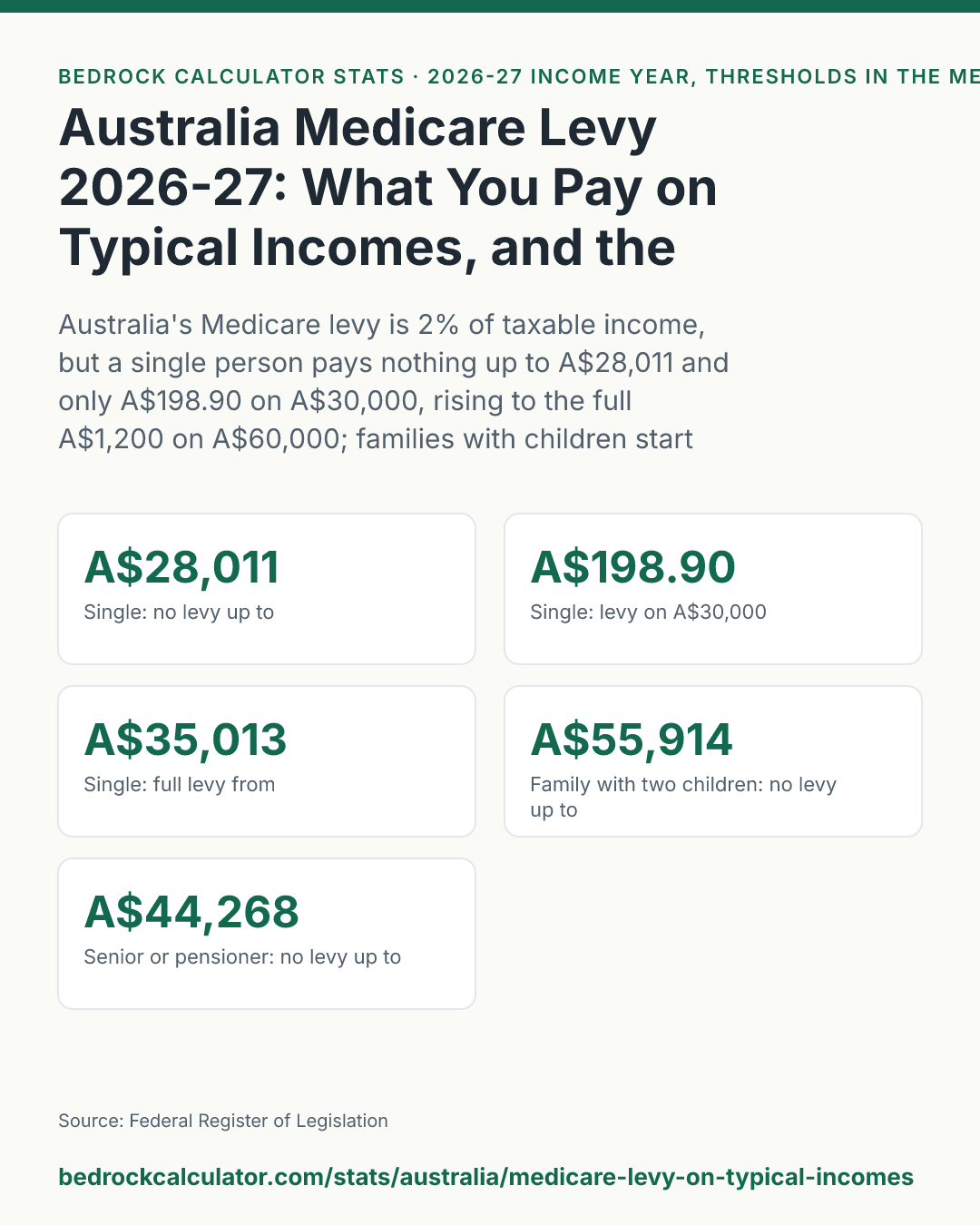
The Medicare levy is 2% of your taxable income in Australia, on top of income tax. Most people pay the full 2%: A$1,200 on A$60,000, A$1,800 on A$90,000 and A$3,000 on A$150,000. But people on low incomes pay less, or nothing at all.
A single person pays no levy on a taxable income up to A$28,011. Just above that the levy starts small and grows: A$198.90 on A$30,000, against A$600.00 at the full rate. Families get a much higher starting point, A$47,238 for a couple plus A$4,338 for each child, and seniors and pensioners start at A$44,268.
How the low-income reduction works
The Medicare Levy Act 1986 doesn't switch the levy straight from nothing to 2%. That would mean earning one dollar over the threshold could cost hundreds of dollars in levy. Instead it phases the levy in.
For a single person with no dependants it works like this:
- Up to A$28,011: no levy at all.
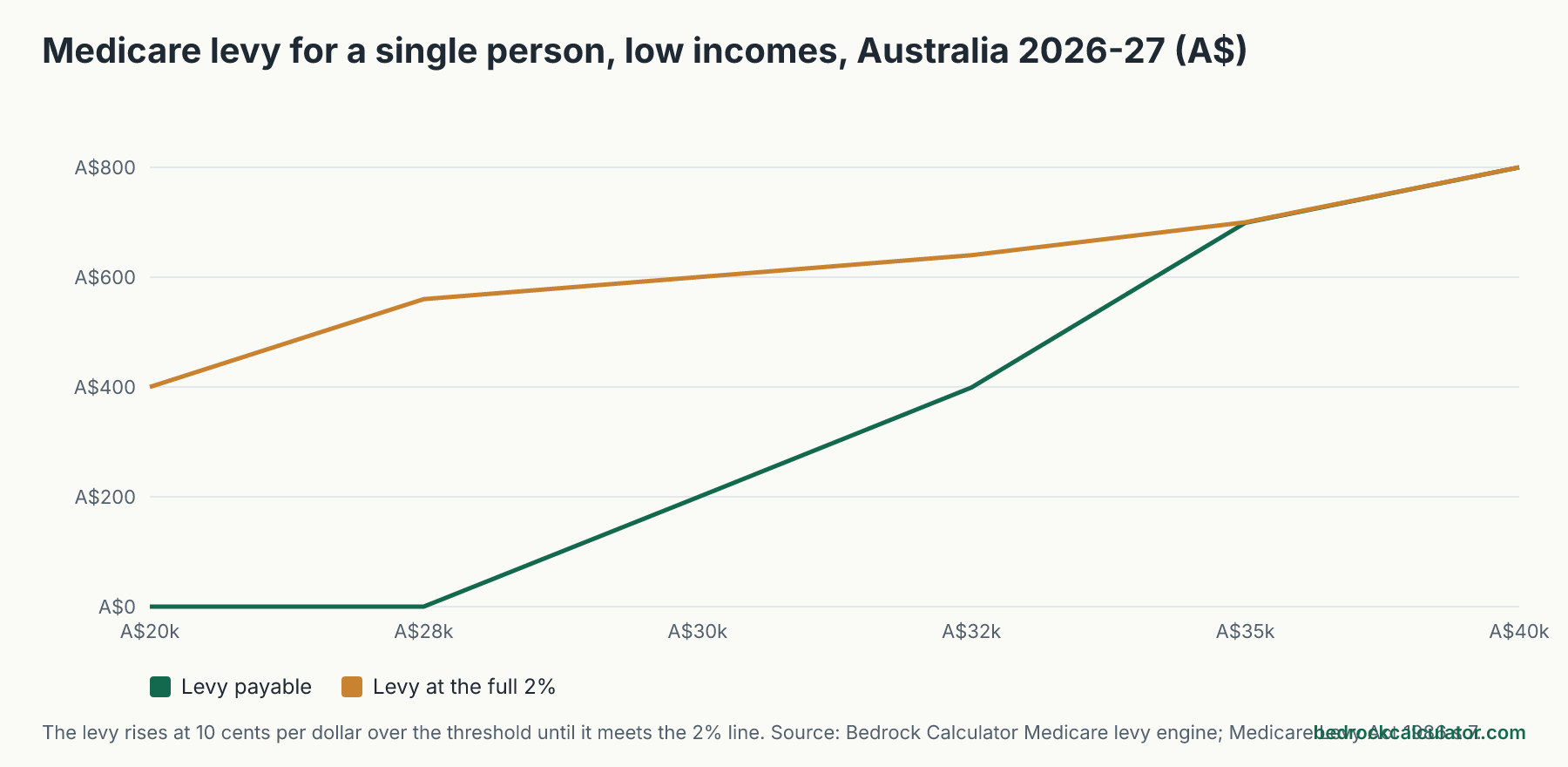
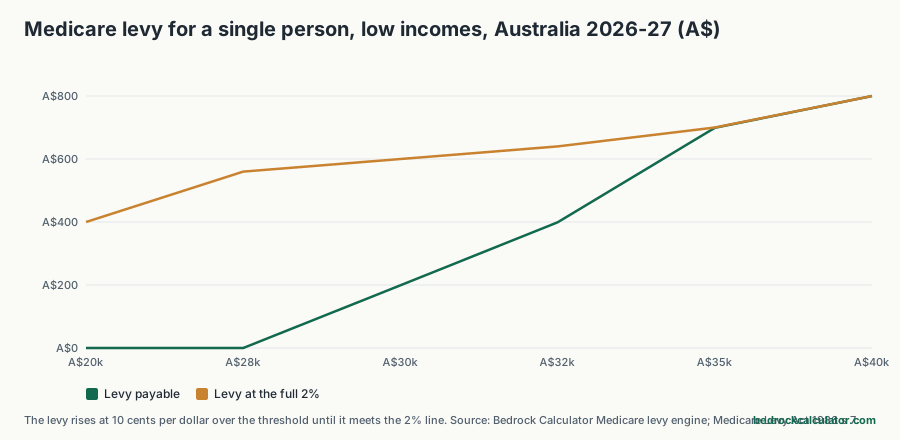
- From A$28,011 to A$35,013: the levy can't be more than 10% of the amount your income is over A$28,011. So every extra dollar adds 10 cents of levy until the levy catches up with the full rate.
- Above A$35,013: the full 2% applies to your whole taxable income.
On A$30,000 that gives A$198.90, or 0.66% of income. On A$32,000 it's A$398.90. By A$35,000 the levy is A$698.90, only cents away from the full-rate A$700.00, and from A$35,013 the reduction is gone.
What a single person pays at each income
Click a column heading to sort.
Medicare levy for a single person with no dependants, Australia 2026-27 (A$)
Download CSVTaxable income for the year, not a senior or pensioner, no exemption. Does not include the Medicare levy surcharge.
| A$20,000 | A$400 | A$0 | 0.00% |
| A$28,000 | A$560 | A$0 | 0.00% |
| A$30,000 | A$600 | A$198.90 | 0.66% |
| A$32,000 | A$640 | A$398.90 | 1.25% |
| A$35,000 | A$700 | A$698.90 | 2.00% |
| A$40,000 | A$800 | A$800 | 2.00% |
| A$60,000 | A$1,200 | A$1,200 | 2.00% |
| A$90,000 | A$1,800 | A$1,800 | 2.00% |
| A$150,000 | A$3,000 | A$3,000 | 2.00% |
Above the shading range the levy is just 2% of taxable income: A$800 on A$40,000, A$1,200 on A$60,000 and A$3,000 on A$150,000. It's charged on taxable income, so deductions you claim reduce it too.
Families start paying much later
If you have a spouse, or you're a sole parent with dependent children, a different test applies. Instead of your own income against A$28,011, the levy looks at family income, meaning your taxable income plus your spouse's, against a family threshold:
- A$47,238 for a couple with no children
- A$51,576 with one dependent child
- A$55,914 with two
- A$60,252 with three
Each child adds A$4,338. At or below the threshold the family pays nothing. Above it, the Act gives a reduction that shrinks as family income rises, which works out to the same 10 cents in the dollar as the single rule.
Medicare levy for a single-income family by number of children, Australia 2026-27 (A$)
Download CSVOne earner whose taxable income is the whole family income; the spouse has no taxable income. Not seniors or pensioners.
| A$45,000 | A$0 | A$0 | A$0 | A$0 |
| A$50,000 | A$276.20 | A$0 | A$0 | A$0 |
| A$55,000 | A$776.20 | A$342.40 | A$0 | A$0 |
| A$60,000 | A$1,200 | A$842.40 | A$408.60 | A$0 |
| A$65,000 | A$1,300 | A$1,300 | A$908.60 | A$474.80 |
| A$70,000 | A$1,400 | A$1,400 | A$1,400 | A$974.80 |
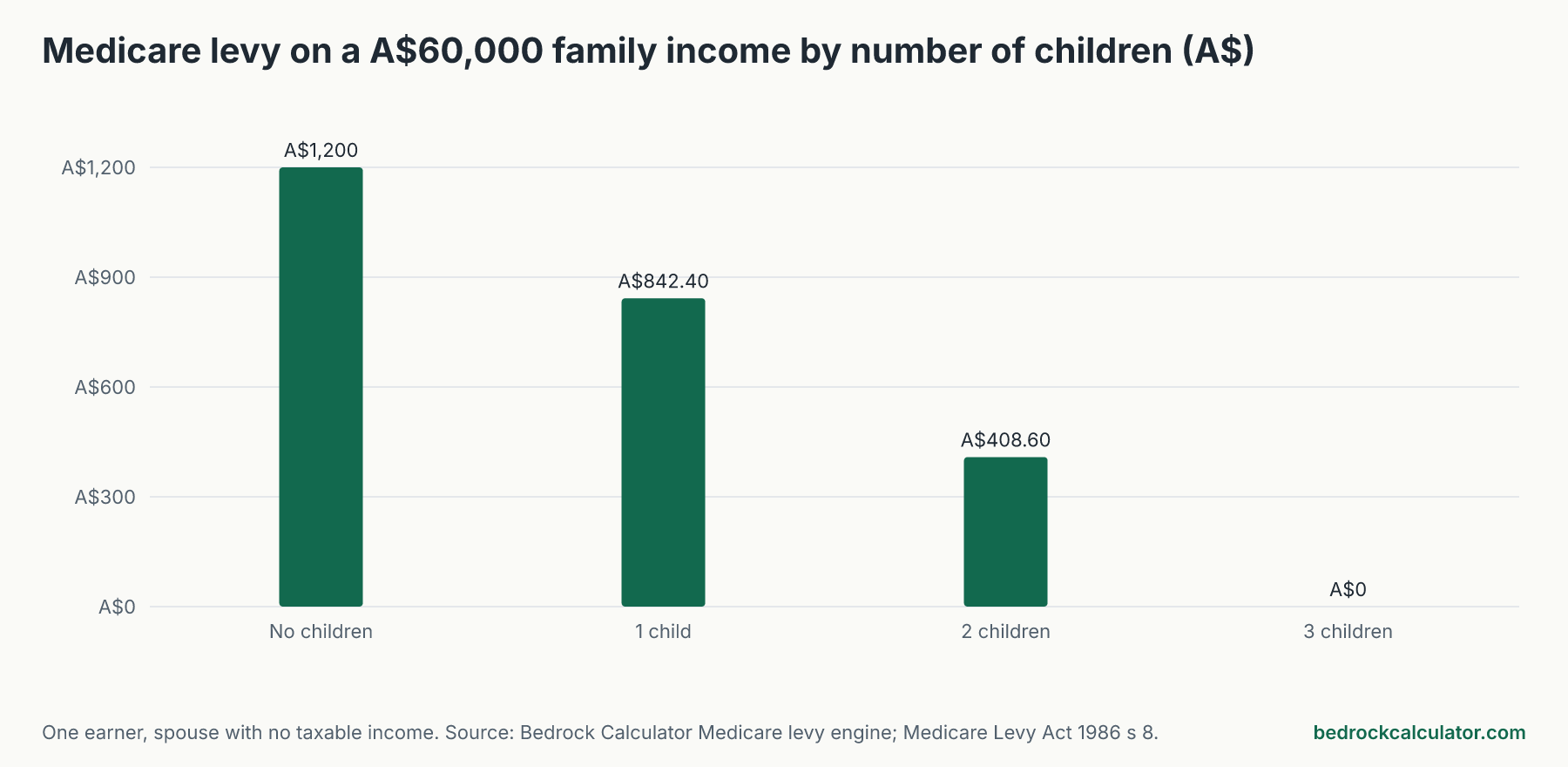
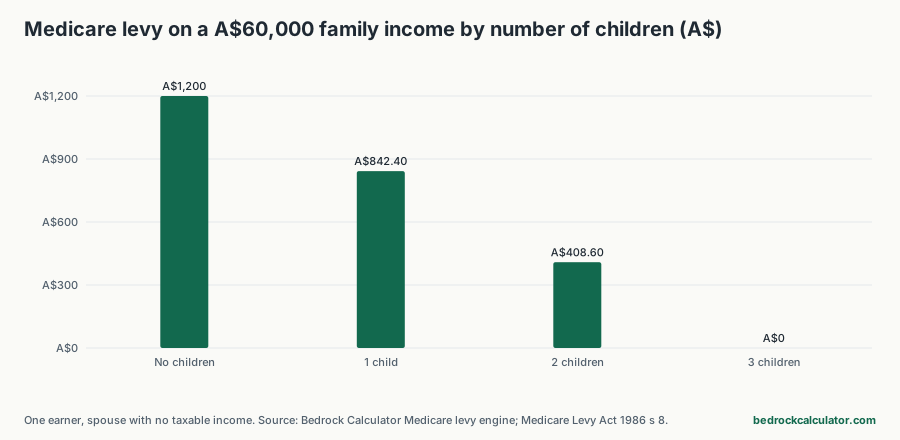
Take one earner on A$60,000 with a partner who has no income. With no children the levy is A$1,200.00. With two children it falls to A$408.60, because the family threshold of A$55,914 is close to their income. On A$70,000 with three children the levy is A$974.80, against A$1,400.00 for a couple with none.
When both partners earn
If your partner earns enough to pay the levy in their own right, more than A$28,011, the family reduction is shared between you in proportion to your taxable incomes. And it comes off each person's levy after the low-income rule above has already been applied.
Two partners on A$30,000 each with two children have a family income of A$60,000. On their own, each would pay A$198.90. Their family income is only a little over the A$55,914 threshold for two children, so each partner's share of the family reduction more than covers that, and each pays A$0.00.
Seniors and pensioners
If you're entitled to the seniors and pensioners tax offset, your own threshold is A$44,268 and shading in runs to A$55,335. On A$40,000 that means A$0.00 of levy, where a younger single would pay A$800.00. On A$45,000 it's A$73.20 against A$900.00, and on A$50,000 it's A$573.20 against A$1,000.00.
These are the thresholds in the Act today
Every threshold here is the figure in the Medicare Levy Act 1986 as compiled on 1 July 2026. Those amounts were set for the 2025-26 year by an amendment passed in 2026, and they apply to 2026-27 until Parliament changes them. In recent years Parliament has raised the thresholds for a year after that year has started. If it does that for 2026-27, the levy for incomes near the thresholds will come down a little. The full 2% for everyone well above them won't change.
How we worked out these numbers
Every figure comes from the Medicare levy calculator on this site, which applies sections 6, 7 and 8 of the Act. The runs assume:
- Taxable income as shown, for the full year
- No exemption from the levy
- For families, a single earner with a partner who has no taxable income, except in the two-earner example
- Not a senior or pensioner, except in the seniors section
What these numbers leave out
- The Medicare levy surcharge. That's a separate charge of 1% to 1.5% for higher earners without private hospital cover. We cover it in our Medicare levy surcharge article.
- Exemptions. Some people, including foreign residents and people not entitled to Medicare benefits, can be fully or half exempt. The calculator handles a full exemption only.
- Part-year situations. Becoming a resident, or gaining a spouse, during the year can change the levy in ways not modelled here.
- Your partner's share. In a two-earner family, if your share of the reduction is more than your own levy, the extra reduces your partner's levy. That shows on their assessment, not yours.
Run your own numbers
Use the Medicare levy calculator with your taxable income, your partner's income and the number of children you support. To see the levy alongside income tax, use the take-home pay calculator or the income tax calculator.