How much tax and TDS does an NRI pay in India?
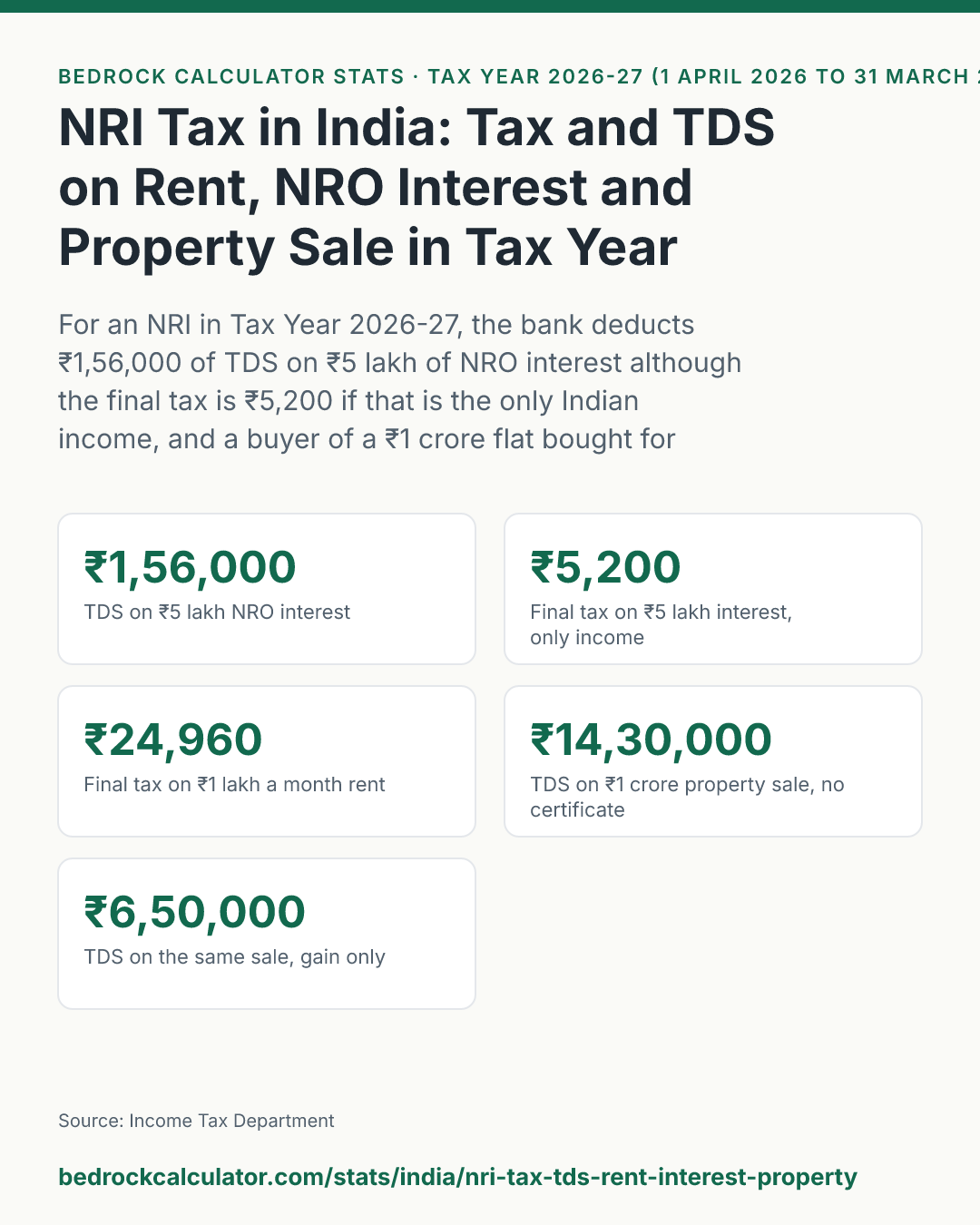
For a non-resident Indian, the tax deducted at source on Indian income is often far more than the tax actually owed. In Tax Year 2026-27, a bank deducts ₹1,56,000 on ₹5 lakh of NRO interest. If that's your only Indian income, the final tax under the new regime is ₹5,200.
The rest, ₹1,50,800, comes back only when you file a return.
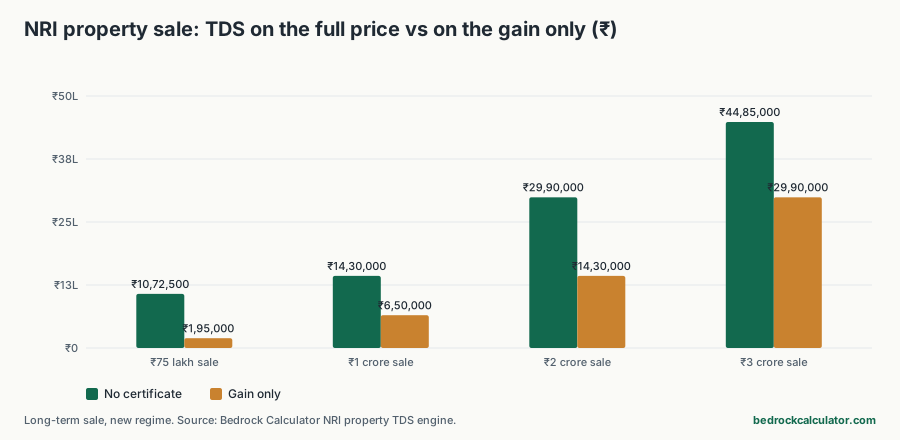
Property sales show the same gap on a bigger scale. Sell a flat bought for ₹50 lakh for ₹1 crore and, without a lower deduction certificate, the buyer withholds ₹14,30,000. Withheld on the ₹50 lakh gain alone, it would be ₹6,50,000.
Who this applies to
These figures are for someone who is a non-resident under India's residence rules: we assumed a citizen who spent about a month in India this year and little time in earlier years. NRIs are taxed only on income earned in India. They pay tax at the same slab rates as residents, but without the Section 87A rebate, so the zero-tax limit that residents enjoy doesn't apply. Each income below is treated as your only Indian income, under the new regime.
NRO interest: TDS vs the tax you actually owe
Interest on an NRE account is exempt. Interest on an NRO account is taxable, and banks deduct TDS at a base rate of 30%, plus surcharge where it applies and the 4% cess.
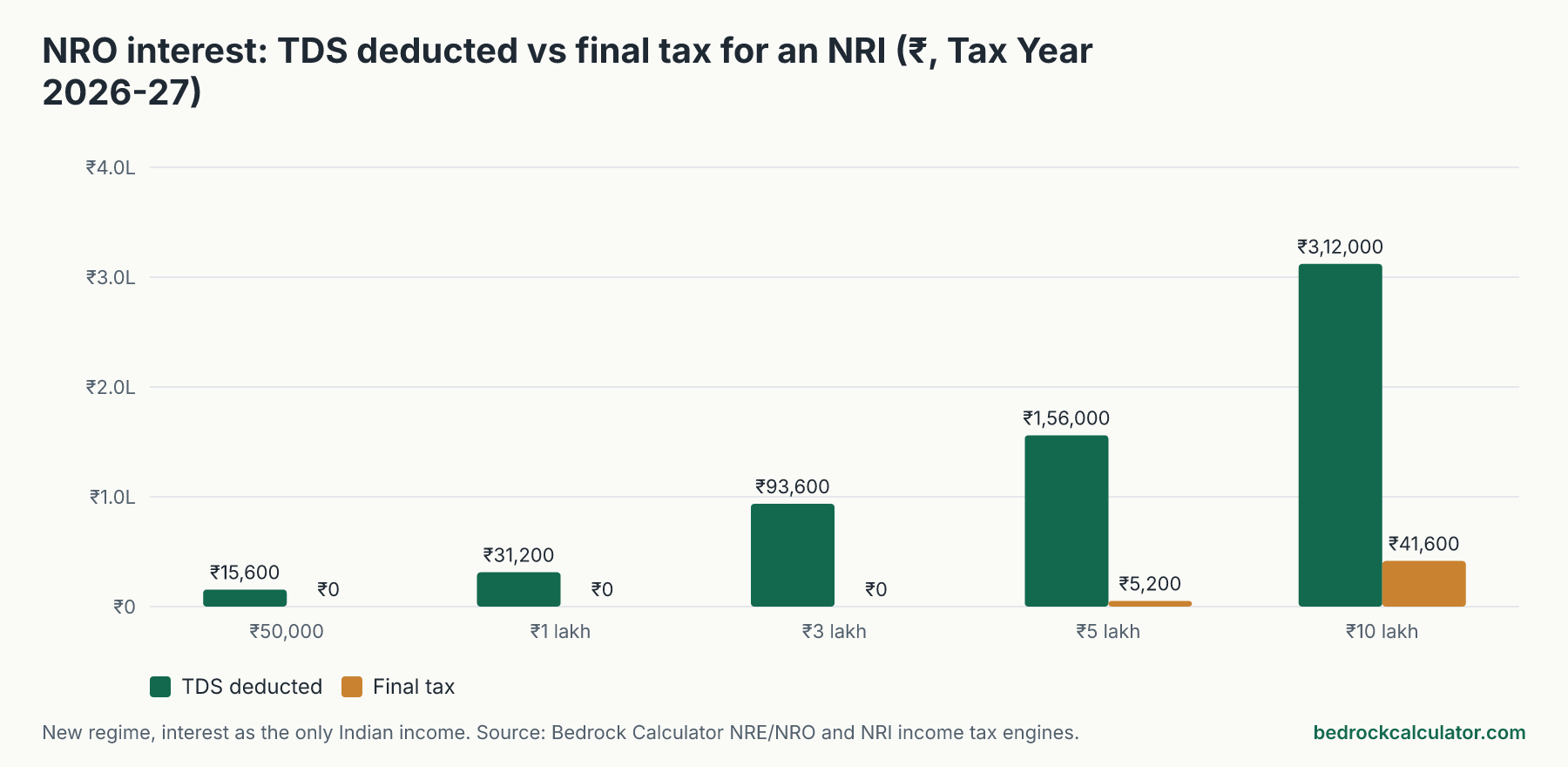
India: TDS vs final tax on NRO interest for an NRI, Tax Year 2026-27 (₹, new regime)
Download CSVTDS is the bank's deduction on NRO interest including surcharge and 4% cess. Final tax is slab tax on the interest if it is your only Indian income; NRIs get no 87A rebate. The difference comes back as a refund when you file. NRE interest is exempt and not shown.
| ₹50,000 | ₹15,600 | ₹0 | ₹15,600 |
| ₹1,00,000 | ₹31,200 | ₹0 | ₹31,200 |
| ₹3,00,000 | ₹93,600 | ₹0 | ₹93,600 |
| ₹5,00,000 | ₹1,56,000 | ₹5,200 | ₹1,50,800 |
| ₹10,00,000 | ₹3,12,000 | ₹41,600 | ₹2,70,400 |
On ₹1 lakh of NRO interest the bank deducts ₹31,200, but no tax is due, so all of it is refundable. On ₹3 lakh, ₹93,600 is deducted against a final tax of ₹0. On ₹10 lakh, ₹3,12,000 is deducted against ₹41,600, a refund of ₹2,70,400.
The reason is that the bank deducts at a flat high rate, while your actual tax runs through the slabs, starting at nil. If you live in a country with a tax treaty with India, the treaty rate may cap the deduction lower too; the DTAA relief calculator works that out.
Rent from an Indian property
Rent is taxed after a standard deduction for let-out property, which the engine applies before the slabs. There's no home loan in our examples; interest on one would cut taxable rent further.
Final tax on rent from an Indian property for an NRI (₹, new regime, Tax Year 2026-27)
Download CSVTaxable rent is gross rent less the engine's standard deduction for let-out property, with no home loan. Final tax if rent is the only Indian income, including cess. Tenants also withhold TDS on rent paid to an NRI, which this table does not show.
| ₹20,000 | ₹2,40,000 | ₹1,68,000 | ₹0 |
| ₹30,000 | ₹3,60,000 | ₹2,52,000 | ₹0 |
| ₹50,000 | ₹6,00,000 | ₹4,20,000 | ₹1,040 |
| ₹1,00,000 | ₹12,00,000 | ₹8,40,000 | ₹24,960 |
At ₹30,000 a month, ₹3,60,000 a year, taxable rent is ₹2,52,000 and no tax is due. At ₹50,000 a month, taxable rent is ₹4,20,000 and the tax is ₹1,040. At ₹1 lakh a month, ₹12 lakh a year, it's ₹24,960.
What we can't show is the TDS. Tenants paying rent to an NRI must deduct tax before paying, at the rates for non-residents, and that is usually much more than these final figures. The site's engine doesn't yet have a rent-specific TDS calculation, so we've left it out rather than guess. As with interest, the excess comes back when you file.
Selling property: TDS on the whole price
This is where the money held back can be largest. When an NRI sells Indian property, the buyer has to deduct tax under Section 393 of the Income-tax Act, 2025, which replaced Section 195. Unless the tax department has issued a certificate or fixed the chargeable amount, the buyer deducts on the full sale price, not your gain, and the surcharge band is set by that price too.
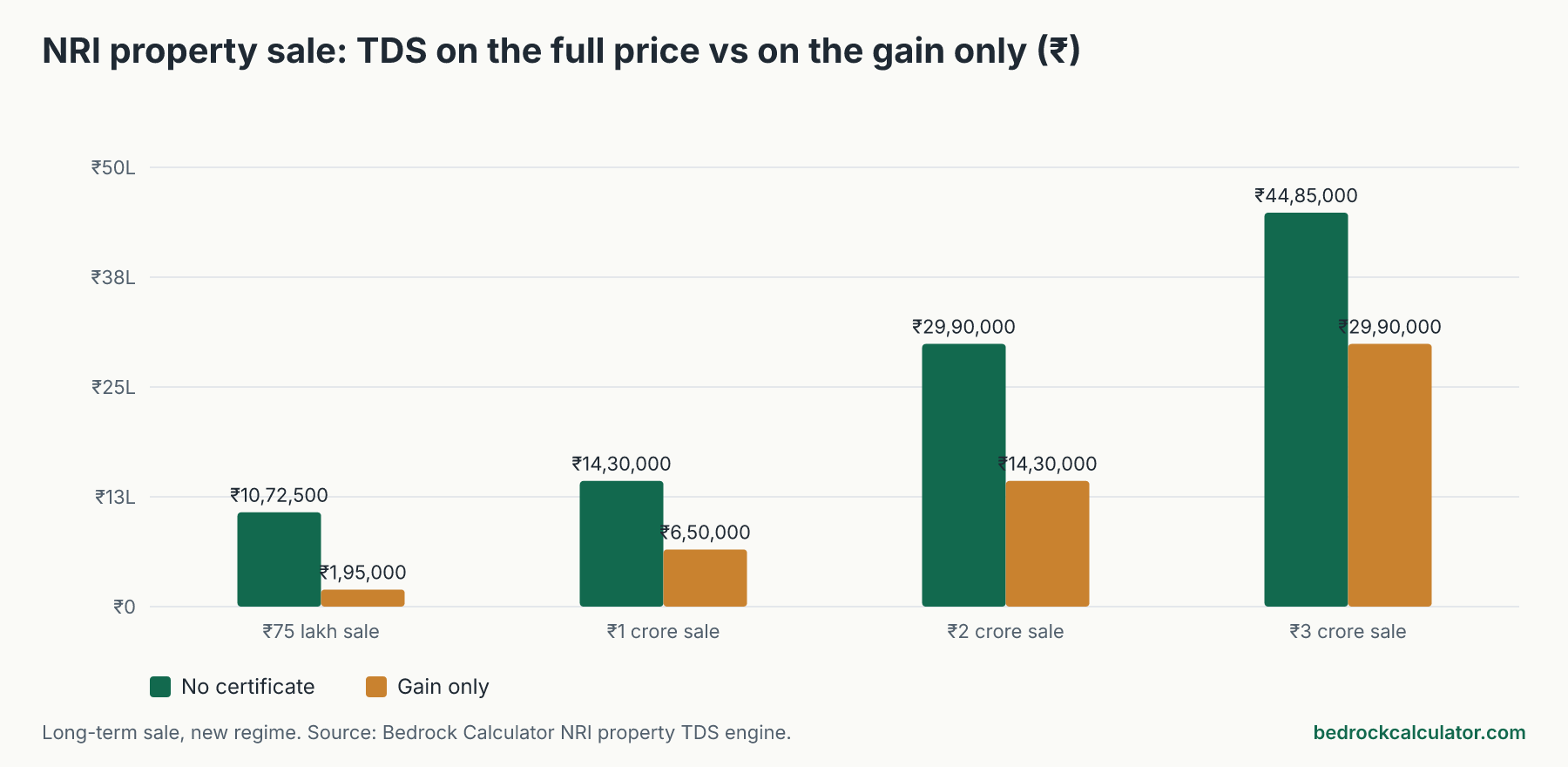
TDS when an NRI sells Indian property, held 5 years (₹, Tax Year 2026-27)
Download CSVLong-term gain at 12.5% plus surcharge and cess. Without a certificate the buyer deducts on the full price, and the surcharge tier is set by that price. The gain-only column is TDS where the tax officer has fixed the gain as the amount chargeable, with the surcharge tier set by the gain.
| ₹75 lakh | ₹60 lakh | ₹15,00,000 | 14.30% | ₹10,72,500 | ₹1,95,000 | ₹8,77,500 |
| ₹1 crore | ₹50 lakh | ₹50,00,000 | 14.30% | ₹14,30,000 | ₹6,50,000 | ₹7,80,000 |
| ₹2 crore | ₹1 crore | ₹1,00,00,000 | 14.95% | ₹29,90,000 | ₹14,30,000 | ₹15,60,000 |
| ₹3 crore | ₹1 crore | ₹2,00,00,000 | 14.95% | ₹44,85,000 | ₹29,90,000 | ₹14,95,000 |
On a ₹75 lakh sale with a ₹15 lakh gain, the buyer deducts ₹10,72,500. On the gain alone it would be ₹1,95,000. On the ₹1 crore example, ₹7,80,000 more is held back on the full price than on the gain, partly because the ₹1 crore price puts the deduction in a higher surcharge band (14.30% all in) than the gain alone (13.00%). On a ₹3 crore sale with a ₹2 crore gain, the rate including surcharge and cess is 14.95%, and the deduction is ₹44,85,000.
There are two ways to cut the deduction before the sale. You can apply for a lower deduction certificate, and the buyer then deducts at whatever rate the tax officer prints on it. Or the buyer can ask the tax officer to fix the part of the price that is chargeable, usually the gain, and deduct only on that, which is what our gain-only column shows. Without either, you get the excess back only after filing and processing, which can take months.
NRIs also can't use indexation on property. They pay the flat 12.5% on long-term gains, as the property capital gains comparison shows.
How we worked out these numbers
Interest TDS comes from the site's NRE vs NRO calculator. Final tax on interest and rent comes from the NRI income tax calculator, which applies slab rates with no 87A rebate, surcharge and cess. Taxable rent comes from the engine's house property calculation for a let-out home. Property TDS comes from the NRI property TDS calculator: the full-price column uses its no-certificate option and the "gain only" column its option for a tax officer's determination of the chargeable gain.
All sales assume the property was held for 5 years, so the gain is long-term.
What this leaves out
The rent figures don't include TDS, municipal taxes paid by you as owner, or a home loan. The interest figures assume no other Indian income: if you have several, they add together and the slab tax rises. We haven't modelled the tax in your country of residence or the credit you may get there for Indian tax.
Work out your own figures
Use the NRI income tax calculator for your total Indian income and residence status, the NRE vs NRO calculator for interest, and the NRI property TDS calculator before you sell. If your country has a treaty with India, check the DTAA relief calculator too.