How long does it take to pay off a student loan?
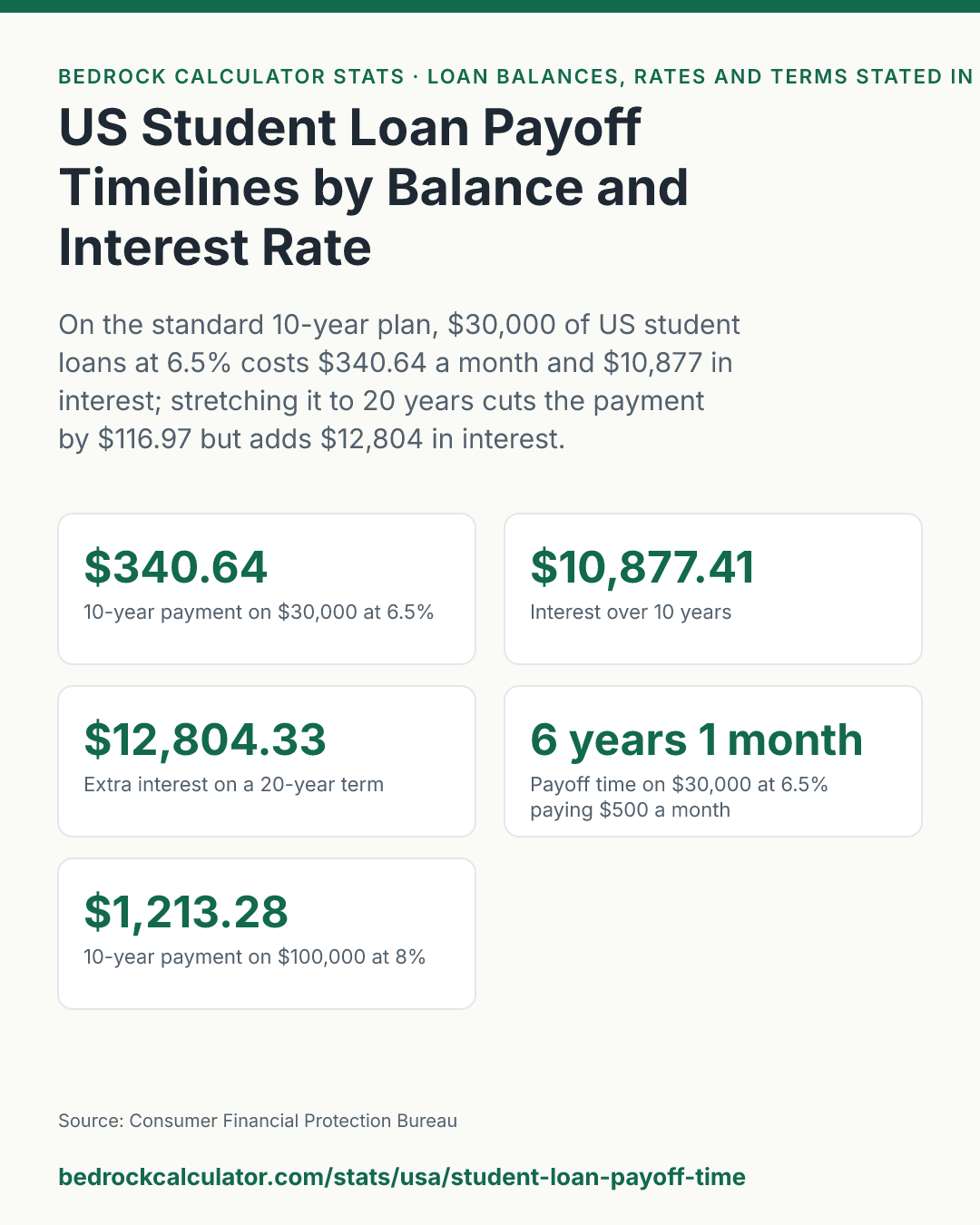
On a 10-year repayment plan, $30,000 of US student loans at 6.5% costs $340.64 a month and $10,877.41 in interest over the life of the loan. At 8% the payment rises to $363.98 and the interest to $13,678.14.
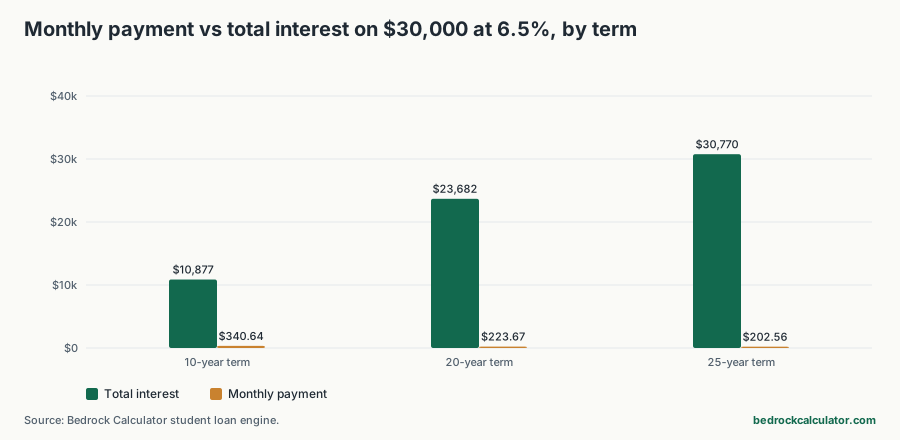
Stretching the same $30,000 at 6.5% to 20 years drops the payment to $223.67, but the interest more than doubles to $23,681.74. If you can pay more than the minimum instead, $500 a month clears it in 6 years 1 month.
How we worked out these numbers
We used two calculators on this site.
The student loan calculator gives the fixed monthly payment and total interest for a balance, a rate and a term. We ran balances of $10,000, $20,000, $30,000, $50,000 and $100,000 at 5%, 6.5% and 8% over 120 months, the length of the standard 10-year federal plan, and ran $30,000 at 6.5% over 20 and 25 years.
The student loan payoff calculator answers the other question: if you pay a set amount each month, how long does it take? We ran $30,000 at the same three rates with payments of $300, $400, $500 and $750 a month and no extra payments. It finds the number of months the payment needs, rounds up to a whole month and spreads the balance evenly over that many payments, so the actual payment can come out a few dollars under the round figure.
The rates are inputs we chose to cover a typical range for US student loans, federal and private. They aren't the current federal rates, which are set each year and depend on the loan type. Check your loan servicer for yours.
Payment and interest on a 10-year plan
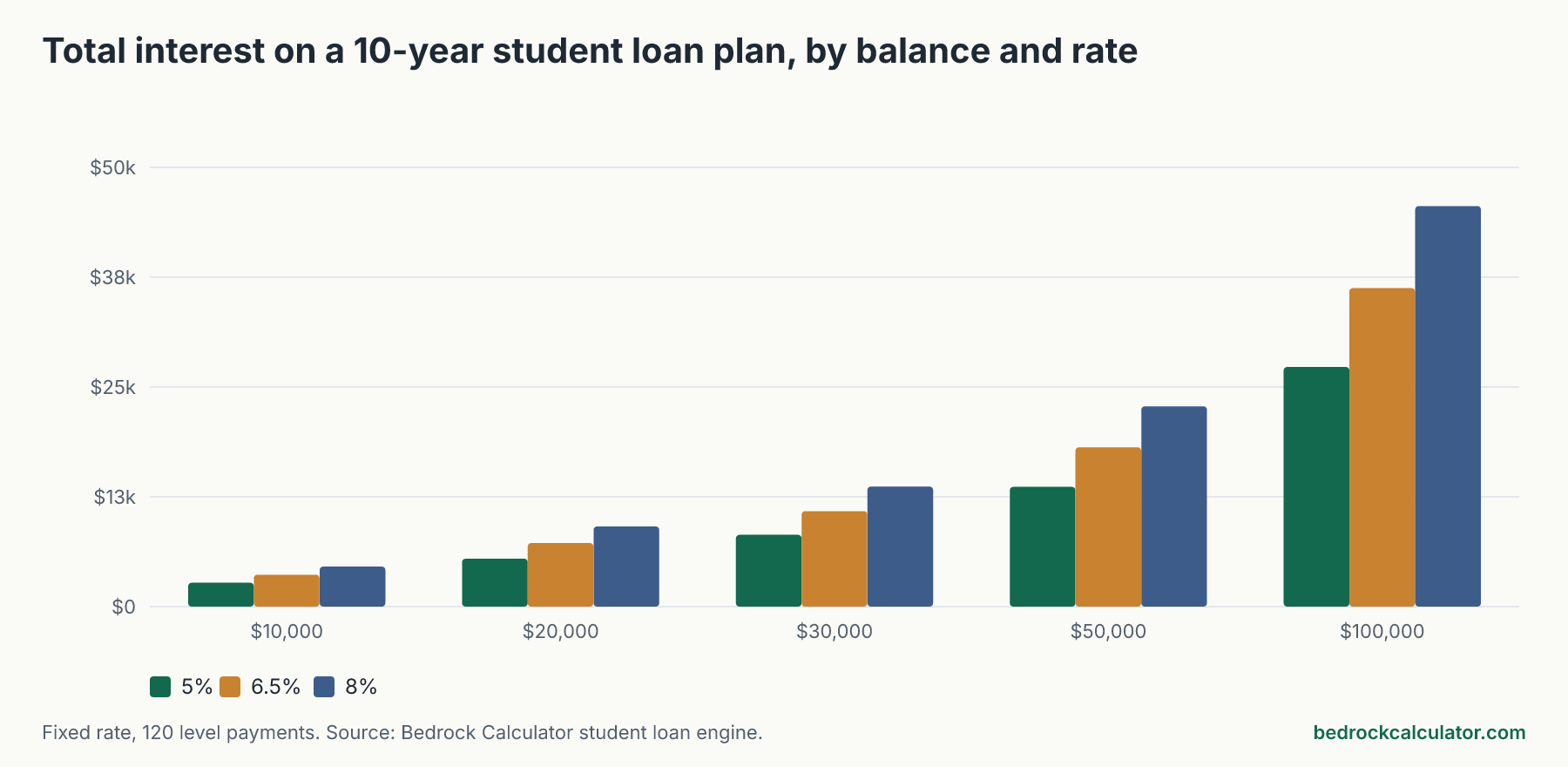
Student loan payment and interest on a 10-year plan, by balance and rate
Download CSVFixed rate, level monthly payments over 120 months.
| $10,000 | $106.07 | $2,727.71 | $113.55 | $3,625.71 | $121.33 | $4,559.20 |
| $20,000 | $212.13 | $5,455.83 | $227.10 | $7,251.30 | $242.66 | $9,118.28 |
| $30,000 | $318.20 | $8,183.49 | $340.64 | $10,877.41 | $363.98 | $13,678.14 |
| $50,000 | $530.33 | $13,639.21 | $567.74 | $18,128.80 | $606.64 | $22,796.36 |
| $100,000 | $1,060.66 | $27,278.47 | $1,135.48 | $36,257.61 | $1,213.28 | $45,592.79 |
Every row scales in a straight line with the balance: double the balance, double the payment and the interest. The rate is what changes the shape. On $100,000, going from 5% to 8% adds $152.62 to every monthly payment, and raises total interest from $27,278.47 to $45,592.79.
At 6.5%, ten years of interest on $30,000 comes to 36.3% of what you borrowed.
How long it takes at a set monthly payment
How long $30,000 takes to repay at a fixed monthly payment
Download CSVPayoff time and total interest when you pay a set amount each month, no extra payments.
| $300 | 10 years 10 months | $8,916.05 | 12 years 1 month | $13,384.71 | 13 years 10 months | $19,690.79 |
| $400 | 7 years 7 months | $6,107.75 | 8 years 1 month | $8,647.64 | 8 years 9 months | $11,811.00 |
| $500 | 5 years 10 months | $4,649.44 | 6 years 1 month | $6,401.25 | 6 years 5 months | $8,453.57 |
| $750 | 3 years 8 months | $2,896.26 | 3 years 10 months | $3,973.31 | 3 years 11 months | $5,044.09 |
This is the table to use if you've decided what you can afford each month. A few things stand out:
- $300 a month on $30,000 is slow. At 6.5% it takes 12 years 1 month and costs $13,384.71 in interest. At 8% it takes 13 years 10 months.
- Each step up in payment saves years. At 6.5%, going from $300 to $500 a month cuts the payoff from 12 years 1 month to 6 years 1 month and the interest from $13,384.71 to $6,401.25.
- At high payments the rate matters less. At $750 a month, the payoff is 3 years 8 months at 5% and 3 years 11 months at 8%. There just isn't much time for interest to build.
The cost of a longer term
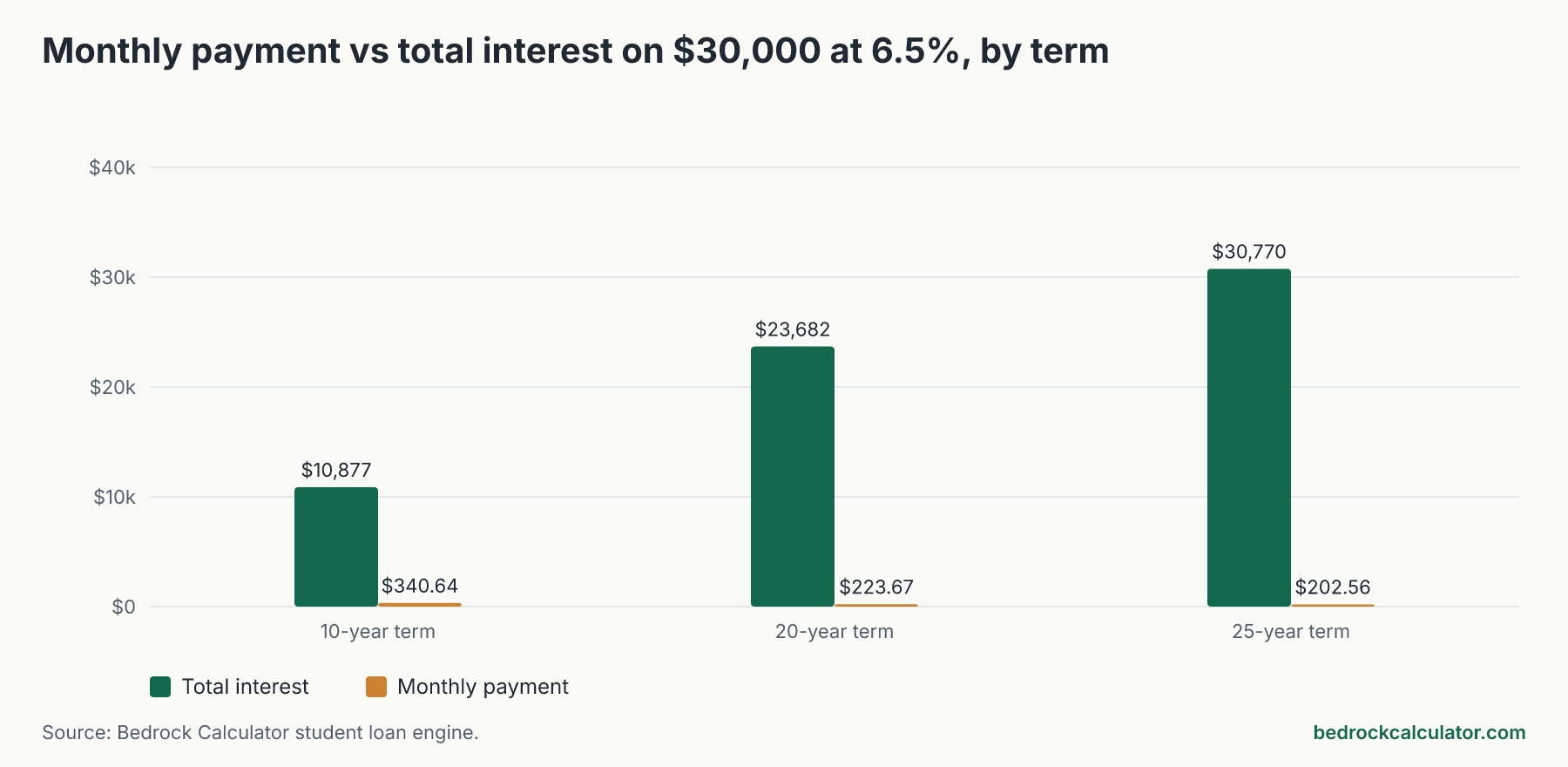
$30,000 at 6.5%: 10, 20 and 25-year terms
Download CSV| 10 years | $340.64 | $10,877.41 |
| 20 years | $223.67 | $23,681.74 |
| 25 years | $202.56 | $30,769.58 |
Longer terms are tempting because the payment drops. On $30,000 at 6.5%, a 20-year term saves $116.97 a month compared with 10 years. But you pay $12,804.33 more in interest for that, and a 25-year term adds $19,892.17.
A longer term can still make sense if the lower payment keeps you current, or frees money for higher-rate debt or an emergency fund. Just know the price.
What this leaves out
- Income-driven repayment. Federal plans that set payments by income, and any forgiveness at the end of them, follow different rules. These figures assume a fixed payment that repays the loan in full. The SAVE plan calculator covers that case.
- Interest during school and grace periods. Unsubsidized loans build interest before repayment starts. These figures start from the balance on day one of repayment.
- Multiple loans at different rates. Most borrowers have several loans. Run each separately, or use a weighted average rate for a rough figure.
- Variable rates and refinancing. Every rate here is fixed. If you're thinking of refinancing to a lower rate, the student loan refinance calculator shows the trade-off, including the federal protections you'd give up.
- Tax. The student loan interest deduction isn't included.
Run your own numbers
Enter your own balance, rate and term in the student loan calculator, or your planned payment in the student loan payoff calculator, which also shows what an extra payment each month saves. For other debts competing for the same money, see the debt snowball vs avalanche example.