How much does an annuity pay per month at each age?
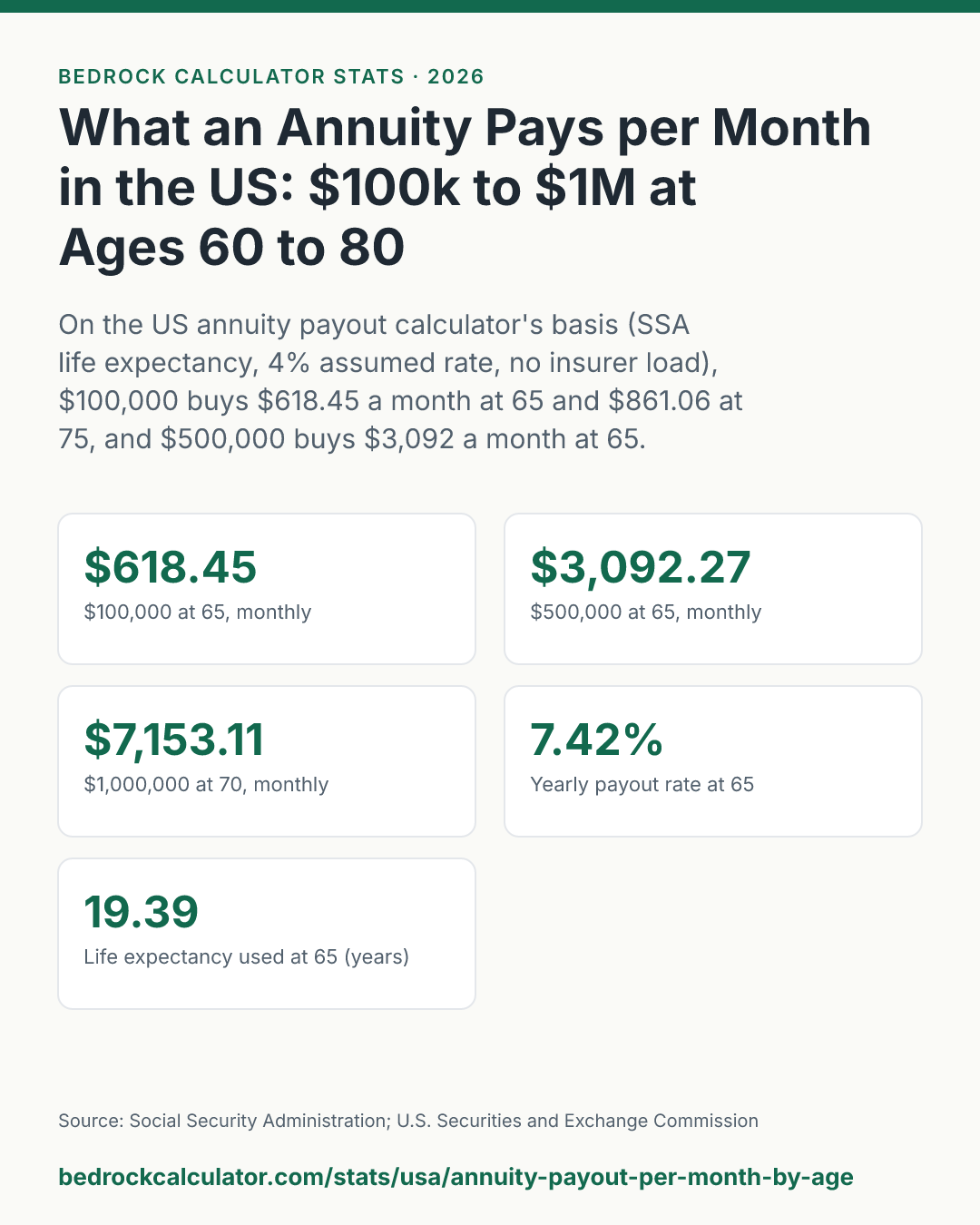
On the basis our annuity calculator uses, $100,000 spent on an immediate annuity in the US pays about $618.45 a month for someone buying at 65. Buy at 75 and the same money pays $861.06 a month. A $500,000 premium at 65 pays $3,092.27 a month, or $37,107 a year.
Two things drive the number: how old you are when you buy, and the interest rate the insurer assumes. The older you are, the fewer years the payments are expected to last, so each one is bigger.
The payout basis behind these figures
It matters exactly how these numbers are built, because they aren't insurance company quotes. Every figure comes from the site's annuity payout calculator, which works like this:
- It looks up your remaining life expectancy at the age you buy, from the Social Security Administration's period life table. The "unisex" figure is the average of the male and female values, since SSA doesn't publish a combined one.
- It treats the premium like a loan being paid back to you. It works out the level monthly payment that would pay the whole premium out over exactly that many years.
- It discounts those payments at an assumed interest rate. The calculator's default, used throughout this article unless we say otherwise, is 4% a year.
That's the core arithmetic of a single premium immediate annuity, sometimes called a SPIA, the simplest kind: you hand over a lump sum and get a fixed monthly income for life.
What the calculator leaves out explains most of the gap between these figures and a real quote:
- Insurer costs and profit. Real quotes include the company's expenses, reserves and margin, which lower the payout.
- Annuity buyers live longer. People who buy annuities tend to outlive the general population, and insurers price for that with their own tables. The SSA table is a general-population average.
- No extra features. A cash refund, a guaranteed period, a joint payout for a spouse or a cost-of-living increase would all cut the starting payment.
- No tax. How payments are taxed depends on whether you bought with pre-tax or after-tax money.
So treat these as a starting point for what an annuity should roughly pay, and compare real quotes against it.
Monthly income by premium and age
Monthly income from an immediate annuity in the US by premium and age (unisex, 4% assumed rate)
Download CSVLevel monthly payment that pays the premium down over SSA period life expectancy at a 4% assumed interest rate. Not an insurer quote: no expense or profit load, no refund or survivor feature, before tax.
| 60 | 23.26 | $550.97 | $1,377.43 | $2,754.85 | $5,509.70 | 6.61% |
| 65 | 19.39 | $618.45 | $1,546.14 | $3,092.27 | $6,184.54 | 7.42% |
| 70 | 15.71 | $715.31 | $1,788.28 | $3,576.56 | $7,153.11 | 8.58% |
| 75 | 12.26 | $861.06 | $2,152.65 | $4,305.31 | $8,610.62 | 10.33% |
| 80 | 9.16 | $1,088.07 | $2,720.18 | $5,440.36 | $10,880.73 | 13.06% |
Because the payment scales directly with the premium, $1,000,000 pays ten times what $100,000 does at every age: $6,184.54 a month at 65 against $618.45. The table also shows the yearly payout rate, the year's income as a share of the premium. At 65 it's 7.42%; at 80 it's 13.06%.
That payout rate isn't an investment return. Each payment is partly your own money coming back and partly interest. Over the 19.39 years of life expectancy the calculator uses at 65, a $500,000 premium pays out $719,509 in total.
Annuitizing part of your savings
Few retirees put everything into an annuity. A common approach is to annuitize enough to cover essential bills alongside Social Security and keep the rest invested. On this basis, $250,000 buys $1,546.14 a month at 65 and $1,788.28 at 70. If your fixed costs run a few thousand dollars a month more than Social Security pays, the table shows roughly how large a premium would close that gap, before the insurer's costs.
Why waiting raises the monthly check
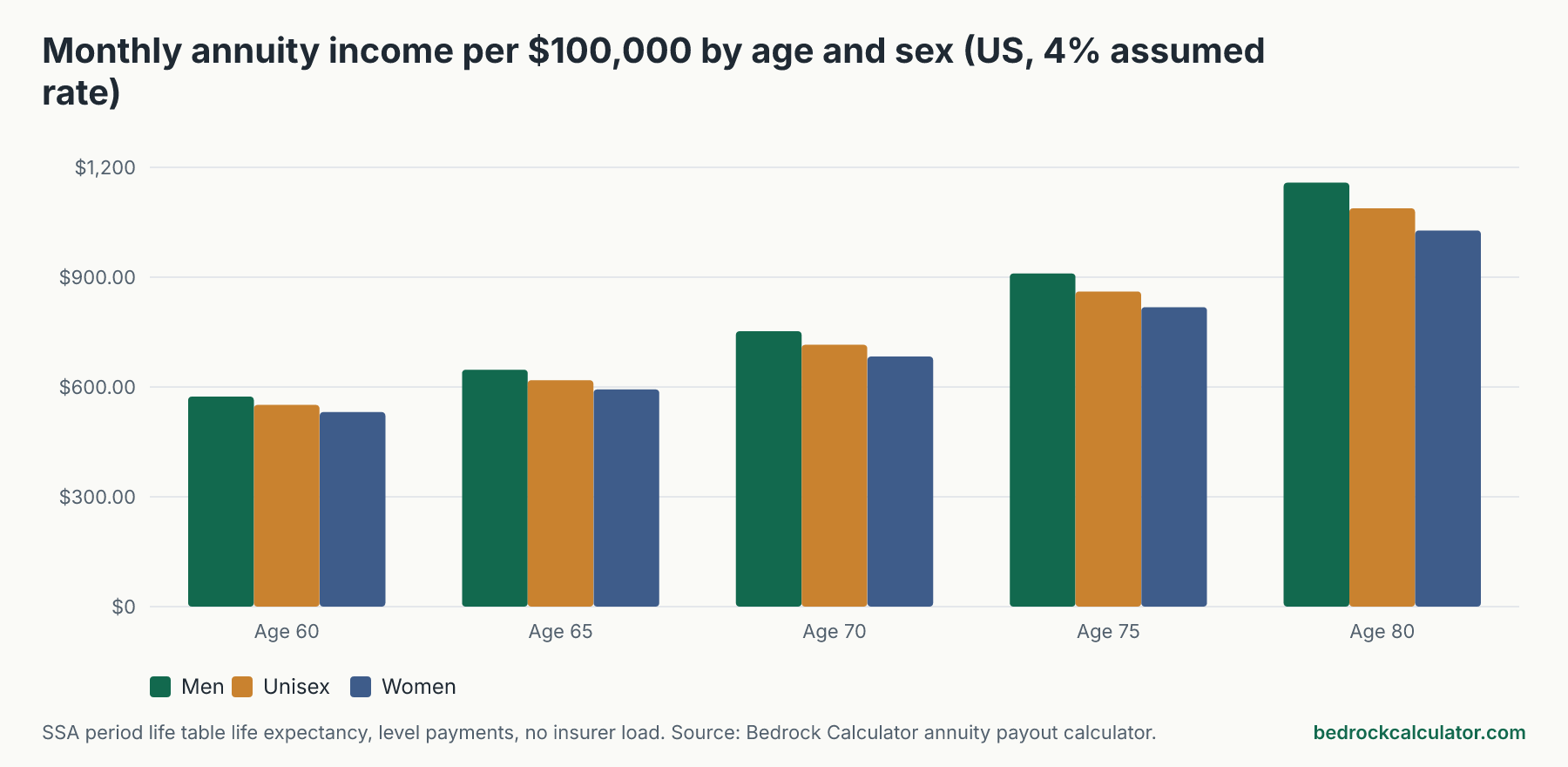
At 60 the calculator uses a life expectancy of 23.26 years. At 70 it's 15.71, and at 80 it's 9.16. Spread the same premium over fewer expected years and each payment goes up: $100,000 pays $550.97 a month at 60, $715.31 at 70 and $1,088.07 at 80.
The catch is that you give up the years of income you'd have had by buying earlier, and the money has to come from somewhere in the meantime. Waiting makes sense mainly if your other savings or Social Security can cover the gap.
The chart above also shows the difference by sex. At 65 the SSA table gives men 18.12 years and women 20.66. On this basis $100,000 pays a man $647.26 a month and a woman $593.36.
How much the interest rate matters
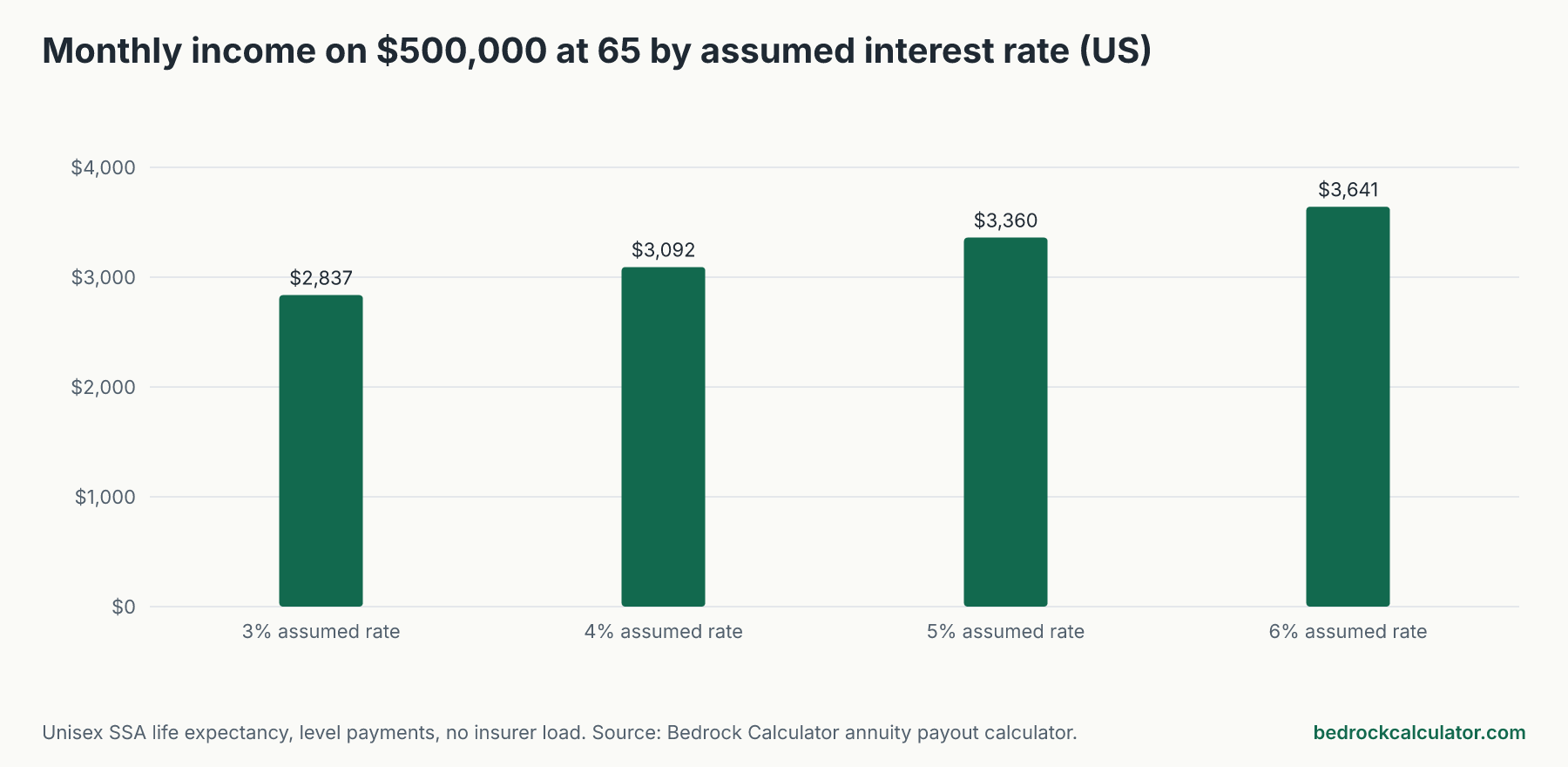
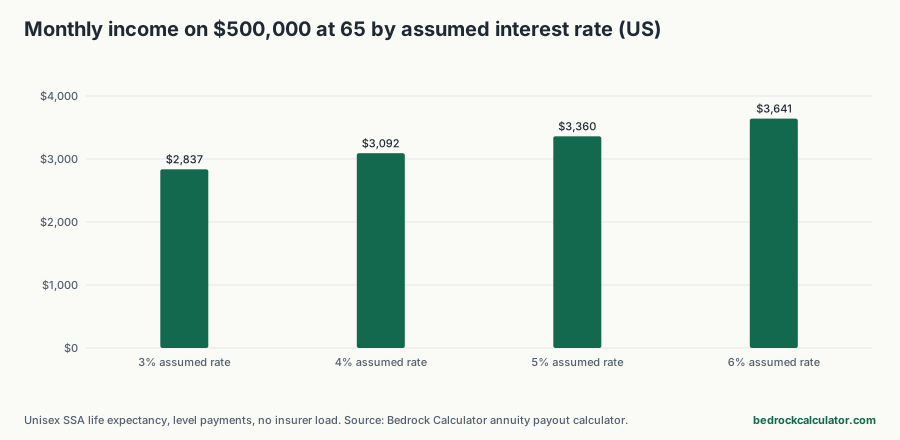
The assumed rate is the other big lever. A $500,000 premium at 65 pays $2,836.74 a month at 3%, $3,092.27 at 4%, $3,360.42 at 5% and $3,640.75 at 6%. Insurers invest premiums largely in bonds, so annuity payouts tend to move with interest rates. Buying when rates are higher locks in a higher income for life.
Is an annuity worth it?
An immediate annuity answers one question well: what if I live a long time? Payments keep coming for as long as you live, even past the life expectancy the calculator uses. That's insurance against outliving your money, and it's why some retirees put part of their savings into one.
The trade-offs are real, though. The money is no longer yours to spend as a lump sum or leave to heirs, unless you buy a refund or guaranteed-period feature. A fixed payment loses buying power to inflation over a long retirement. And your income depends on the insurer staying able to pay, backed only up to limits set by state guaranty associations.
Compare an annuity with drawing down your savings yourself. Our article on how long a million dollars lasts in retirement shows how far fixed withdrawals stretch at different returns.
Run your own numbers
Enter your premium, age, sex and an assumed rate in the annuity payout calculator, then hold the result up against real quotes. To compare with a do-it-yourself withdrawal plan, use the safe withdrawal rate calculator. The Social Security breakeven calculator helps with a related choice, since delaying Social Security is another way to buy more guaranteed lifetime income, and the retirement calculator ties it together.