How much do biweekly mortgage payments save?
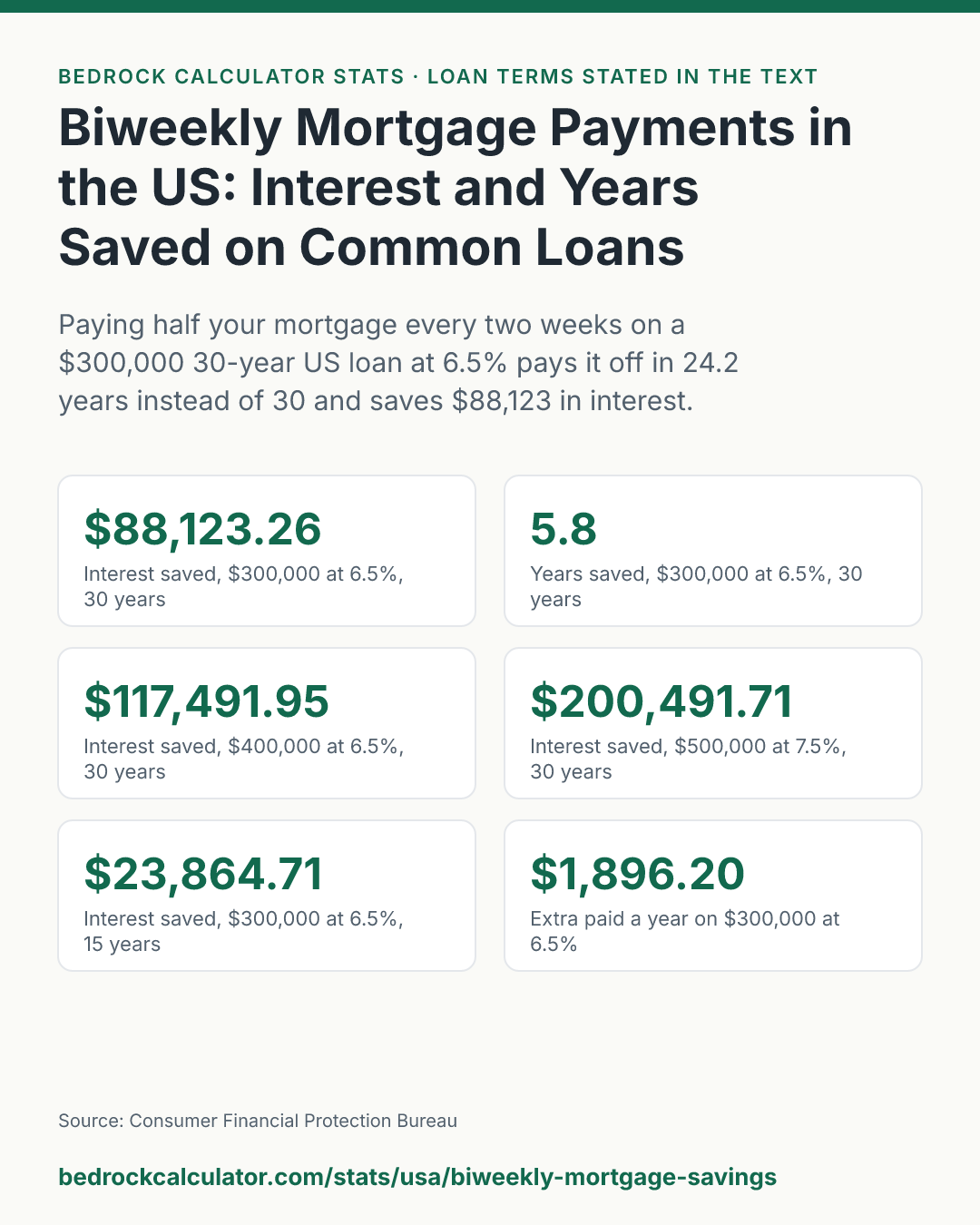
Paying half your mortgage payment every two weeks, instead of the full payment once a month, takes a $300,000 30-year US loan at 6.5% from 30 years down to 24.2 years. It saves $88,123.26 in interest, about 23.0% of what the loan would otherwise cost.
On $400,000 at the same rate the saving is $117,491.95. On a 15-year loan the effect is much smaller: $23,864.71 and 1.8 years on $300,000.
Why paying every two weeks works
There's no trick in the interest math. A year has 26 two-week periods, so half a payment every two weeks adds up to 13 full monthly payments a year instead of 12. That one extra payment goes entirely to principal. On $300,000 at 6.5% it's $1,896.20 more a year than paying monthly.
Because the balance falls faster, every later payment carries a little less interest and a little more principal. Over decades that compounds into years off the loan.
You could get almost the same result by making one extra payment a year, or by adding a twelfth of a payment to each monthly bill. What the biweekly schedule offers is habit: if you're paid every two weeks, the mortgage comes out of each paycheck and you never see the extra money.
How we worked out these numbers
Every figure comes from the biweekly mortgage calculator on this site. For each loan size, rate and term, it works out the standard monthly principal and interest, halves it, and runs a schedule of payments every two weeks until the loan is paid off. It then compares total interest against the same loan paid monthly for its full term. We took the payoff time from the length of that schedule, so it's exact to the payment.
What the calculator assumes, and what it leaves out:
- Each half payment reaches your loan right away. The calculator credits every biweekly payment the day it's made and charges interest every two weeks. Many US servicers instead hold the first half until the second arrives and apply a full payment once a month. That still saves a lot, but somewhat less than shown here.
- Program fees. Some lenders and third-party services charge setup or monthly fees for a biweekly plan. Those fees aren't in these numbers and can eat into the saving. You can usually get the same effect for free by sending extra principal yourself.
- Prepayment penalties. Most US home loans don't have one, but check your note.
- Taxes, insurance and PMI. Only principal and interest are included.
- What else the money could do. Paying the mortgage down faster isn't compared with investing the same money.
Interest and years saved on a 30-year mortgage
Sort by any column. The biweekly payment is half the monthly one, rounded to the cent.
Biweekly vs monthly payments on a 30-year US mortgage
Download CSVBiweekly payment is half the standard monthly principal and interest, paid 26 times a year and applied to the loan as soon as it is paid.
| $500,000 | 7.5% | $3,496.07 | $1,748.04 | 23.3 | 6.7 | $200,491.71 | 26.4% |
| $400,000 | 7.5% | $2,796.86 | $1,398.43 | 23.3 | 6.7 | $160,395.50 | 26.4% |
| $500,000 | 6.5% | $3,160.34 | $1,580.17 | 24.2 | 5.8 | $146,869.14 | 23.0% |
| $300,000 | 7.5% | $2,097.64 | $1,048.82 | 23.3 | 6.7 | $120,299.22 | 26.4% |
| $400,000 | 6.5% | $2,528.27 | $1,264.14 | 24.2 | 5.8 | $117,491.95 | 23.0% |
| $500,000 | 5.5% | $2,838.95 | $1,419.47 | 24.9 | 5.1 | $103,753.98 | 19.9% |
| $300,000 | 6.5% | $1,896.20 | $948.10 | 24.2 | 5.8 | $88,123.26 | 23.0% |
| $400,000 | 5.5% | $2,271.16 | $1,135.58 | 24.9 | 5.1 | $83,006.49 | 19.9% |
| $200,000 | 7.5% | $1,398.43 | $699.21 | 23.3 | 6.7 | $80,192.56 | 26.4% |
| $300,000 | 5.5% | $1,703.37 | $851.68 | 24.9 | 5.1 | $62,250.83 | 19.9% |
| $200,000 | 6.5% | $1,264.14 | $632.07 | 24.2 | 5.8 | $58,746.46 | 23.0% |
| $200,000 | 5.5% | $1,135.58 | $567.79 | 24.9 | 5.1 | $41,503.01 | 19.9% |
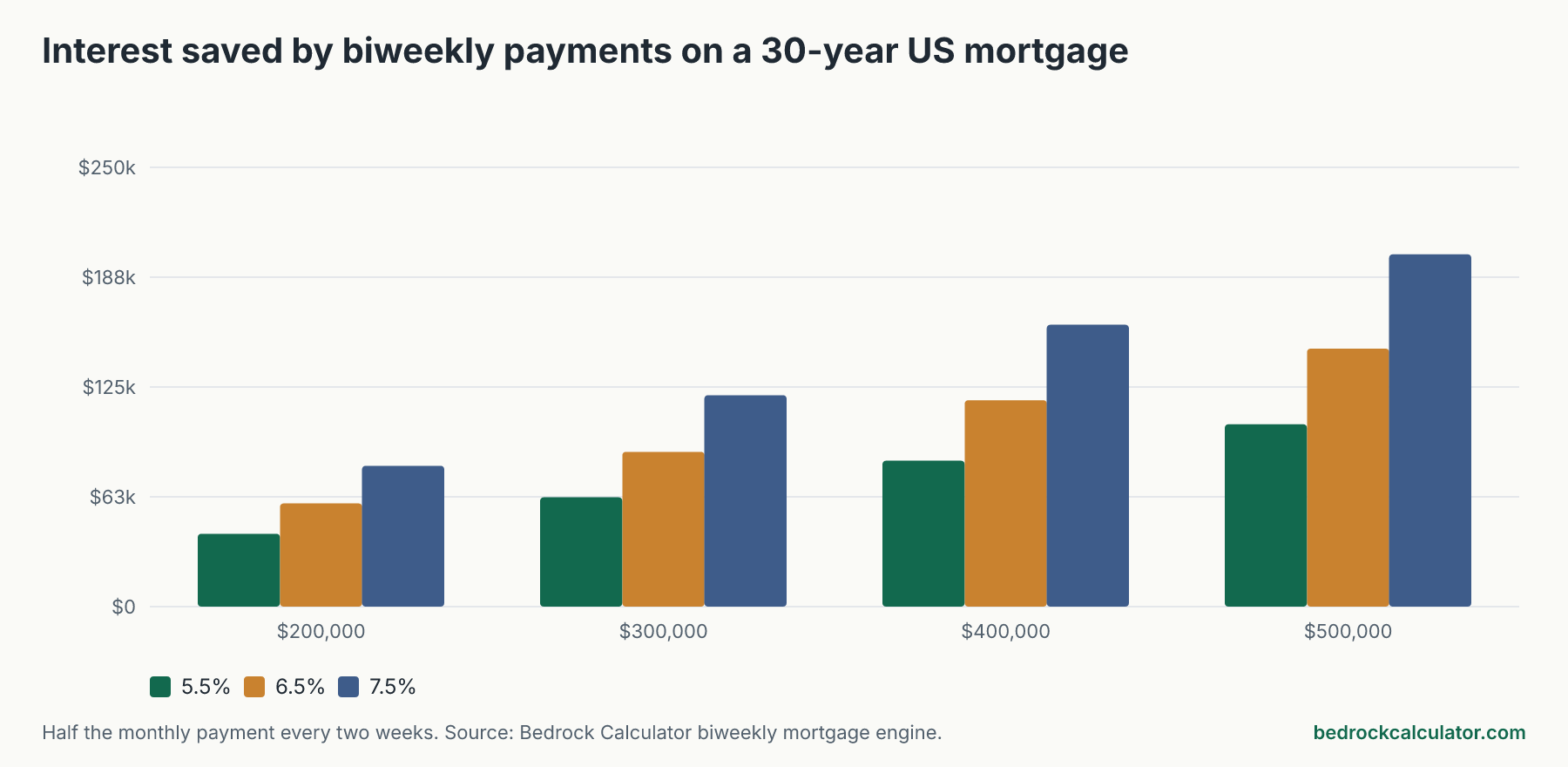
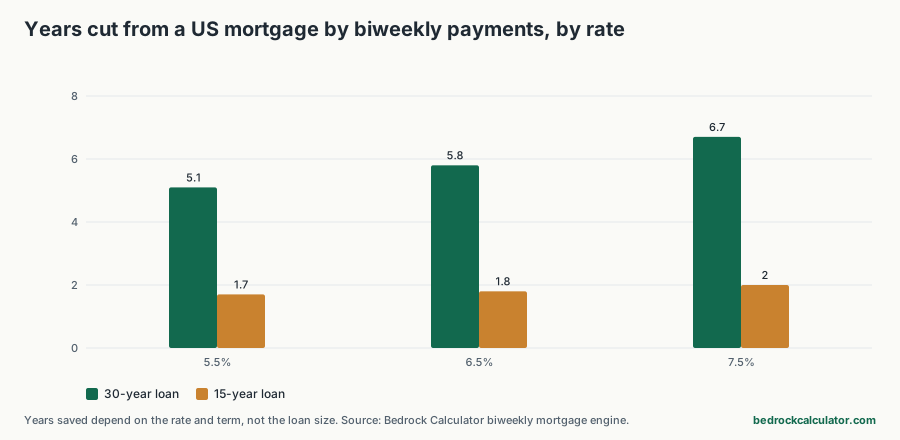
Two things stand out. First, the years saved don't depend on the loan size. At 6.5% every loan size here is paid off in 24.2 years, because the extra payment is always the same share of the loan. Second, the dollar saving grows with both the loan and the rate. On $200,000 at 5.5% it's $41,503.01. On $500,000 at 7.5% it's $200,491.71.
Higher rates mean bigger savings
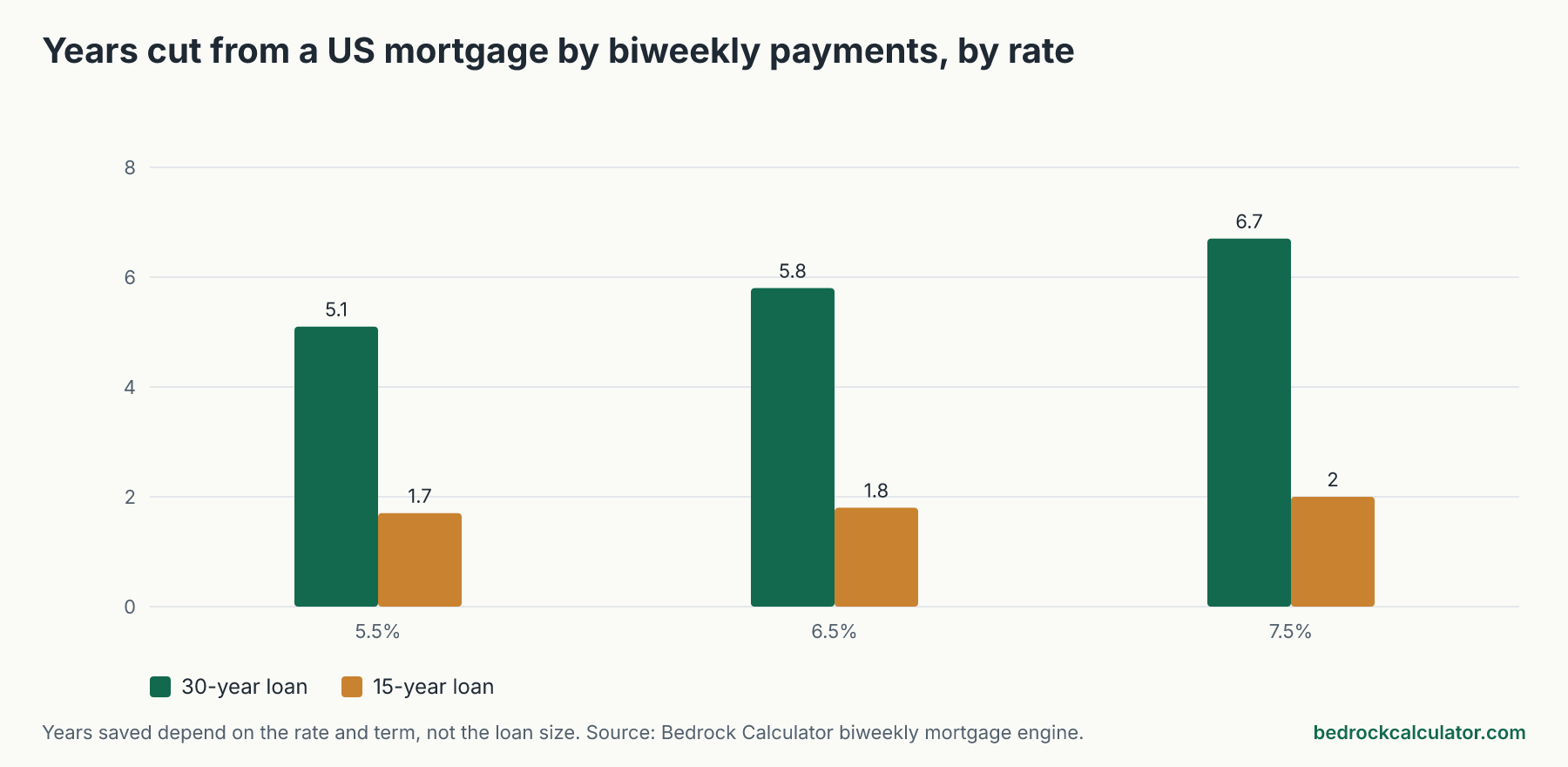
At 5.5% the biweekly schedule cuts 5.1 years from a 30-year loan. At 7.5% it cuts 6.7. When more of each payment is interest, every dollar of extra principal stops more future interest from building. On $300,000 that makes the saving $62,250.83 at 5.5% and $120,299.22 at 7.5%.
If you're comparing biweekly payments against a fixed extra amount each month, our page on what a fixed amount of extra principal each month saves runs that side of it. And our mortgage interest by year breakdown shows how heavily the early payments lean toward interest, which is why extra principal early on works so well.
Biweekly payments on a 15-year mortgage
Biweekly vs monthly payments on a 15-year US mortgage
Download CSVBiweekly payment is half the standard monthly principal and interest, paid 26 times a year and applied to the loan as soon as it is paid.
| $500,000 | 7.5% | $4,635.06 | $2,317.53 | 13 | 2 | $50,838.94 | 15.2% |
| $400,000 | 7.5% | $3,708.05 | $1,854.02 | 13 | 2 | $40,669.82 | 15.2% |
| $500,000 | 6.5% | $4,355.54 | $2,177.77 | 13.2 | 1.8 | $39,774.21 | 14.0% |
| $400,000 | 6.5% | $3,484.43 | $1,742.21 | 13.2 | 1.8 | $31,820.53 | 14.0% |
| $300,000 | 7.5% | $2,781.04 | $1,390.52 | 13 | 2 | $30,503.06 | 15.2% |
| $500,000 | 5.5% | $4,085.42 | $2,042.71 | 13.3 | 1.7 | $30,314.69 | 12.9% |
| $400,000 | 5.5% | $3,268.33 | $1,634.17 | 13.3 | 1.7 | $24,252.71 | 12.9% |
| $300,000 | 6.5% | $2,613.32 | $1,306.66 | 13.2 | 1.8 | $23,864.71 | 14.0% |
| $200,000 | 7.5% | $1,854.02 | $927.01 | 13 | 2 | $20,338.02 | 15.2% |
| $300,000 | 5.5% | $2,451.25 | $1,225.63 | 13.3 | 1.7 | $18,189.68 | 12.9% |
| $200,000 | 6.5% | $1,742.21 | $871.11 | 13.2 | 1.8 | $15,910.83 | 14.0% |
| $200,000 | 5.5% | $1,634.17 | $817.08 | 13.3 | 1.7 | $12,125.03 | 12.9% |
A 15-year loan already pays principal down quickly, so there's less interest left to save. On $300,000 at 6.5% the biweekly schedule saves $23,864.71 and pays the loan off in 13.2 years. That's still real money, but it's about a quarter of what the same habit saves on a 30-year loan.
Is a biweekly mortgage worth it?
If your paychecks come every two weeks and your servicer will apply half payments as they arrive at no charge, it's one of the easiest ways to shorten a mortgage. You'll hardly notice the extra payment, and on a typical 30-year loan it takes off 5.8 years at 6.5%.
If your servicer charges for it, or batches payments monthly, you may do just as well by adding a set amount to your regular monthly payment and marking it as principal. Either way, get confirmation that extra money is going to principal, not being held for your next payment.
Run your own numbers
Enter your balance, rate and original term in the biweekly mortgage calculator to see your own payoff date and saving. To try a fixed extra amount instead, use the mortgage payoff calculator. The mortgage calculator shows the full monthly cost with taxes and insurance, and the loan amortization calculator lays out each payment. For monthly payments at every quarter-point rate, see mortgage payments by rate and loan amount.