Which saves more, the debt snowball or the debt avalanche?
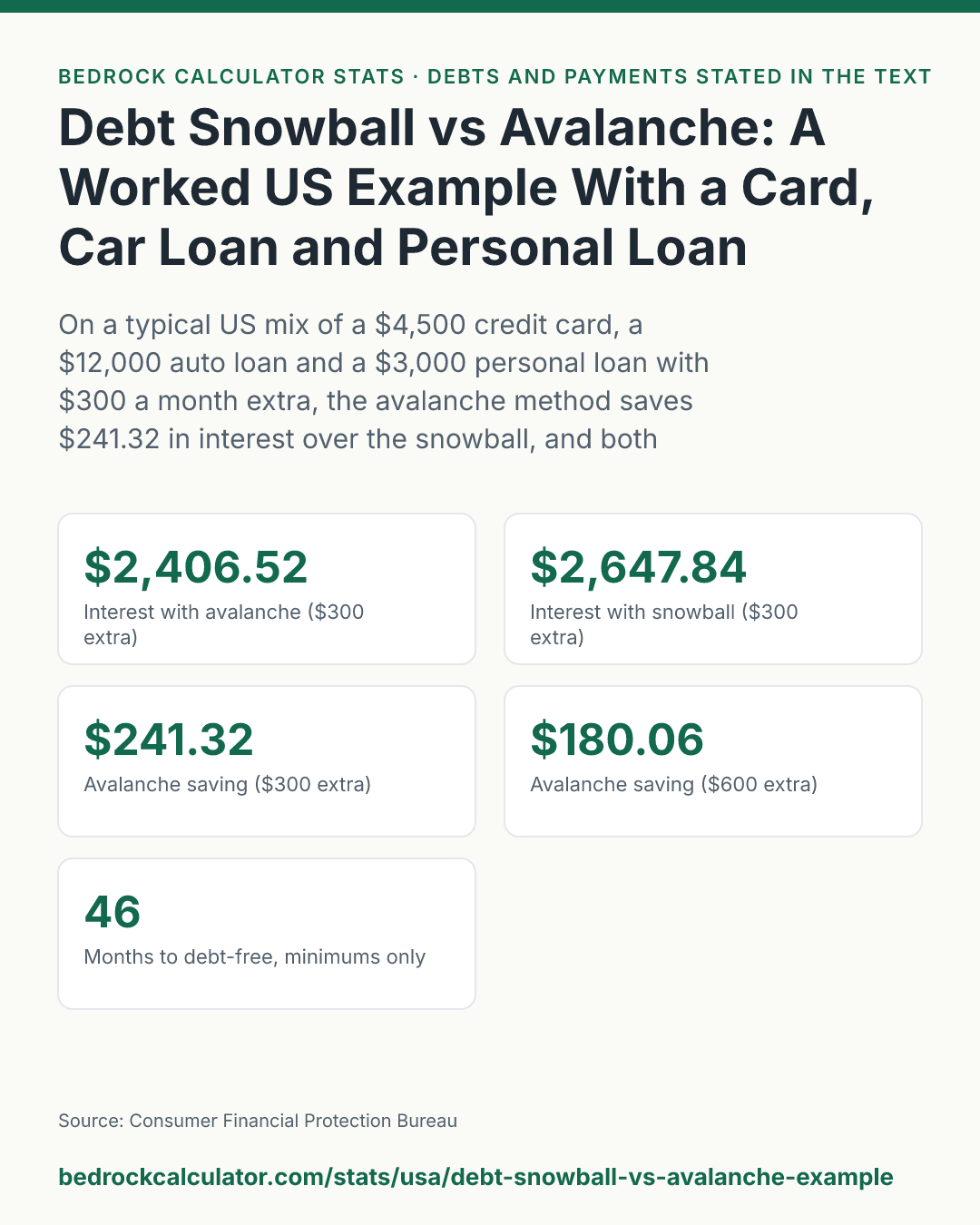
Take a common US debt mix: a $4,500 credit card at 24.99%, a $12,000 auto loan at 7.5% and a $3,000 personal loan at 15%, $19,500 in all. Pay the minimums plus $300 a month extra. The avalanche method, which targets the highest interest rate first, costs $2,406.52 in interest.
The snowball method, which targets the smallest balance first, costs $2,647.84. Avalanche saves $241.32, and both are done in 27 months.
So avalanche wins on cost, as it always does on paper, but in this example the gap is modest. If the quick early win from the snowball keeps you paying, it may well be worth the difference.
The debts in this example
The example debts
Download CSV| Auto loan | $12,000 | 7.5% | $320 |
| Credit card | $4,500 | 24.99% | $135 |
| Personal loan | $3,000 | 15% | $95 |
These are the default inputs in our debt snowball vs avalanche calculator, chosen to look like a typical household's mix of revolving and installment debt. The minimum payments add up to $550 a month.
How we worked out these numbers
We ran the calculator four times, with nothing extra and with $100, $300 and $600 a month on top of the minimums. Every month, the engine charges each debt interest at its APR divided by 12, pays every minimum, then puts the extra money on one target debt:
- Snowball: the debt with the smallest balance.
- Avalanche: the debt with the highest APR.
When a debt is paid off, its minimum payment rolls into the money going to the next target. That rollover is what makes both methods speed up over time.
Every scenario side by side
Snowball vs avalanche at four levels of extra payment
Download CSVExtra paid on top of the combined minimums every month. Minimums of paid-off debts roll into the next target.
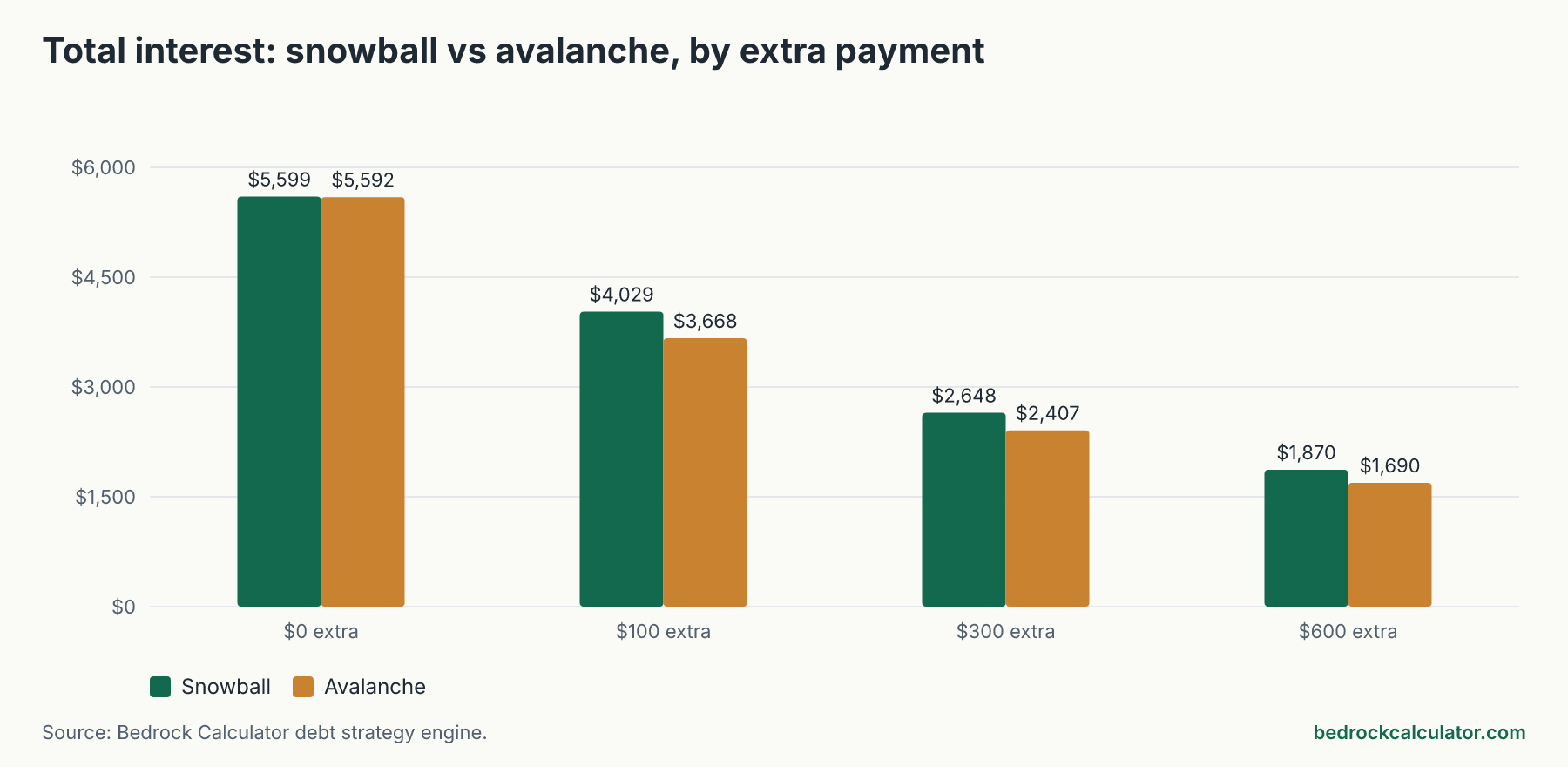
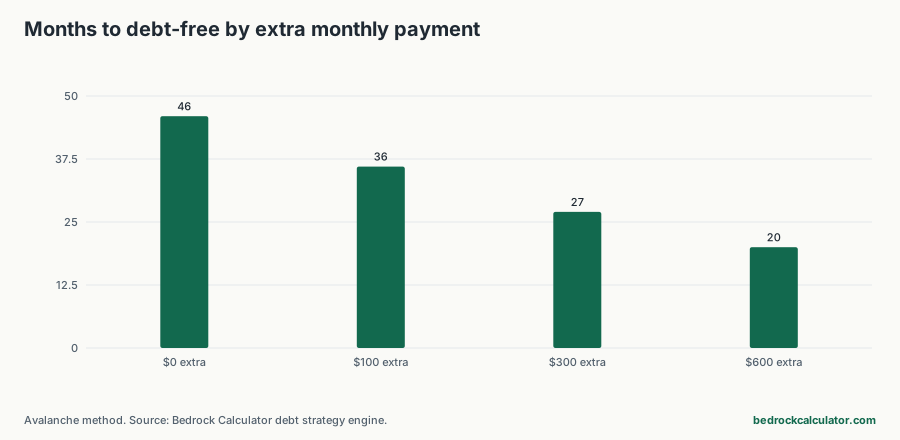
| $0 | 46 | 46 | $5,599.35 | $5,591.78 | $7.57 |
| $100 | 37 | 36 | $4,029.45 | $3,667.53 | $361.92 |
| $300 | 27 | 27 | $2,647.84 | $2,406.52 | $241.32 |
| $600 | 20 | 20 | $1,869.88 | $1,689.82 | $180.06 |
Which debt goes first, and why it matters
With $300 extra, the snowball clears the personal loan first, in month 9. The full order is personal loan (month 9), then credit card (month 17), then auto loan (month 27).
The avalanche goes after the credit card first, because its rate is highest, and clears it in month 12. The full order is credit card (month 12), then personal loan (month 17), then auto loan (month 27).
The snowball's first win comes a few months earlier. That's its whole appeal: you see a debt disappear sooner and get one fewer bill to track. The avalanche spends those early months knocking down the most expensive debt, which is why it pays less interest overall.
Why the saving isn't bigger
You might expect the avalanche's advantage to grow with every extra dollar. In this example it doesn't. The saving is $361.92 with $100 extra, $241.32 with $300 and $180.06 with $600.
Two things explain it. First, the two smaller debts are both small, so whichever goes first, both are gone within a year and a half. Second, the more you pay, the faster everything disappears, which leaves less time for the order to matter. With only minimum payments, the extra money is just the rolled-over minimums, and the saving shrinks to $7.57.
The avalanche advantage gets bigger when a large balance carries a high rate, for example a big credit card balance at a card-level rate sitting next to a small low-rate loan. Then the snowball would spend months paying off the cheap debt while the expensive one keeps growing.
The extra payment matters more than the method
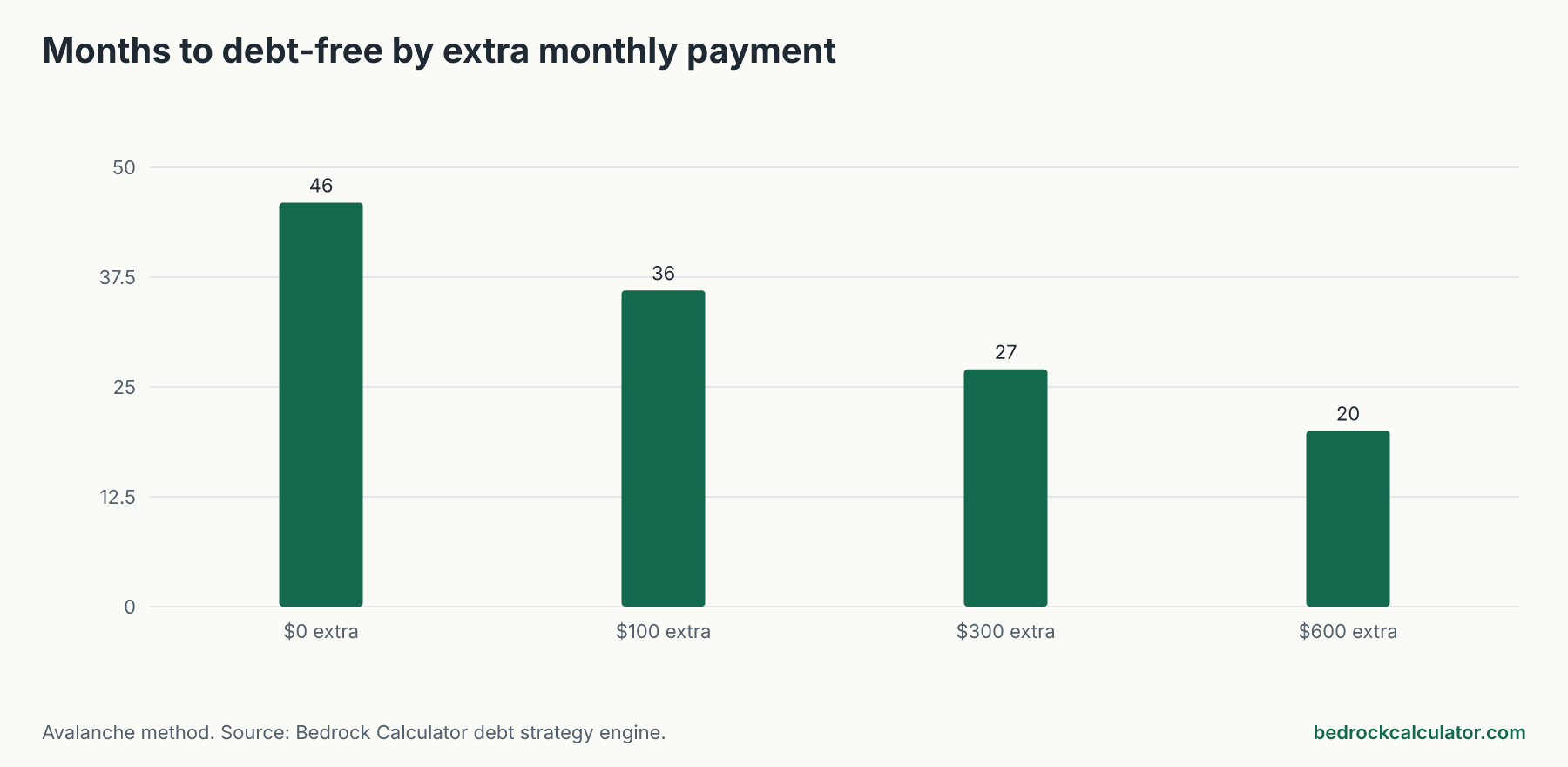
Look at the bigger picture. Paying only the minimums, the debts take 46 months and cost $5,591.78 in interest. Adding $300 a month cuts that to 27 months and $2,406.52. Adding $600 gets you out in 20 months.
The choice between snowball and avalanche moved the interest by a few hundred dollars. Adding extra money moved it by thousands. Pick the method you'll actually stick with, and put as much as you can toward it.
What this leaves out
- New borrowing. The engine assumes no new charges on the card.
- Changing minimums. Each minimum is held fixed. A real credit card minimum usually shrinks as the balance falls; our page on credit card payoff time by APR explains why that matters.
- Fees and promotional rates. Late fees, annual fees and zero-interest offers aren't included.
- Monthly interest. Interest is charged at the APR divided by 12 on each month's balance. Card issuers usually use a daily rate, and installment loans may differ slightly, so real figures can move by a few dollars.
- Behavior. The numbers can't capture motivation, which is the main argument for the snowball.
Run your own numbers
Put your own balances, rates and minimums into the debt snowball vs avalanche calculator. For a single card, the credit card payoff calculator shows the time and interest at any payment. If you're thinking about rolling the card into a lower-rate loan, the personal loan calculator shows what that loan would cost.