How many years until you can retire early at each savings rate?
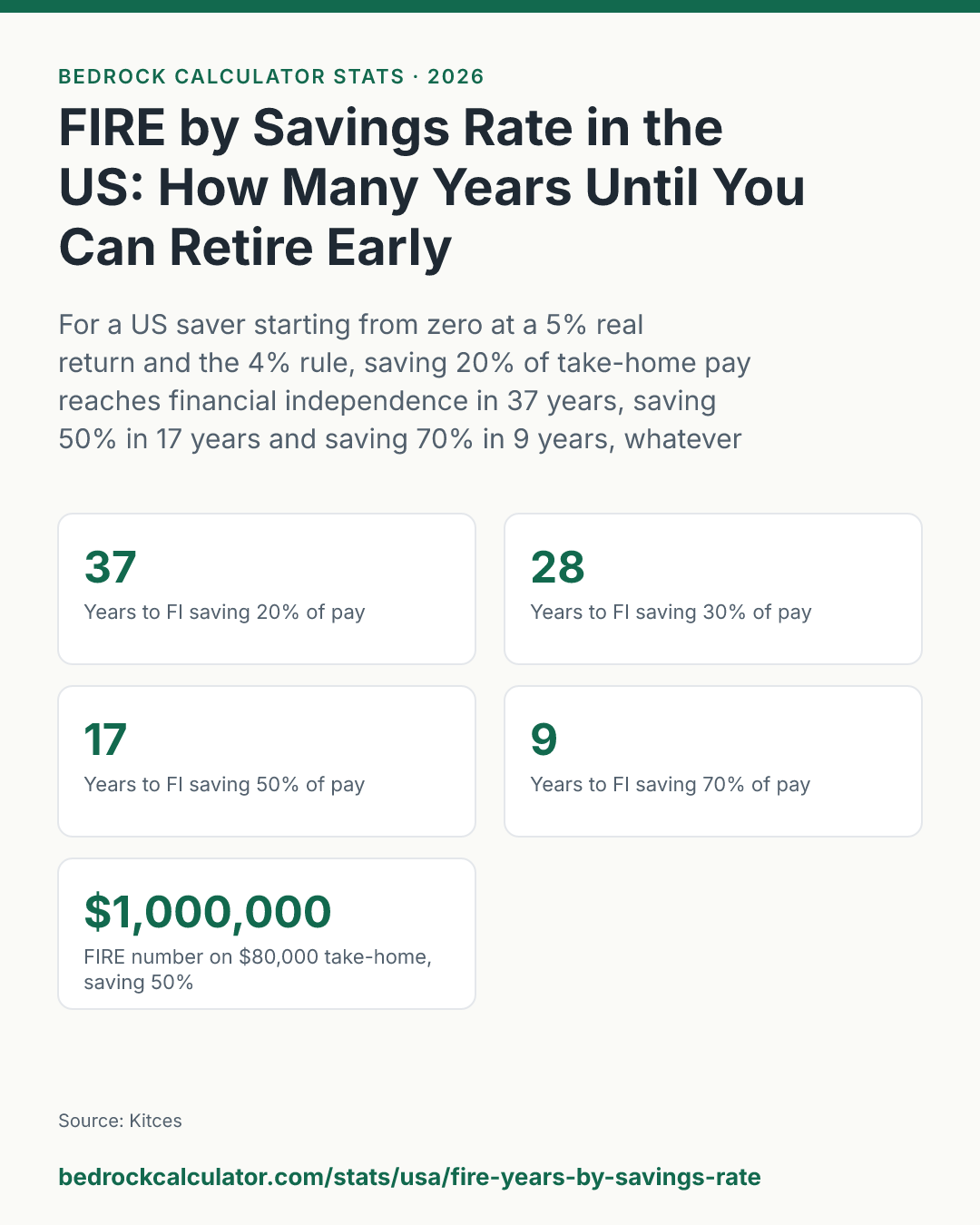
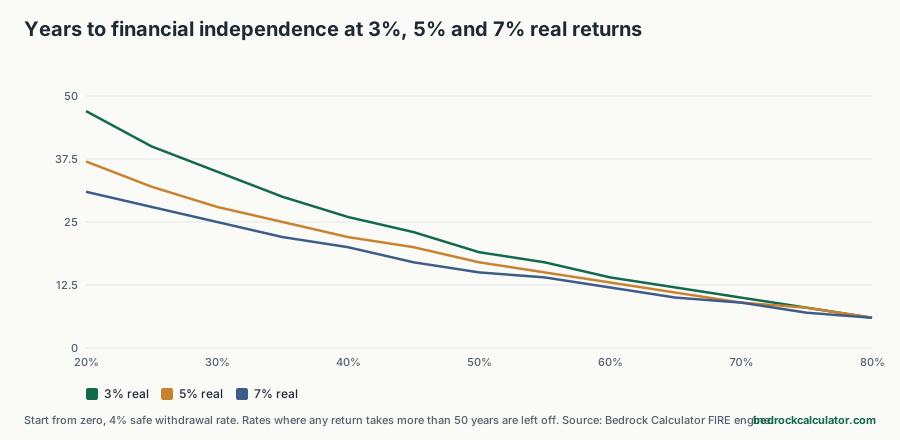
For US savers, how fast you reach financial independence depends far more on the share of your pay you save than on how much you earn. Starting from nothing, saving 20% of your take-home pay gets you there in about 37 years. Saving 50% takes 17 years. Saving 70% takes 9.
Those figures assume a 5% return after inflation and the 4% rule, and they hold at any income.
How we worked out these numbers
All figures are for the United States and use US rules for 2026.
We ran the site's FIRE calculator once for each savings rate from 10% to 80% of take-home pay. The setup is the same every time:
- You start with nothing invested
- Your take-home pay is $80,000 a year and stays the same in real terms
- You save a fixed share of it and spend the rest
- Your investments earn a 5% real return every year, with no bad years
- You're financially independent when your portfolio reaches your yearly spending times 25, which is the 4% rule turned around
The calculator adds a year of growth, then that year's savings, and counts the years until the balance reaches the target. It stops counting at 50 years.
Because the return is a real return, all the dollar figures are in today's money. The calculator doesn't model taxes on your investments or withdrawals, raises, changes in spending, Social Security, or market swings. It also assumes you'd spend the same amount in retirement as you do while saving.
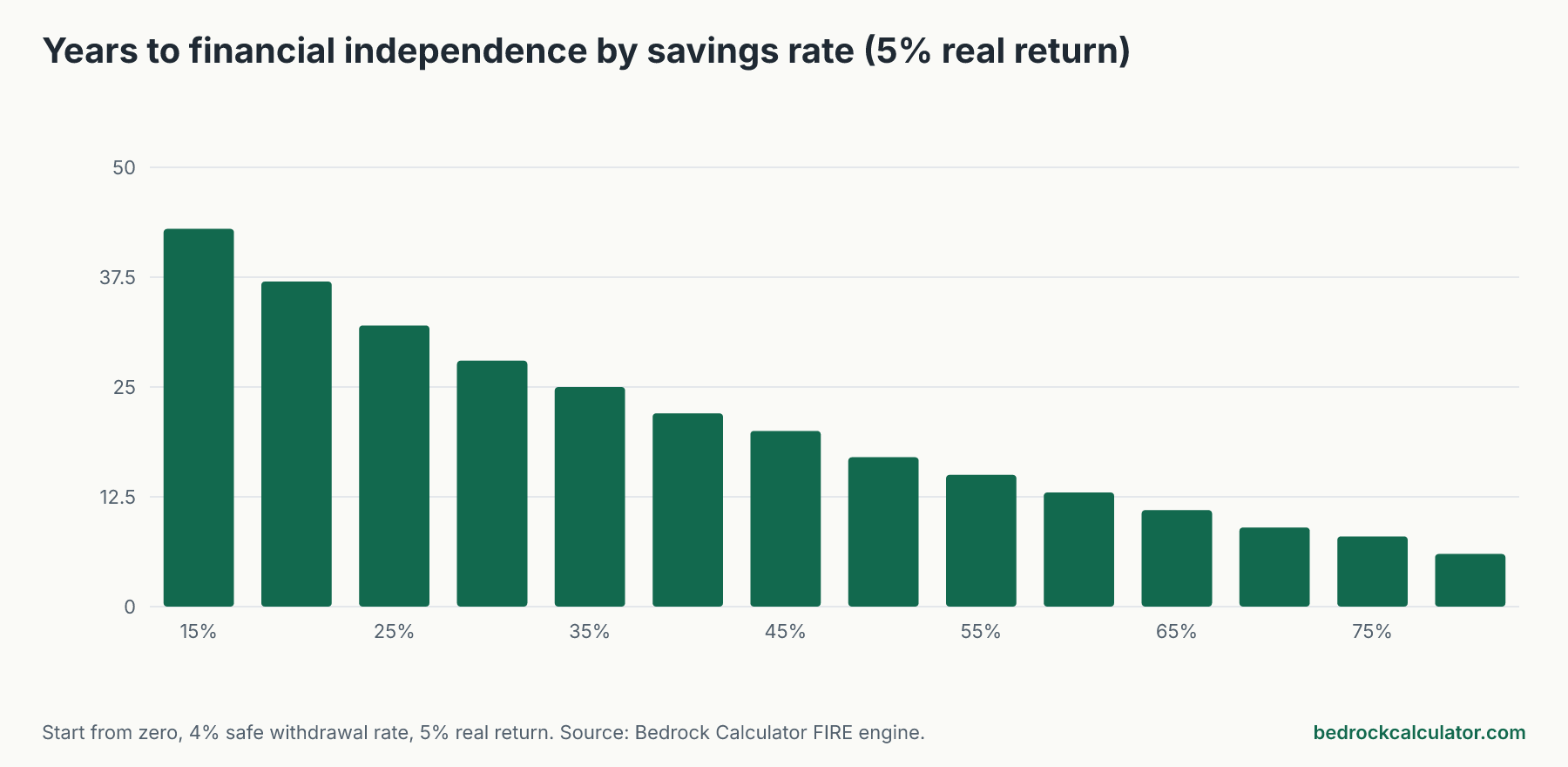
Years to financial independence by savings rate
The table shows the savings and spending behind each rate on a $80,000 take-home pay, the target that spending sets, and the years it takes at three different real returns. Where the table says n/a, it takes more than 50 years.
Years to financial independence by savings rate
Download CSVStart from zero, $80,000 take-home pay, spend the rest, 4% safe withdrawal rate. n/a means more than 50 years, where the calculator stops counting.
| 10% | $8,000 | $72,000 | $1,800,000 | n/a | n/a | 42 |
| 15% | $12,000 | $68,000 | $1,700,000 | n/a | 43 | 36 |
| 20% | $16,000 | $64,000 | $1,600,000 | 47 | 37 | 31 |
| 25% | $20,000 | $60,000 | $1,500,000 | 40 | 32 | 28 |
| 30% | $24,000 | $56,000 | $1,400,000 | 35 | 28 | 25 |
| 35% | $28,000 | $52,000 | $1,300,000 | 30 | 25 | 22 |
| 40% | $32,000 | $48,000 | $1,200,000 | 26 | 22 | 20 |
| 45% | $36,000 | $44,000 | $1,100,000 | 23 | 20 | 17 |
| 50% | $40,000 | $40,000 | $1,000,000 | 19 | 17 | 15 |
| 55% | $44,000 | $36,000 | $900,000 | 17 | 15 | 14 |
| 60% | $48,000 | $32,000 | $800,000 | 14 | 13 | 12 |
| 65% | $52,000 | $28,000 | $700,000 | 12 | 11 | 10 |
| 70% | $56,000 | $24,000 | $600,000 | 10 | 9 | 9 |
| 75% | $60,000 | $20,000 | $500,000 | 8 | 8 | 7 |
| 80% | $64,000 | $16,000 | $400,000 | 6 | 6 | 6 |
At a 10% savings rate, you don't get there inside 50 years at a 5% real return. The first rate in our table that does is 15%.
Why the savings rate does double duty
Raising your savings rate helps in two ways at once. You put more money in each year, and you also need less at the end, because you've shown you can live on less.
Take $80,000 of take-home pay. Saving 20% means putting away $16,000 a year and spending $64,000. Your FIRE number is $1,600,000. Saving 50% means putting away $40,000 and spending $40,000, so the target drops to $1,000,000. More money going in, a smaller pile to build: that's why the years fall so fast.
It's also why your income doesn't change the answer. We checked by running the same 50% savings rate at other incomes, and the years to independence does not change. A higher earner saving 20% spends more, so they need a bigger portfolio, and it takes them just as long. Income matters in a different way: a 50% savings rate is a lot easier to live with on a big salary than on a small one.
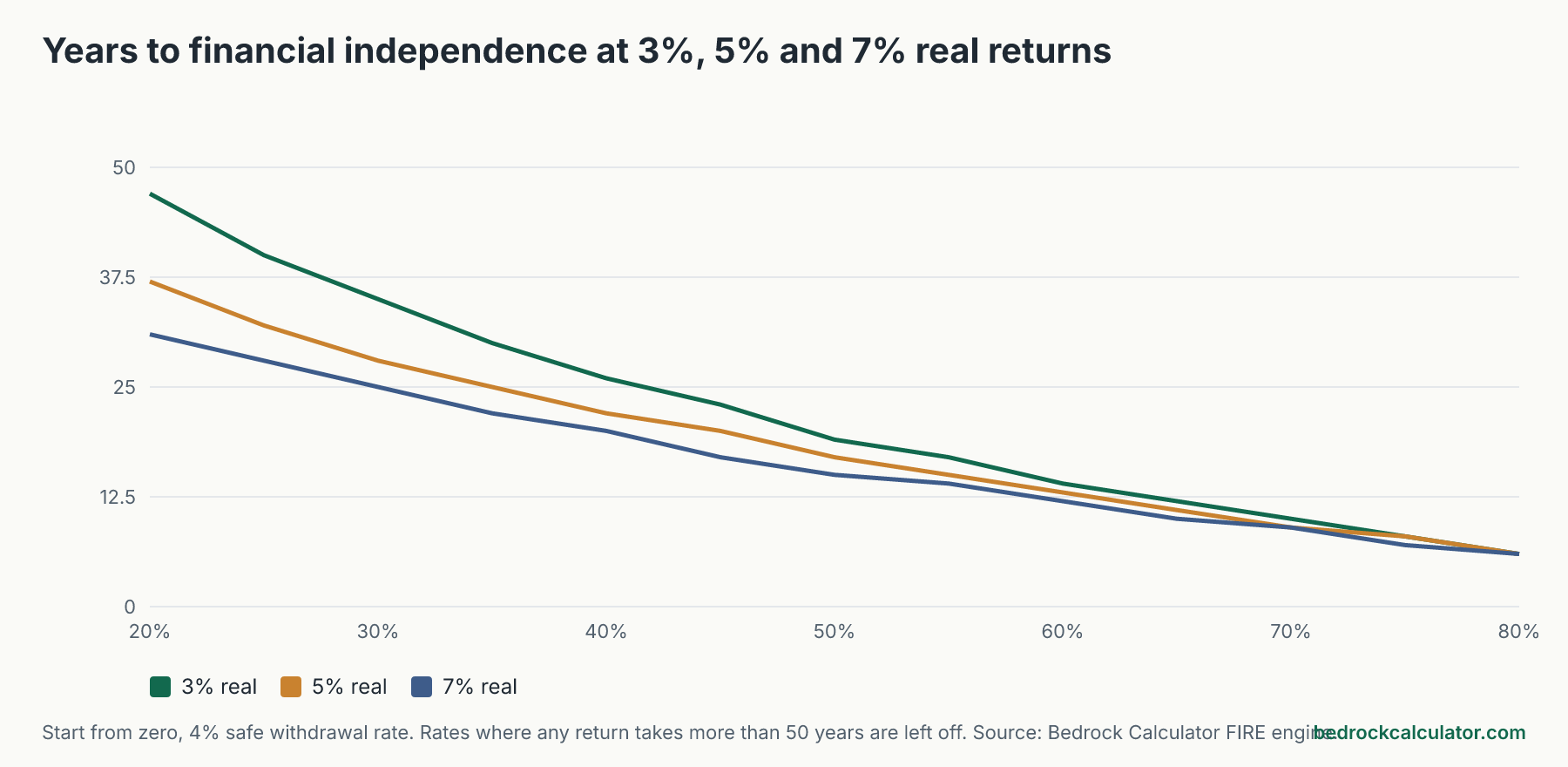
How much the return assumption matters
The return you assume shifts the answer, but less than you might expect at high savings rates. At 50% you reach independence in 19 years at a 3% real return, 17 at 5% and 15 at 7%. At 20% the range is much wider, from 47 years down to 31.
That's because high savers reach their target mostly through what they put in. Low savers depend on decades of compounding, so the return makes a bigger difference to them.
The FIRE calculator's own default is a 7% real return. We used 5% for the headline figures because a long-run real return of 7% is optimistic for a mixed portfolio, and an early retiree has less room for error.
Is the 4% rule right for early retirement?
The 4% rule came out of research on 30-year retirements. Someone who reaches financial independence at 40 might need their money to last 50 years or more. Many people in the FIRE community plan around 3.5% for that reason.
A lower withdrawal rate means a bigger target. At 3.5% it takes 19 years to reach independence at a 50% savings rate, instead of 17, and 40 years at 20%, instead of 37. The retirement calculator shows how the length of retirement changes the target.
What this leaves out
Real life is lumpier than a calculator. A few things that would change your number:
- Starting balance. If you already have savings, you'll get there sooner. Enter your current balance in the calculator.
- Taxes. Money in a traditional 401(k) or IRA is taxed when you take it out, so your target is a pre-tax figure. Money in a taxable account is taxed on gains.
- Health insurance. Retiring before 65 means paying for coverage yourself until Medicare, which many early retirees underestimate. The early retirement health insurance calculator prices that gap.
- Social Security. It's not counted here. It reduces what your portfolio needs to cover later in life.
- Market swings. A bad stretch of years early on can push your date back, even if the average return holds.
Getting your own number
Open the FIRE calculator, enter your age, what you have invested, what you spend and what you save, and try a few returns and withdrawal rates. If you'd rather stop saving early and let what you have grow, the Coast FIRE calculator shows when you can. And if you plan to keep working part-time, the Barista FIRE calculator works out how a smaller paycheck changes the target.