How much does an H-1B worker take home in each large state?
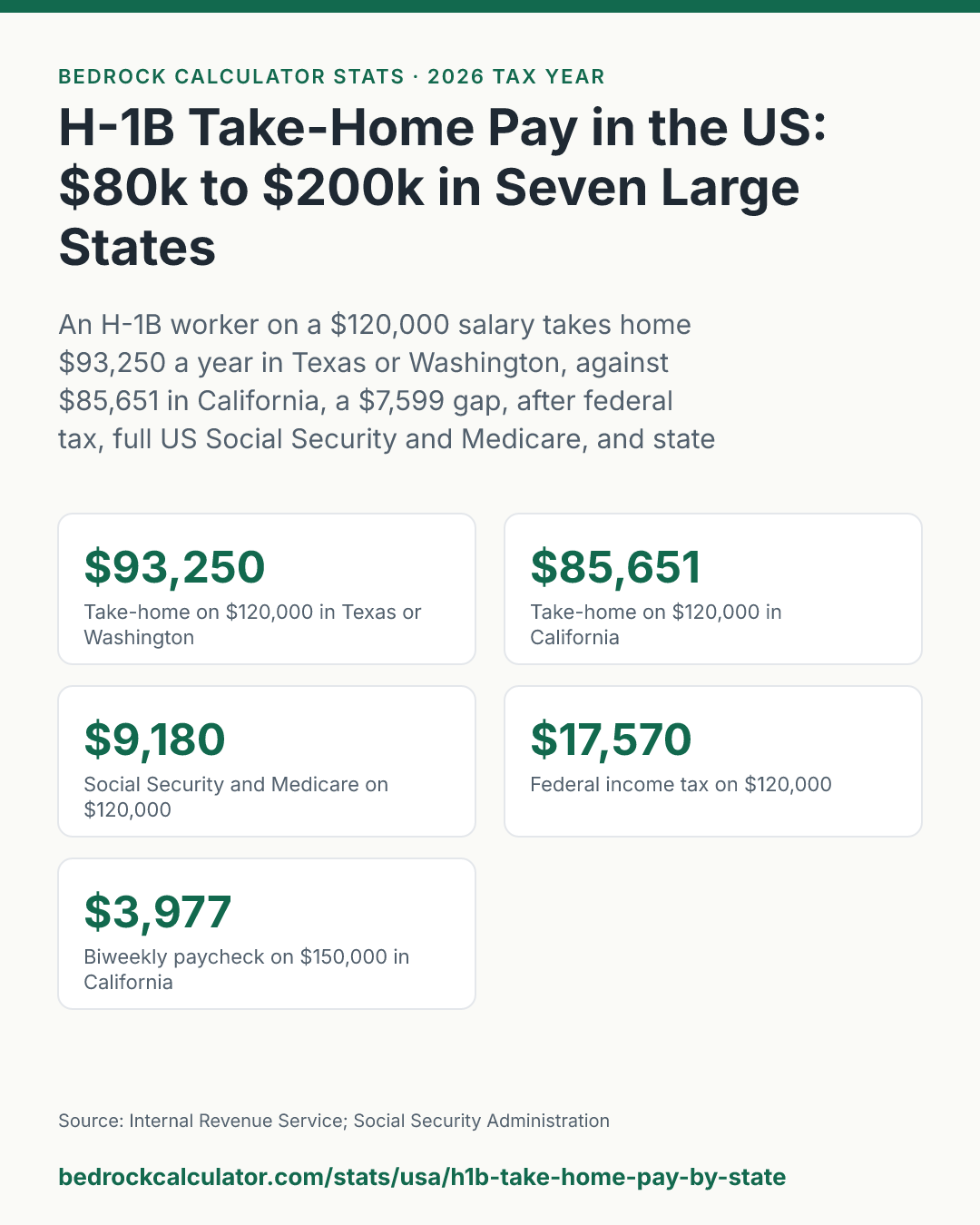
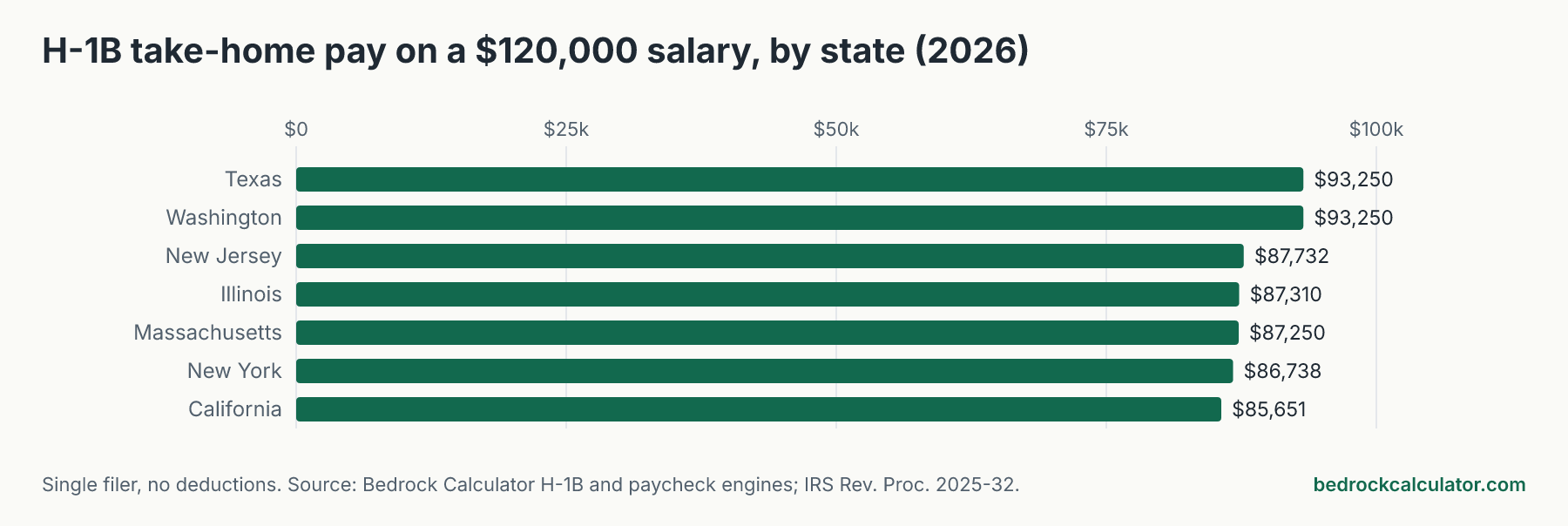
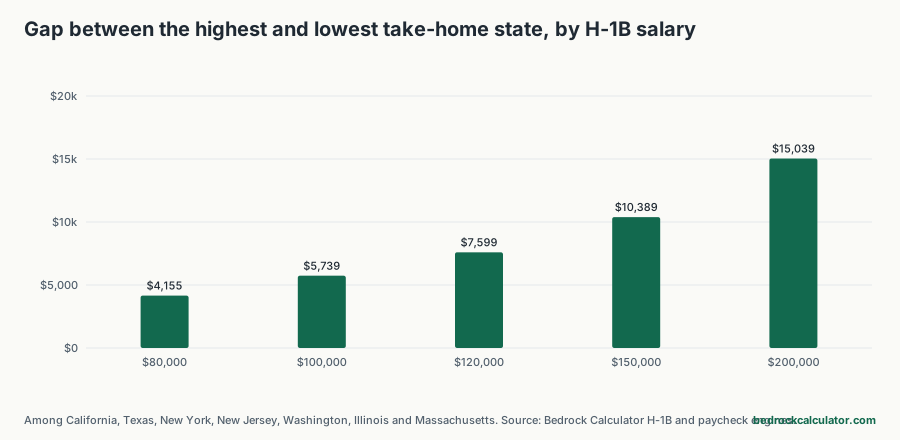
On a $120,000 salary, a single H-1B worker in the US takes home $93,250 a year in Texas or Washington, where wages aren't taxed by the state. In California, the lowest of the seven states we checked at that salary, the same paycheck leaves $85,651. That's $7,599 a year, or about $292 every two weeks.
Before any state tax, every H-1B worker on $120,000 pays $17,570 of federal income tax and $9,180 of Social Security and Medicare. There's no visa discount on either.
How H-1B workers are taxed
Once you pass the IRS substantial presence test, which most H-1B workers do in their first full calendar year in the US, you're a resident alien for tax purposes. That means you're taxed exactly like a US citizen: the same federal brackets, the same standard deduction, and the same state income tax as anyone else living there.
It also means full FICA. Some international students on F-1 or J-1 visas are exempt from Social Security and Medicare tax for their first few years. H-1B status never carries that exemption, so the deductions start with your first paycheck. The Social Security part stops once your pay passes the yearly wage base, which is why it grows more slowly than your salary at the top of the table.
How we worked out these numbers
We used two calculators on this site:
- The H-1B take-home pay calculator for federal income tax, Social Security and Medicare. It treats you as a resident alien for the whole year.
- The paycheck calculator for each state's income tax on the same salary. The H-1B calculator stops at federal tax, so this fills the gap. Both use the same federal and FICA math, so the take-home figures here match what the paycheck calculator shows for each state.
Every run uses the same setup:
- Single filer, paid every two weeks
- Salaries of $80,000, $100,000, $120,000, $150,000 and $200,000
- No 401(k), HSA or other deductions
- 2026 federal brackets, standard deduction and Social Security wage base
We picked seven large states with big job markets for the professional roles many H-1B workers fill: California, Texas, New York, New Jersey, Washington, Illinois and Massachusetts. For every other state, run the paycheck calculator or see take-home pay by state.
H-1B take-home pay at each salary and state
H-1B annual take-home pay by salary in seven large US states, 2026
Download CSVSingle filer, resident alien for the full year, biweekly pay, no 401(k) or other deductions. Federal income tax, Social Security, Medicare and state income tax only.
| Texas | $65,110 | $79,180 | $93,250 | $113,791 | $148,927 |
| Washington | $65,110 | $79,180 | $93,250 | $113,791 | $148,927 |
| New Jersey | $62,140 | $74,936 | $87,732 | $106,362 | $138,313 |
| Illinois | $61,150 | $74,230 | $87,310 | $106,366 | $139,027 |
| Massachusetts | $61,110 | $74,180 | $87,250 | $106,291 | $138,927 |
| New York | $60,955 | $73,848 | $86,738 | $105,509 | $137,695 |
| California | $61,231 | $73,441 | $85,651 | $103,402 | $133,888 |
Texas and Washington tie at the top of every column because neither taxes wages. There, what you keep is your salary less federal income tax and FICA: $79,180 on $100,000 and $113,791 on $150,000.
At $100,000, California leaves you $73,441, New York $73,848, New Jersey $74,936, Illinois $74,230 and Massachusetts $74,180.
The order shifts a little by salary. At $80,000, New York is lowest, at $60,955. From $100,000 up, California's higher brackets make it the lowest of the seven. Illinois and Massachusetts use a single flat rate, so their tax grows in a straight line with pay.
What every H-1B worker pays before state tax
What every H-1B worker pays before state tax
Download CSVSingle filer, 2026 federal brackets and standard deduction, full FICA. The same in every state.
| $80,000 | $8,770 | $6,120 | $65,110 | 18.6% |
| $100,000 | $13,170 | $7,650 | $79,180 | 20.8% |
| $120,000 | $17,570 | $9,180 | $93,250 | 22.3% |
| $150,000 | $24,734 | $11,475 | $113,791 | 24.1% |
| $200,000 | $36,734 | $14,339 | $148,927 | 25.5% |
Federal income tax and FICA together take 18.6% of an $80,000 salary and 25.5% of a $200,000 one. Those are the same wherever you live. The state is the only thing that changes the result, and that's what the first table shows.
Why the gap grows with salary
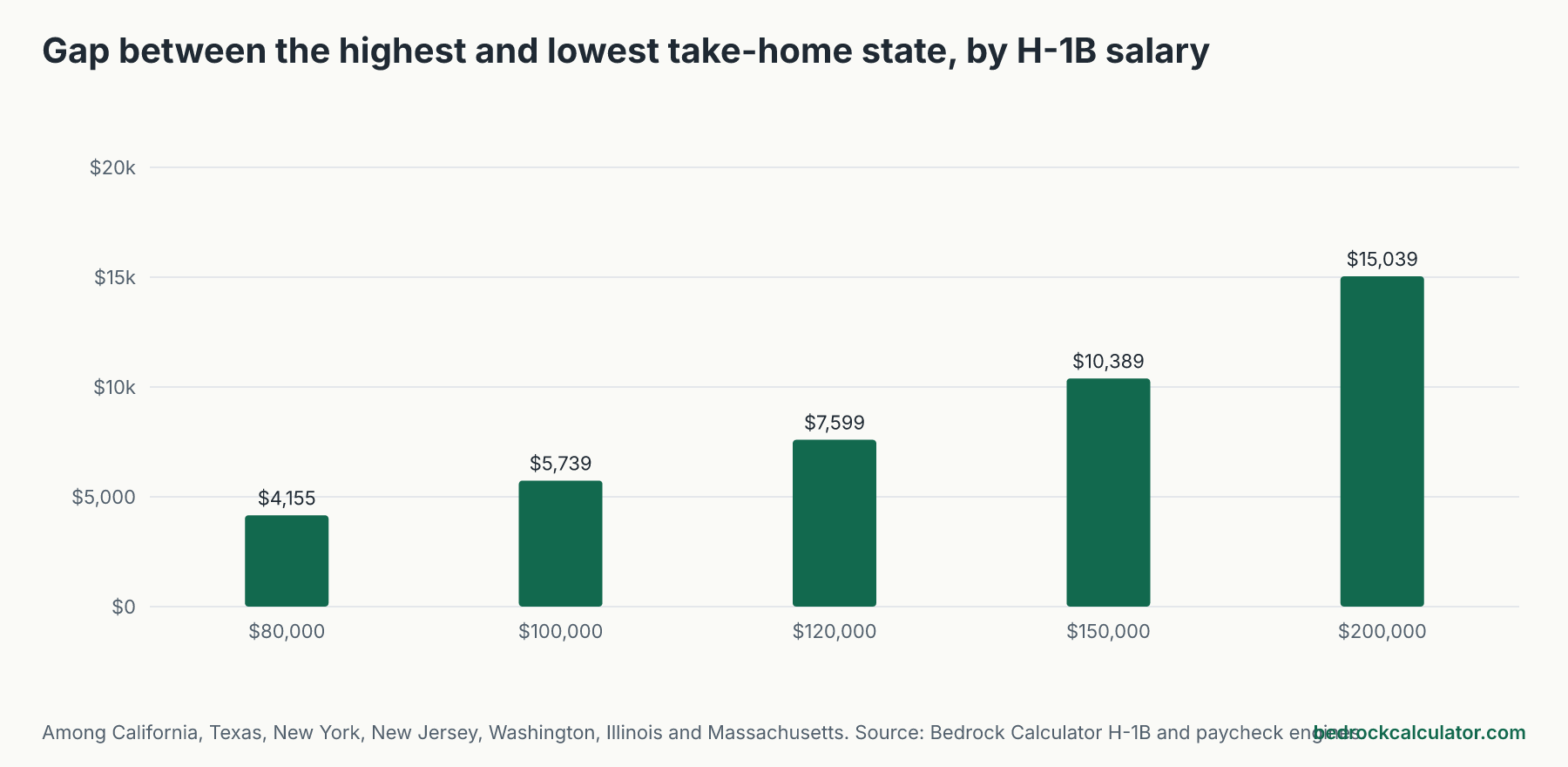
The difference between the best and worst of these states is $4,155 at $80,000, $7,599 at $120,000 and $15,039 at $200,000. Most state income taxes take a larger share from higher earners, so the dollar gap with a no-tax state widens as pay rises.
That's worth weighing if you're comparing offers in different states. A $150,000 offer in California leaves you $103,402. The same offer in Texas leaves $113,791. Housing and other living costs can easily outweigh that difference in either direction, so use the cost of living calculator too.
What this leaves out
- Your first year in the US. If you arrive part way through a year, you may be a dual-status taxpayer, treated as a nonresident for part of the year and a resident for the rest. The calculator assumes a full year as a resident.
- Tax treaties. Some countries' treaties with the US change how certain income is taxed. None are applied.
- State deductions and credits. The paycheck calculator applies each state's rates to your wages without the state's own standard deduction, personal exemption or credits, so it slightly overstates state tax in most of the states that have one.
- City income tax. New York City has its own income tax on top of New York State's. It isn't included, so a worker living in the city takes home less than the New York figure here.
- Deductions from your paycheck. A 401(k), health insurance or HSA contribution would lower your taxable pay and your take-home. None are included.
- Married filers. These are single-filer numbers. If your spouse is on an H-4 visa and you file jointly, your federal tax would be lower; both calculators let you change the filing status.
- Totalization agreements. A few countries have Social Security agreements with the US that can change FICA for workers on short assignments. Standard rules are applied here.
Get your own number
Open the H-1B take-home pay calculator to see federal tax and FICA with your own salary, filing status and 401(k) contribution. Then run the paycheck calculator with your state, or a state page such as the California paycheck calculator, Texas paycheck calculator or New York paycheck calculator, for the full take-home figure.