How much rent can you afford on your salary?
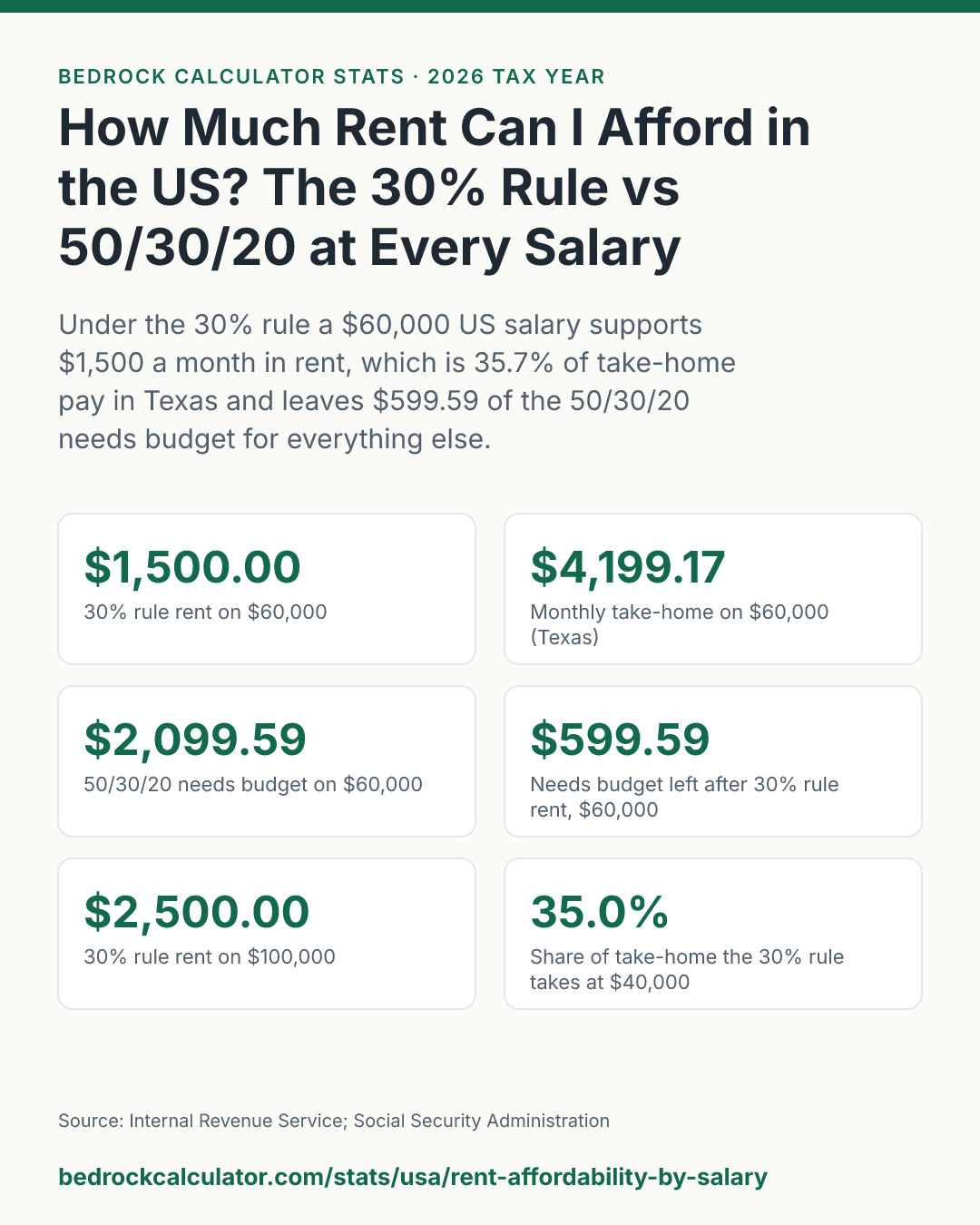
The usual US rule says rent should be no more than 30% of your gross pay. On a $60,000 salary that's $1,500.00 a month. After federal income tax, Social Security and Medicare, a single person in Texas takes home $4,199.17 a month, so that rent is really 35.7% of what lands in the bank.
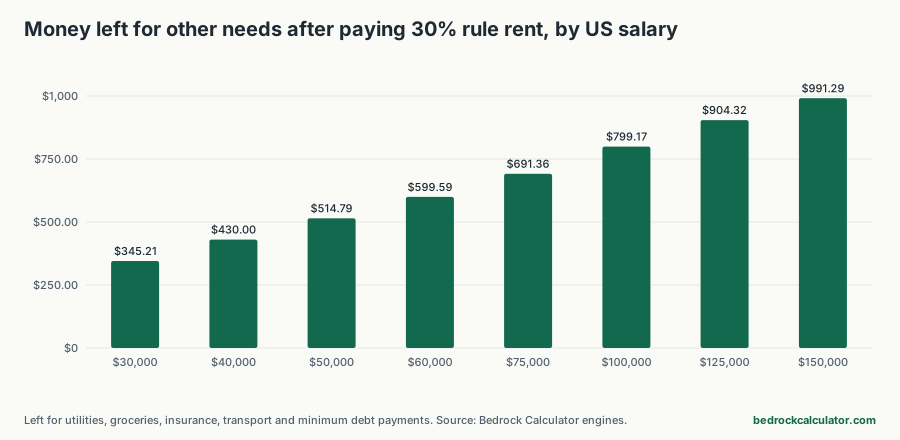
The 50/30/20 budget looks at it from the other side. Half of take-home, $2,099.59 a month at $60,000, has to cover all your needs: rent, utilities, groceries, insurance, getting to work and minimum debt payments. Pay the 30% rule rent out of that and $599.59 is left for everything else on the list.
Two rules, two different questions
The 30% rule is old and simple. It's built on gross pay, which is the number on your offer letter, and landlords often use a version of it when they ask that your income be a set multiple of the rent. It tells you the most rent that's considered affordable.
The 50/30/20 budget is built on take-home pay. It splits what you actually receive into 50% for needs, 30% for wants and 20% for savings and extra debt payments. It doesn't set a rent number on its own. Instead it caps the whole needs bucket, and rent is usually the biggest thing in it.
Putting the two side by side answers the question most renters actually have: if I pay what the 30% rule allows, can I still afford the rest of my life?
How we worked out these numbers
Take-home pay comes from the paycheck calculator on this site, run for a single filer in Texas, paid every two weeks, with no 401(k), health insurance or other deductions, using 2026 federal brackets and the 2026 Social Security wage base. We chose Texas because it has no state income tax, so the figures show federal tax and FICA only. If your state taxes wages, your take-home is lower, and we show how much lower for a few large states further down.
The needs, wants and savings amounts come from the 50/30/20 budget calculator, given that monthly take-home. We also entered the 30% rule rent as the needs spending, so the calculator reports what share of take-home the rent is and how much of the needs budget it leaves.
What's left out:
- Pre-tax deductions. A 401(k) or workplace health plan lowers take-home, which shrinks the 50/30/20 buckets. The 30% rule ignores them.
- Renters insurance, utilities and parking. The rent figure is rent alone.
- Couples, children and second incomes. Everything here is one earner filing single.
- Local taxes. No city or county income tax is included.
How much rent you can afford at every salary
Sort by any column. The last column is a stricter version of the rule that some planners prefer: 30% of take-home rather than gross.
How much rent each salary supports: 30% rule vs 50/30/20 (Texas, 2026)
Download CSVSingle filer in Texas, paid biweekly, no pre-tax deductions. Take-home is after federal income tax, Social Security and Medicare.
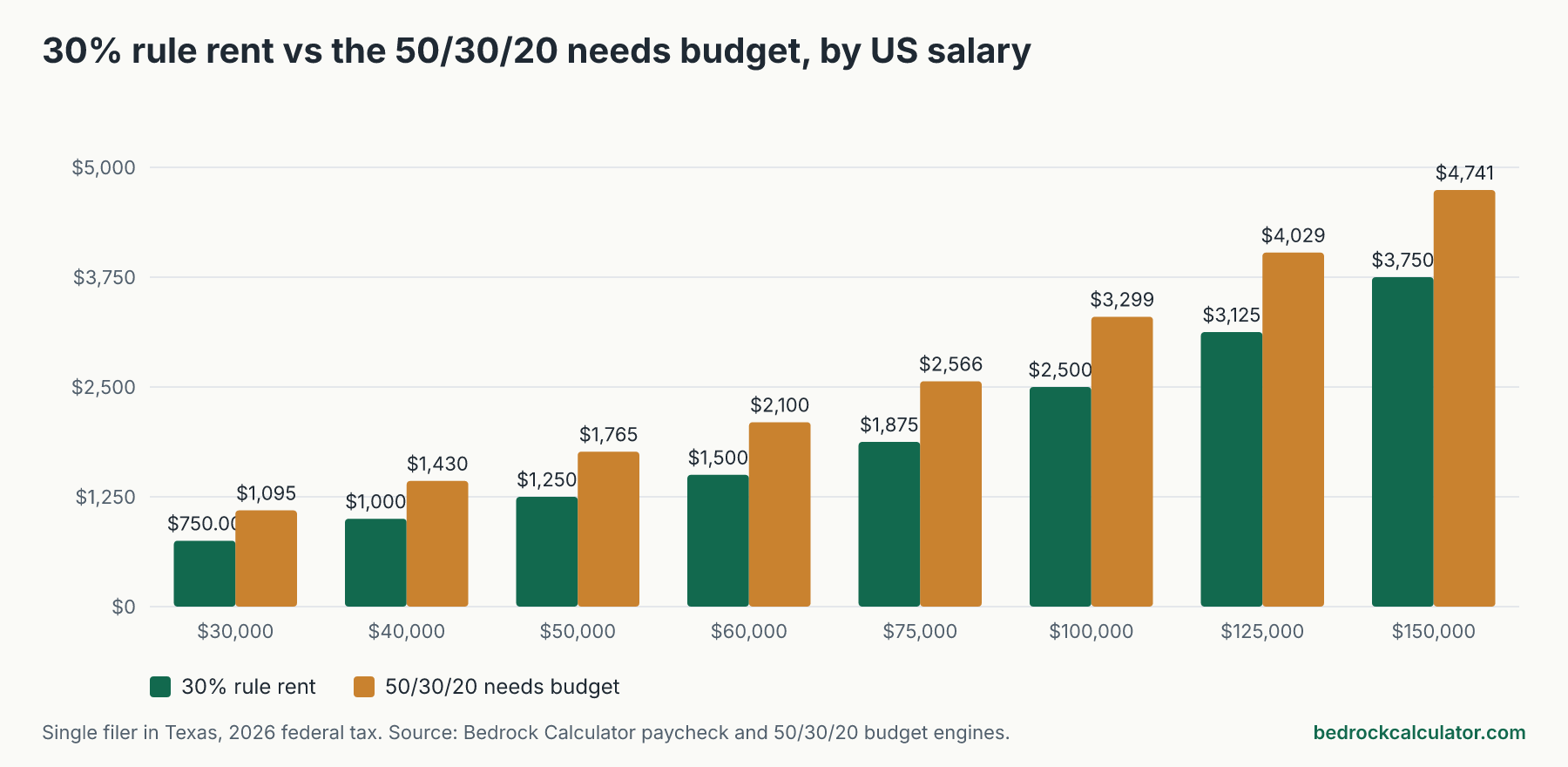
| $30,000 | $2,500.00 | $2,190.42 | $750.00 | 34.2% | $1,095.21 | $345.21 | $657.13 |
| $40,000 | $3,333.33 | $2,860.00 | $1,000.00 | 35.0% | $1,430.00 | $430.00 | $858.00 |
| $50,000 | $4,166.67 | $3,529.58 | $1,250.00 | 35.4% | $1,764.79 | $514.79 | $1,058.87 |
| $60,000 | $5,000.00 | $4,199.17 | $1,500.00 | 35.7% | $2,099.59 | $599.59 | $1,259.75 |
| $75,000 | $6,250.00 | $5,132.71 | $1,875.00 | 36.5% | $2,566.36 | $691.36 | $1,539.81 |
| $100,000 | $8,333.33 | $6,598.33 | $2,500.00 | 37.9% | $3,299.17 | $799.17 | $1,979.50 |
| $125,000 | $10,416.67 | $8,058.63 | $3,125.00 | 38.8% | $4,029.32 | $904.32 | $2,417.59 |
| $150,000 | $12,500.00 | $9,482.58 | $3,750.00 | 39.5% | $4,741.29 | $991.29 | $2,844.77 |
At $40,000 the 30% rule allows $1,000.00 a month. At $75,000 it's $1,875.00, and at $100,000 it's $2,500.00. On $150,000 it reaches $3,750.00.
Why the 30% rule takes a bigger bite as pay rises
You might expect the 30% rule to be hardest on low earners. Measured against take-home it's the other way around. At $30,000 the rule's rent is 34.2% of take-home. At $150,000 it's 39.5%. Federal income tax is progressive, so a bigger share of a larger salary goes to tax before you see it, and a rent set at 30% of gross takes a bigger slice of what's left.
That said, the dollars are what pay the grocery bill, and the dollars are tight at the bottom.
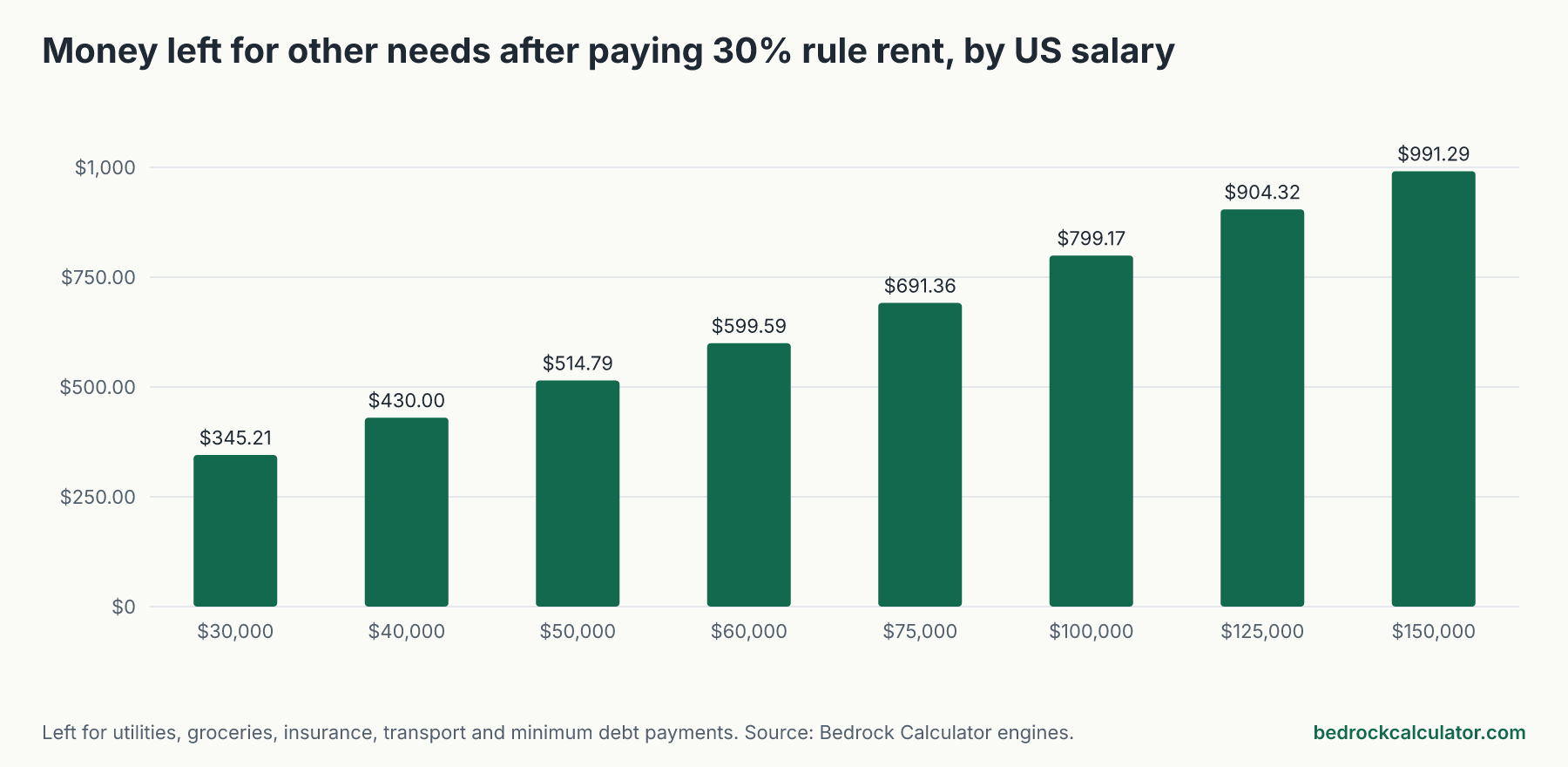
After paying the 30% rule rent, a $30,000 earner has $345.21 a month of the needs budget left for food, utilities, insurance, transport and any minimum debt payments. At $60,000 it's $599.59, and at $150,000 it's $991.29. For many people on lower pay, that remainder may not stretch to a car payment and a month of groceries, and then rent at the full 30% pushes the budget into the wants or savings buckets. If that describes you, the stricter 30% of take-home figure, $858.00 at $40,000, is the safer target.
Does your state change the answer?
For the 30% rule, no, because it's based on gross pay. For a 50/30/20 budget, yes, because state income tax comes out before the split. Here's $60,000 in five large states.
Rent on a $60,000 salary in five large US states
Download CSVSingle filer, biweekly, no deductions. The 30% rule rent is the same everywhere because it is based on gross pay.
| Texas | $4,199.17 | $1,500.00 | 35.7% | $2,099.59 | $599.59 |
| Florida | $4,199.17 | $1,500.00 | 35.7% | $2,099.59 | $599.59 |
| California | $4,017.16 | $1,500.00 | 37.3% | $2,008.58 | $508.58 |
| Illinois | $3,951.67 | $1,500.00 | 38.0% | $1,975.84 | $475.84 |
| New York | $3,942.92 | $1,500.00 | 38.0% | $1,971.46 | $471.46 |
The needs budget is $2,099.59 a month in Texas and Florida, $2,008.58 in California, $1,975.84 in Illinois and $1,971.46 in New York. The gap between the highest and lowest is $128.13 a month. Note that the paycheck calculator applies each state's tax schedule to wages without state deductions or credits, so the state figures slightly overstate tax in states that offer them. For the state-by-state picture of pay after tax, see take-home pay by state.
Which rule should you use?
Use the 30% rule as a ceiling, not a target. If your rent is at or under it and you can still put money aside each month, you're in good shape. Use the 50/30/20 budget to check the rest of your spending fits.
If rent alone uses most of your needs budget, something else has to give, and it's better to know that before you sign a lease.
If you're weighing renting against buying, our rent vs buy break-even analysis shows how many years it takes for buying to come out ahead, and the emergency fund guide shows how much to keep in reserve once rent is set.
Run your own numbers
Get your real take-home pay from the paycheck calculator, including your state, 401(k) and health insurance. Then enter it in the 50/30/20 budget calculator with your actual spending to see where you land. Texans can use the Texas paycheck calculator, and if you're thinking about buying instead, the rent vs buy calculator runs the comparison with your own rent and home price.