How much will Social Security go up in 2027?
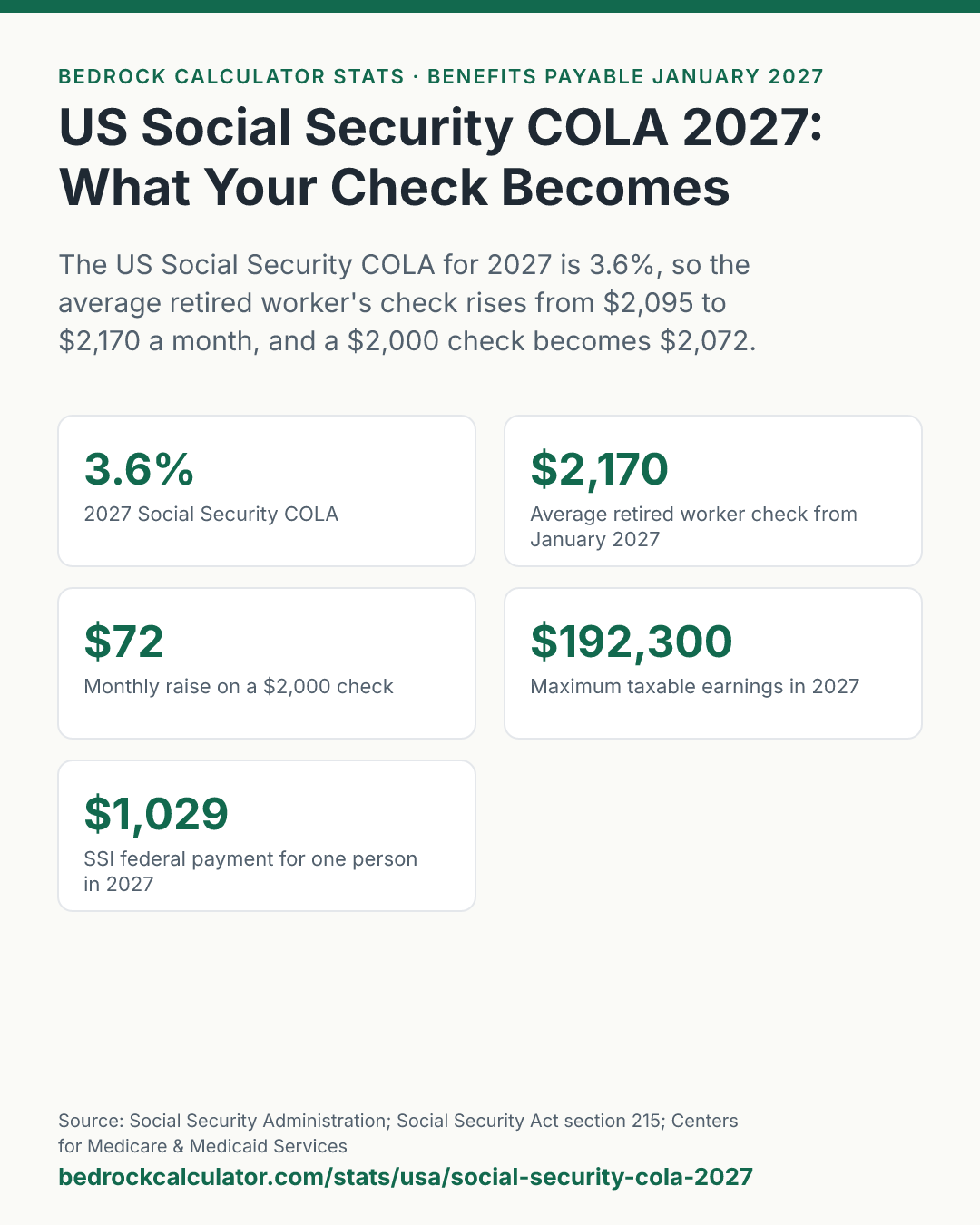
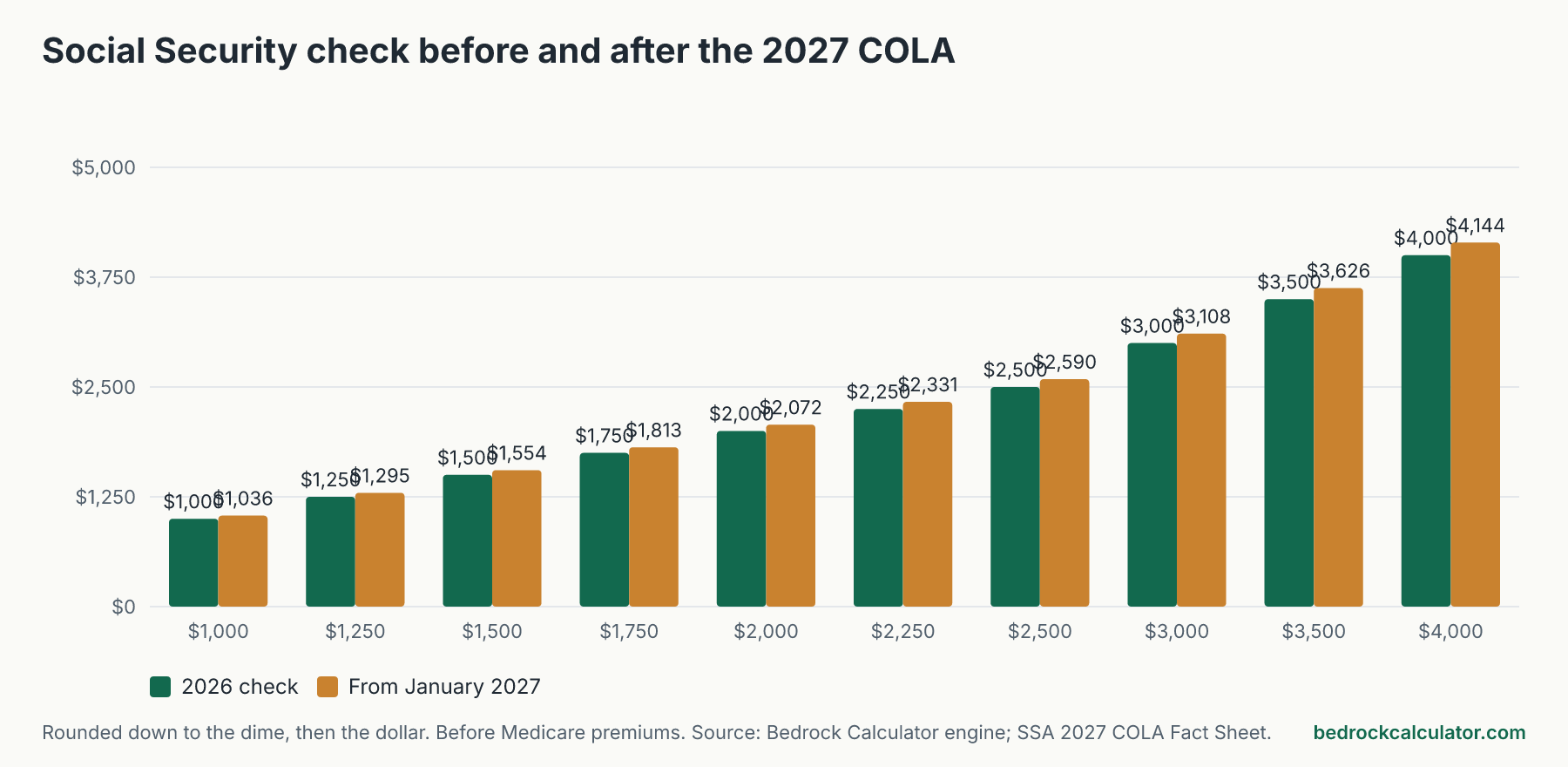
US Social Security checks rise 3.6% in January 2027. For the average retired worker that's $75 more a month, taking the check from $2,095 to $2,170. A $2,000 check becomes $2,072, and a $3,000 check becomes $3,108, before any Medicare premium comes out.
Social Security announced the 2027 cost-of-living adjustment (COLA) on 14 October 2026. It's based on how much the Consumer Price Index for Urban Wage Earners and Clerical Workers (CPI-W) rose from the third quarter of 2025 to the third quarter of 2026. Below we work out what that does to checks of different sizes, show Social Security's own new averages, and list the other figures that change on 1 January.
What your check becomes, from $1,000 to $4,000
The COLA isn't a flat amount. It's a percentage of what you already get, so bigger checks get bigger raises. Social Security also rounds in your disfavor twice: the raised amount is cut down to the next lower dime, and the payment itself is cut down to the whole dollar. That's why a raise can come out a dollar short of a simple 3.6%.
What a US Social Security check becomes with the 2027 COLA
Download CSV3.6% applied to the monthly check, rounded down to the dime and then to the whole dollar as Social Security pays it. Before any Medicare premium.
| $1,000 | $1,036 | $36 | $432 |
| $1,250 | $1,295 | $45 | $540 |
| $1,500 | $1,554 | $54 | $648 |
| $1,750 | $1,813 | $63 | $756 |
| $2,000 | $2,072 | $72 | $864 |
| $2,250 | $2,331 | $81 | $972 |
| $2,500 | $2,590 | $90 | $1,080 |
| $3,000 | $3,108 | $108 | $1,296 |
| $3,500 | $3,626 | $126 | $1,512 |
| $4,000 | $4,144 | $144 | $1,728 |
A few rows worth reading closely:
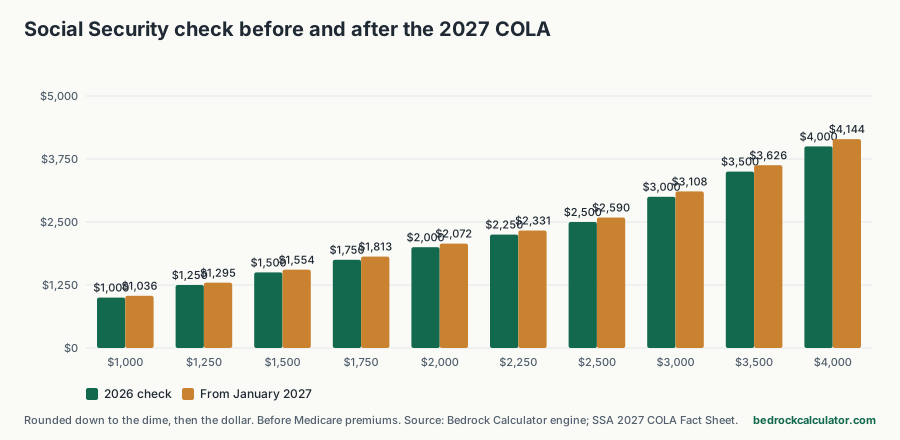
- A $1,000 check becomes $1,036, a raise of $36 a month.
- A $2,000 check becomes $2,072. That's $72 a month, or $864 over the whole of 2027.
- A $4,000 check, close to the most anyone gets at full retirement age, becomes $4,144. The raise is $144 a month and $1,728 over the year.
If your check isn't in the table, multiply it by 1 plus the COLA and drop the cents. You'll land within a dollar of what Social Security sends, because it applies the COLA to your unrounded benefit rather than to the rounded check you see.
What's the average Social Security check in 2027?
Social Security publishes its own estimates of the average benefit before and after the COLA. These are its figures, shown as printed:
Average Social Security benefits before and after the 2027 COLA
Download CSVSocial Security's estimated averages payable in January 2027, as printed in its 2027 COLA fact sheet.
| Widowed mother and two children | $3,932 | $4,074 | $142 | $1,704 |
| Aged couple, both receiving benefits | $3,238 | $3,355 | $117 | $1,404 |
| Disabled worker, spouse and one or more children | $2,970 | $3,077 | $107 | $1,284 |
| All retired workers | $2,095 | $2,170 | $75 | $900 |
| Aged widow(er) alone | $1,936 | $2,005 | $69 | $828 |
| All disabled workers | $1,642 | $1,701 | $59 | $708 |
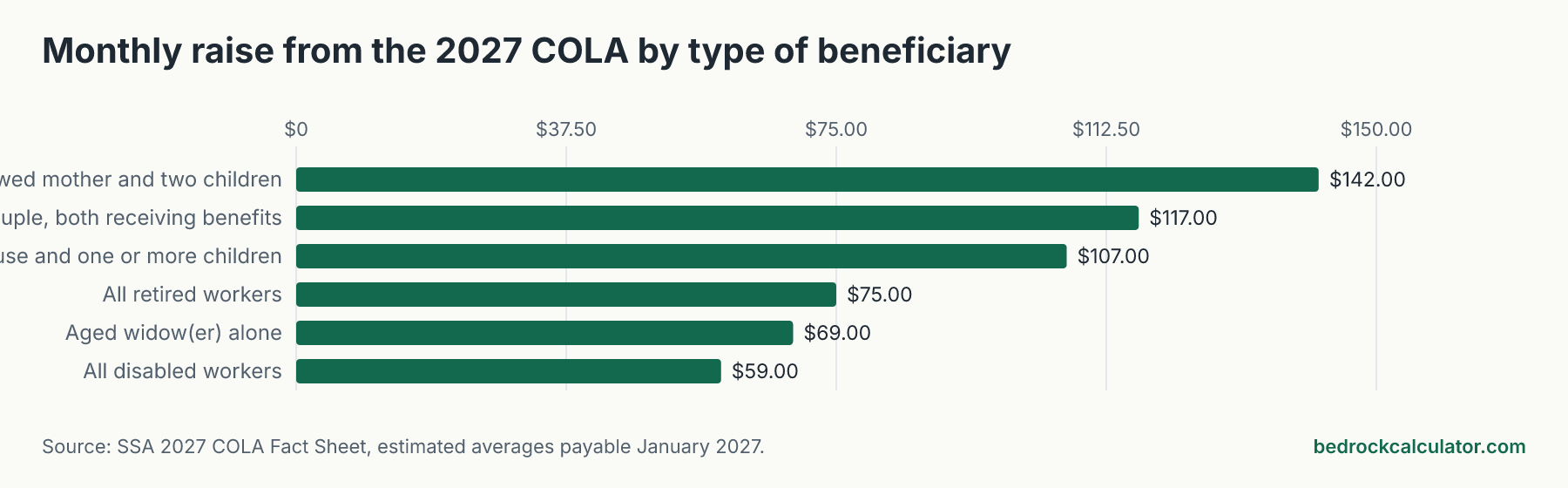
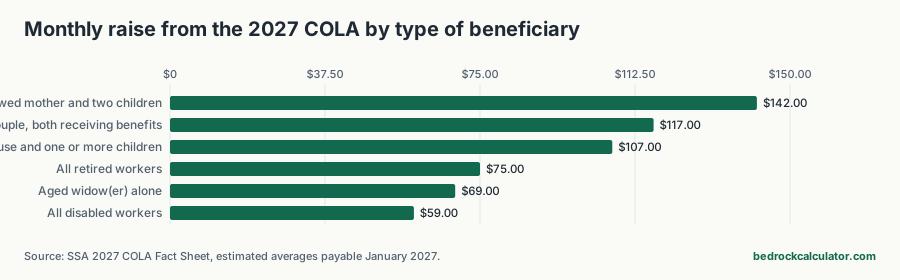
The average retired worker goes from $2,095 to $2,170. An aged couple who both collect benefits go from $3,238 to $3,355, a raise of $117 a month. A widow or widower living alone gets $2,005, and the average disabled worker gets $1,701, up $59.
The raises line up with the size of the check. A widowed mother with two children, whose household gets $4,074 after the COLA, sees one of the largest dollar raises at $142 a month. A disabled worker on an average check sees one of the smallest. The percentage is the same for everyone.
When does the 2027 COLA start?
The raise applies to benefits for December 2026, which Social Security pays in January 2027. So your first bigger Social Security payment arrives in January, on your usual payment date.
SSI works differently. People on Supplemental Security Income get their higher payment starting with the one dated 31 December 2026. The federal SSI payment for one person rises from $994 to $1,029 a month, and for a couple from $1,491 to $1,544.
You can see your own new amount in your my Social Security account from late November. If you don't use the online account, Social Security mails the notice in December.
Will Medicare take part of the raise?
For most retirees on Medicare, yes, some of it. The Part B premium usually comes straight out of the Social Security check, so what lands in your bank account is the new check minus the new premium.
Medicare hasn't announced the 2027 Part B premium yet. It usually does in November. In 2026 the standard premium is $202.90 a month. If the 2027 premium goes up, your net raise will be smaller than the figures above, and if you pay a higher premium because of income-related surcharges, more of it could go. We'll update this page with net figures once the premium is out. Meanwhile, the Medicare Part B premium calculator shows what you pay on 2026 figures.
What else changes for Social Security in 2027?
The COLA gets the headlines, but several other figures move on 1 January too. Most of them rise with average wages rather than prices, so they don't move by exactly 3.6%.
Other Social Security figures that change in 2027
Download CSVFrom the 2026 and 2027 columns of Social Security's 2027 COLA fact sheet.
| Disability earnings limit, blind (monthly) | $2,830 | $2,950 | $120 | 4.2% |
| Disability earnings limit, non-blind (monthly) | $1,690 | $1,770 | $80 | 4.7% |
| Earnings for one work credit | $1,890 | $1,970 | $80 | 4.2% |
| Earnings test limit in the year you reach full retirement age | $65,160 | $67,920 | $2,760 | 4.2% |
| Earnings test limit under full retirement age (yearly) | $24,480 | $25,560 | $1,080 | 4.4% |
| Maximum benefit at full retirement age (monthly) | $4,152 | $4,188 | $36 | 0.9% |
| Maximum taxable earnings (yearly) | $184,500 | $192,300 | $7,800 | 4.2% |
| SSI federal payment, couple (monthly) | $1,491 | $1,544 | $53 | 3.5% |
| SSI federal payment, individual (monthly) | $994 | $1,029 | $35 | 3.5% |
The ones most people notice:
- The taxable maximum. Social Security tax applies to earnings up to $192,300 in 2027, up $7,800 from $184,500. A worker earning that much or more pays $11,922.60 in Social Security tax for the year, against $11,439.00 in 2026.
- The earnings limit if you claim early and keep working. It rises from $24,480 to $25,560 if you're under full retirement age all year, and from $65,160 to $67,920 in the year you reach it.
- The maximum benefit at full retirement age. It goes from $4,152 to $4,188 a month.
- Work credits. You earn one credit for each $1,970 of earnings in 2027, up to four a year, so $7,880 earns the full four.
- Disability earnings limits. Substantial gainful activity rises to $1,770 a month, or $2,950 if you're blind.
How the higher earnings limit helps people still working
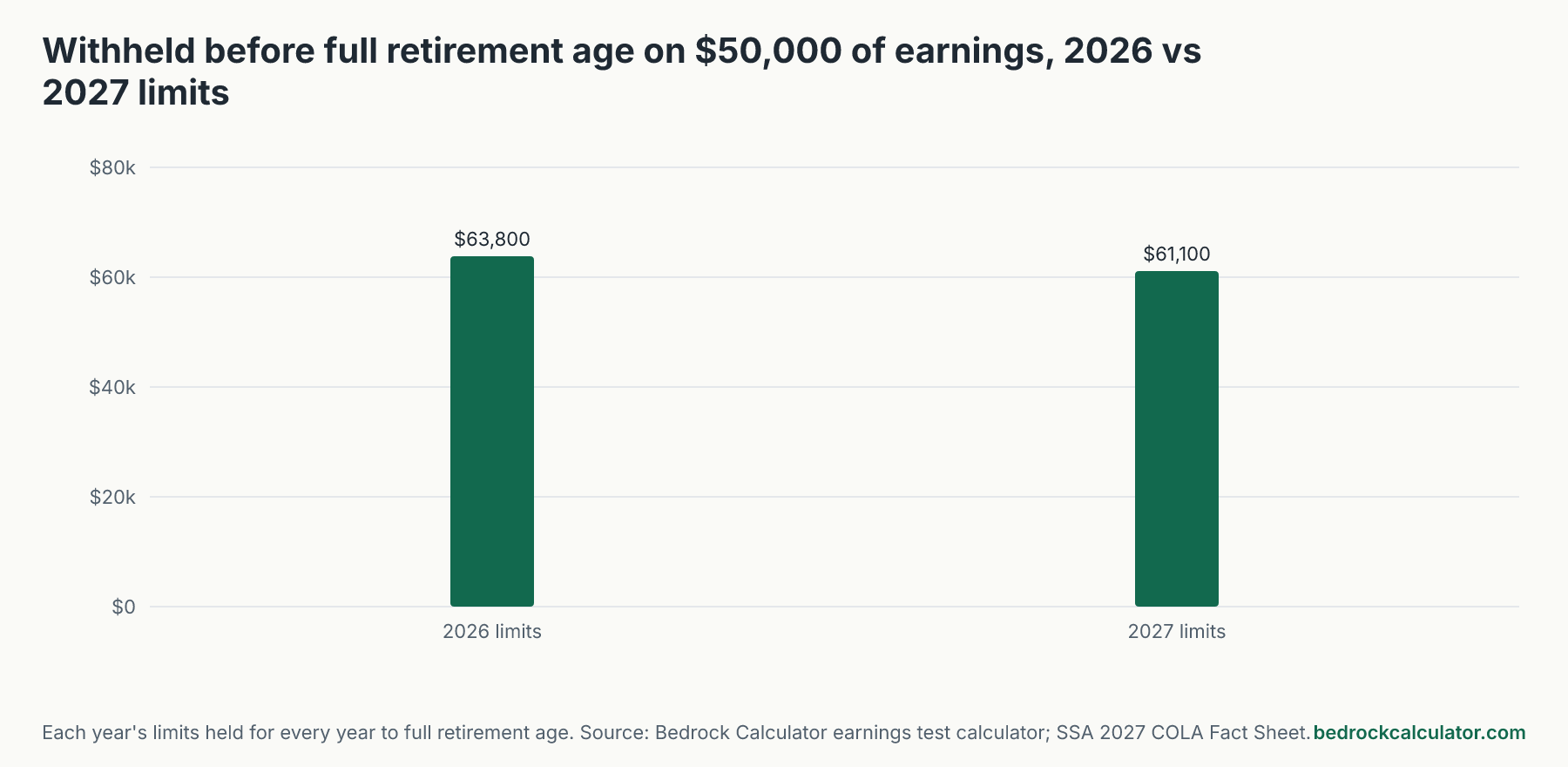
If you've claimed early and you're still working, the higher earnings limit means a little less is held back. We ran our Social Security earnings test calculator for a worker born in 1964 with a $2,400 full benefit who claims at 62 and keeps earning $50,000 a year until full retirement age.
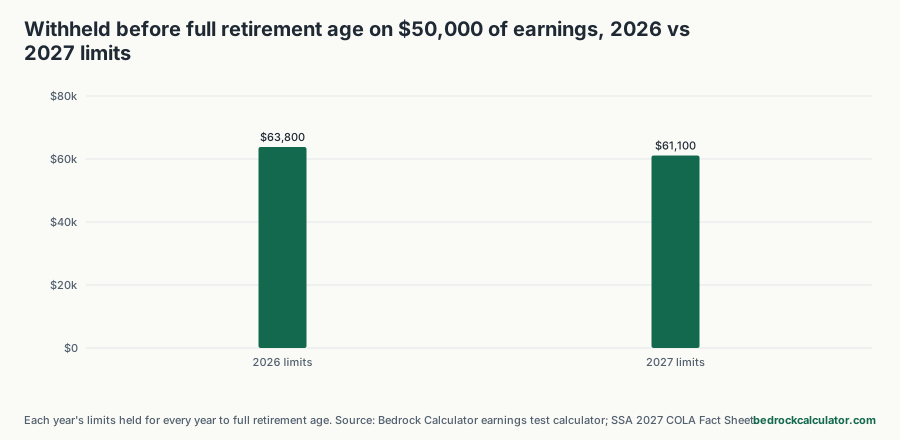
On 2026 limits the earnings test holds back $63,800 before full retirement age. On 2027 limits it holds back $61,100, which is $2,700 less. Either way the money isn't lost: once you reach full retirement age, your check is recalculated to make up for the months that were withheld. The calculator now has a Tax Year choice, so you can run your own numbers on either year's limits.
How we worked out these numbers
All figures come from Social Security's 2027 COLA fact sheet, which prints both the 2026 and 2027 values, held in our engine table for 2027.
- Check sizes apply the 3.6% COLA to the monthly check, round down to the dime and then to the dollar, as section 215 of the Social Security Act requires. Social Security applies the COLA to your unrounded benefit, so your real check can differ by a dollar.
- Averages are Social Security's own estimates for January 2027. We don't recompute them.
- No Medicare premium is taken off, because the 2027 Part B premium isn't announced yet.
- The earnings test comparison holds each year's limits for every year up to full retirement age and assumes steady earnings. Future limits haven't been set.
- Income tax on benefits isn't included. Part of your benefits can be taxable depending on your other income; the Social Security tax calculator works that out.
Run your own numbers
To see how the COLA changes the payoff from claiming at different ages, enter your benefit and a COLA in the Social Security breakeven calculator. To see how Social Security fits with your savings, use the retirement calculator.