How long does it take to save a down payment in the US?
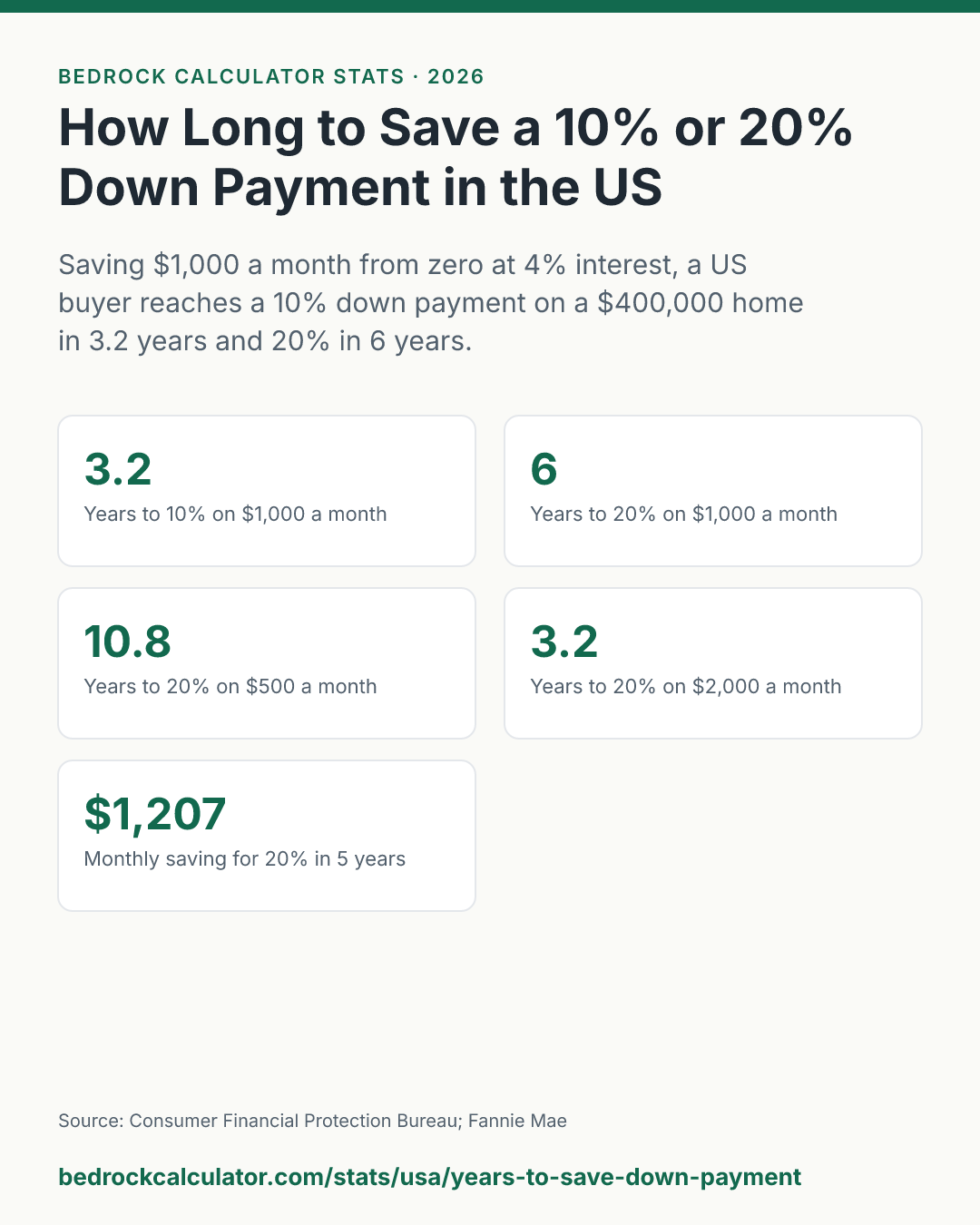
If you're starting from nothing and putting away $1,000 a month in an account earning 4%, it takes 3.2 years to save a 10% down payment on a $400,000 home, and 6 years to save 20%.
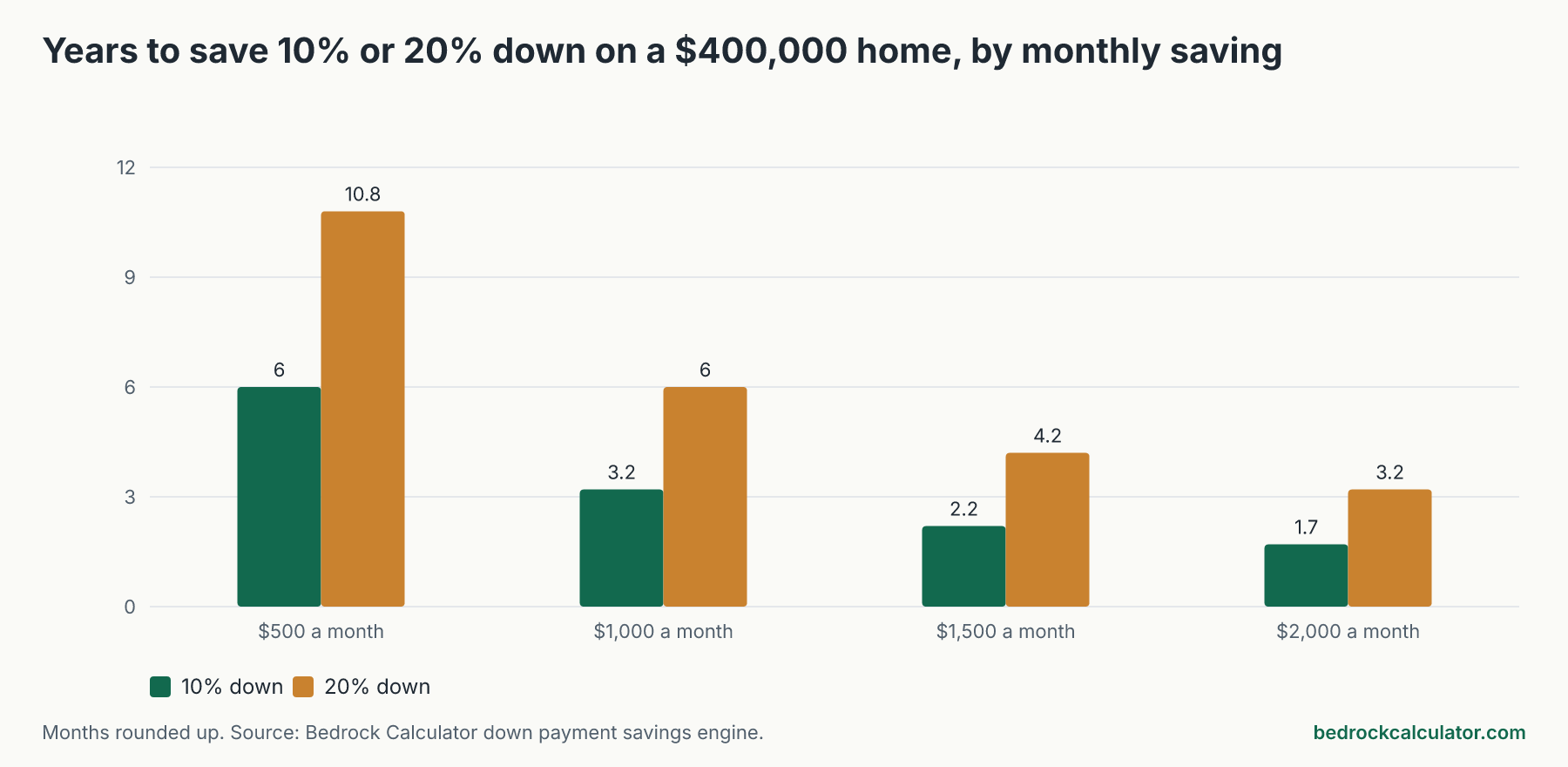
Double the monthly amount to $2,000 and those drop to 1.7 and 3.2 years. Halve it to $500 and 20% down is 10.8 years away. For most US first-time buyers, the down payment isn't a savings problem so much as a time problem, and the monthly amount is the only lever that really moves it.
Why 10% and 20%?
Twenty percent is the classic target because on a conventional loan it's the point where you no longer have to pay private mortgage insurance. On a $400,000 home, that's $80,000.
Ten percent, or $40,000 on the same home, is a common middle ground. You'll pay PMI, but you get into the house years earlier. Many conventional loan programs accept even less than that, and FHA loans go lower again, so neither number is a legal minimum. They're just the two goals most people plan around.
How we worked out these numbers
Every figure comes from the site's down payment savings calculator, run with the same setup each time:
- $400,000 target home price, so 10% is $40,000 and 20% is $80,000
- Starting savings of zero
- The same deposit every month, with no raises or missed months
- 4% a year of interest, added monthly. That's the calculator's default and roughly what a high-yield savings account pays at times, but it's an assumption. Rates on savings accounts change often.
- Months rounded up to whole months, then shown in years
For comparison, the last column of the first table runs the 20% goal again with no interest at all, the result you'd get keeping the money in a checking account.
How long it takes at each monthly amount
Years to save a down payment on a $400,000 home in the US, starting from zero
Download CSVFixed monthly deposit, 4% a year interest compounded monthly, months rounded up. The last column shows the 20% goal with no interest.
| $500 | 6 | 10.8 | 13.3 |
| $1,000 | 3.2 | 6 | 6.7 |
| $1,500 | 2.2 | 4.2 | 4.5 |
| $2,000 | 1.7 | 3.2 | 3.3 |
At $500 a month, 10% down takes 6 years and 20% takes 10.8. That's long enough that home prices could move a lot in the meantime. At $1,500 a month, 10% takes 2.2 years and 20% takes 4.2.
Notice that going from 10% to 20% doesn't quite double the time. The extra money you're saving for 20% sits in the account longer and earns more interest along the way, so the second half arrives a bit faster than the first.
How much the interest actually helps
On $500 a month toward $80,000, earning 4% instead of nothing gets you there 31 months sooner: 10.8 years instead of 13.3. That's real, and it's the reason not to leave a down payment fund in a checking account.
On $2,000 a month the interest only saves 2 months, 3.2 years instead of 3.3. The faster you save, the less time the money has to earn anything. So if you're short on time, the deposit matters far more than the rate.
How much to save each month for a down payment in 3 or 5 years
If you'd rather start from a date and work backwards, this table shows the monthly deposit needed to get there from zero, still at 4% interest.
Monthly saving needed to reach a down payment in 3 or 5 years
Download CSVStarting from zero, 4% a year interest compounded monthly.
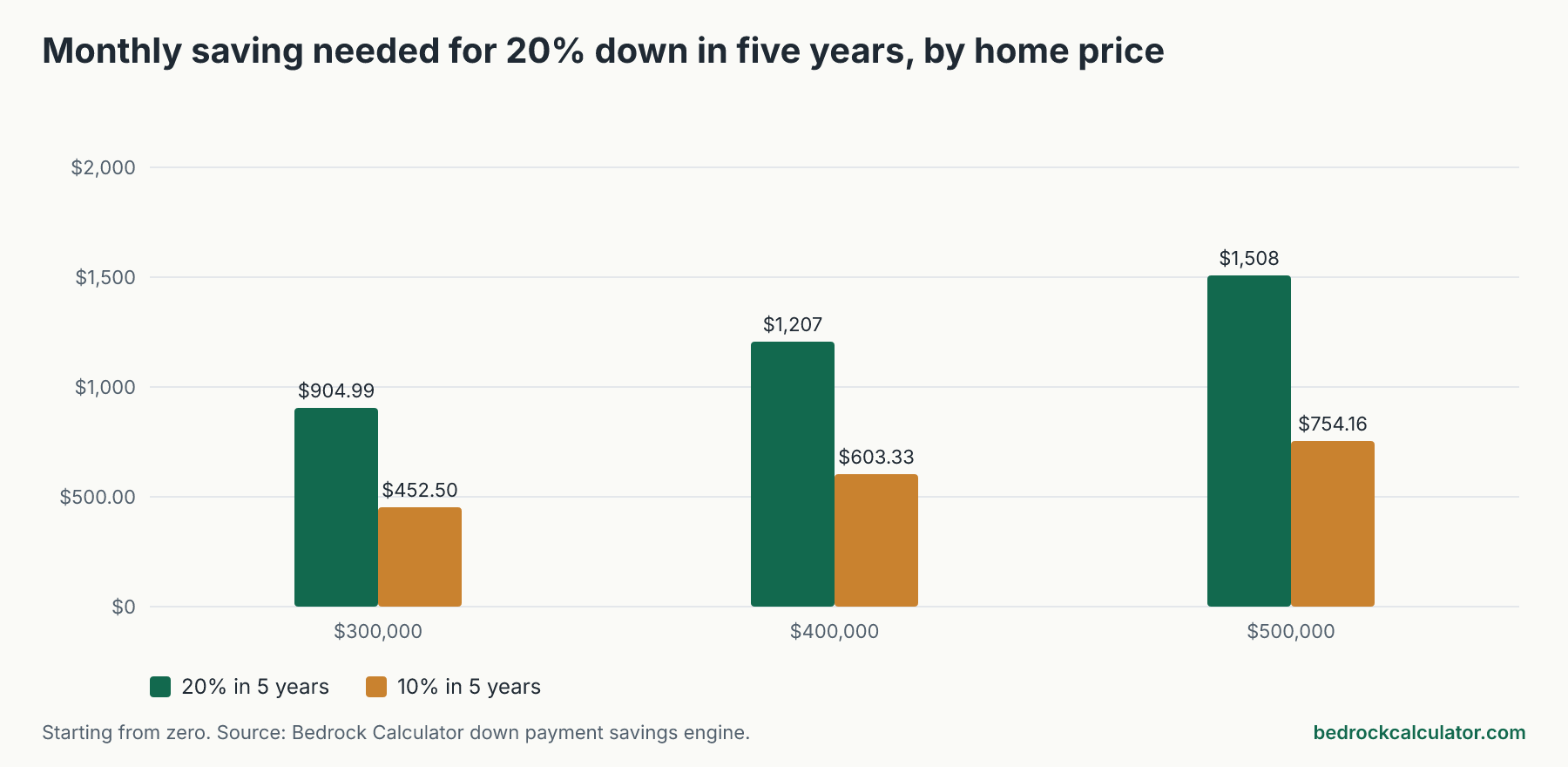
| $300,000 | $786 | $453 | $1,571 | $905 |
| $400,000 | $1,048 | $603 | $2,095 | $1,207 |
| $500,000 | $1,310 | $754 | $2,619 | $1,508 |
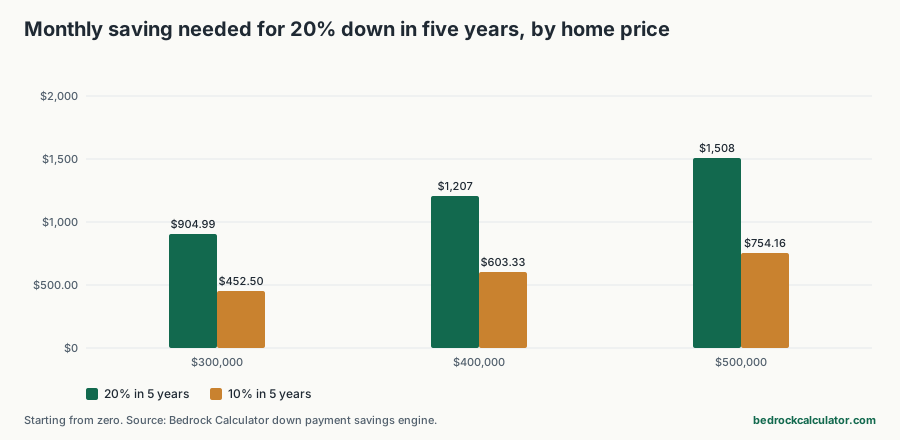
On a $400,000 home, getting 20% down in five years takes about $1,207 a month. Wanting it in three years pushes that to $2,095. Settling for 10% in five years cuts it to $603.
Home price matters in a straight line here. Each step up in price adds the same amount to the monthly deposit, because the goal is a fixed share of the price. For a $300,000 home, 20% in five years is $905 a month. For a $500,000 home it's $1,508.
What this leaves out
The calculator solves one clean equation, a fixed deposit growing at a fixed rate toward a fixed target. Real life is messier:
- Tax on the interest. Interest in a regular savings account is taxable income. The calculator doesn't subtract that, so the real growth is a little slower than shown.
- Home prices that move. The target stays fixed. If prices in your area climb while you save, the goal moves away from you, and the timelines here would be too short.
- Changing deposits. The calculator assumes you save the same amount every month. If your pay rises and you save more over time, you'll get there sooner.
- Help with the down payment. Gift money from family, first-time buyer assistance programs and employer programs aren't included, and they can cut years off the timeline.
- Closing costs. These come on top of the down payment, and you need cash for them at closing. Run the closing costs calculator alongside this one.
Getting your own timeline
Open the down payment savings calculator, enter the price you're aiming for, what you have saved already and what you can put away each month. It'll show either how long it takes or how much you need to save to hit a date.
Then check what you can actually borrow on your income with the house affordability calculator, or see how much house you can afford on four common salaries. If you're weighing a smaller down payment, what PMI costs at each down payment shows the trade-off, and the mortgage calculator gives the monthly payment at either level.