How much net salary does €50,000 leave in each European country?
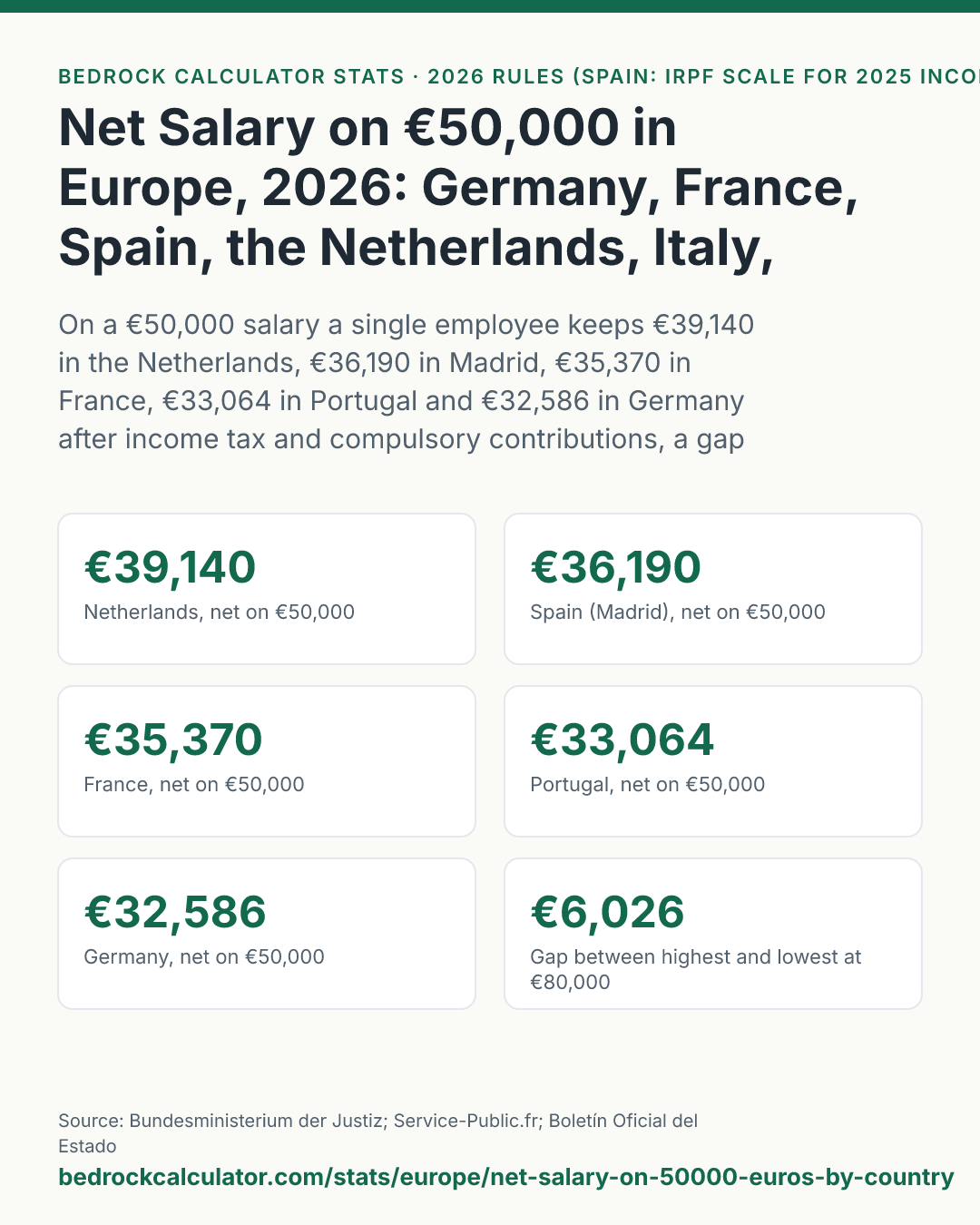
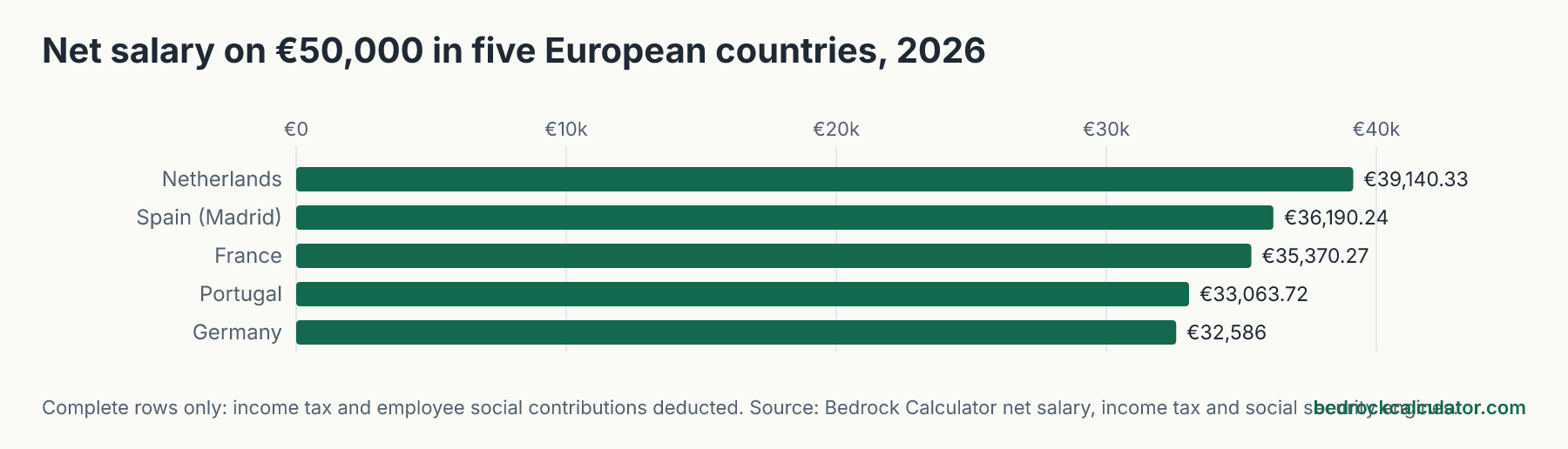
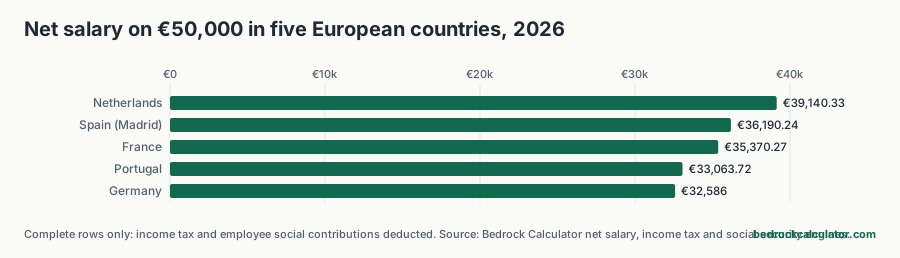
A €50,000 salary is worth noticeably different amounts across Europe once tax and social contributions come off. For a single employee with no children, it leaves €39,140 a year in the Netherlands, €36,190 in Madrid, €35,370 in France, €33,064 in Portugal and €32,586 in Germany. The difference between the top and the bottom is €6,554 a year.
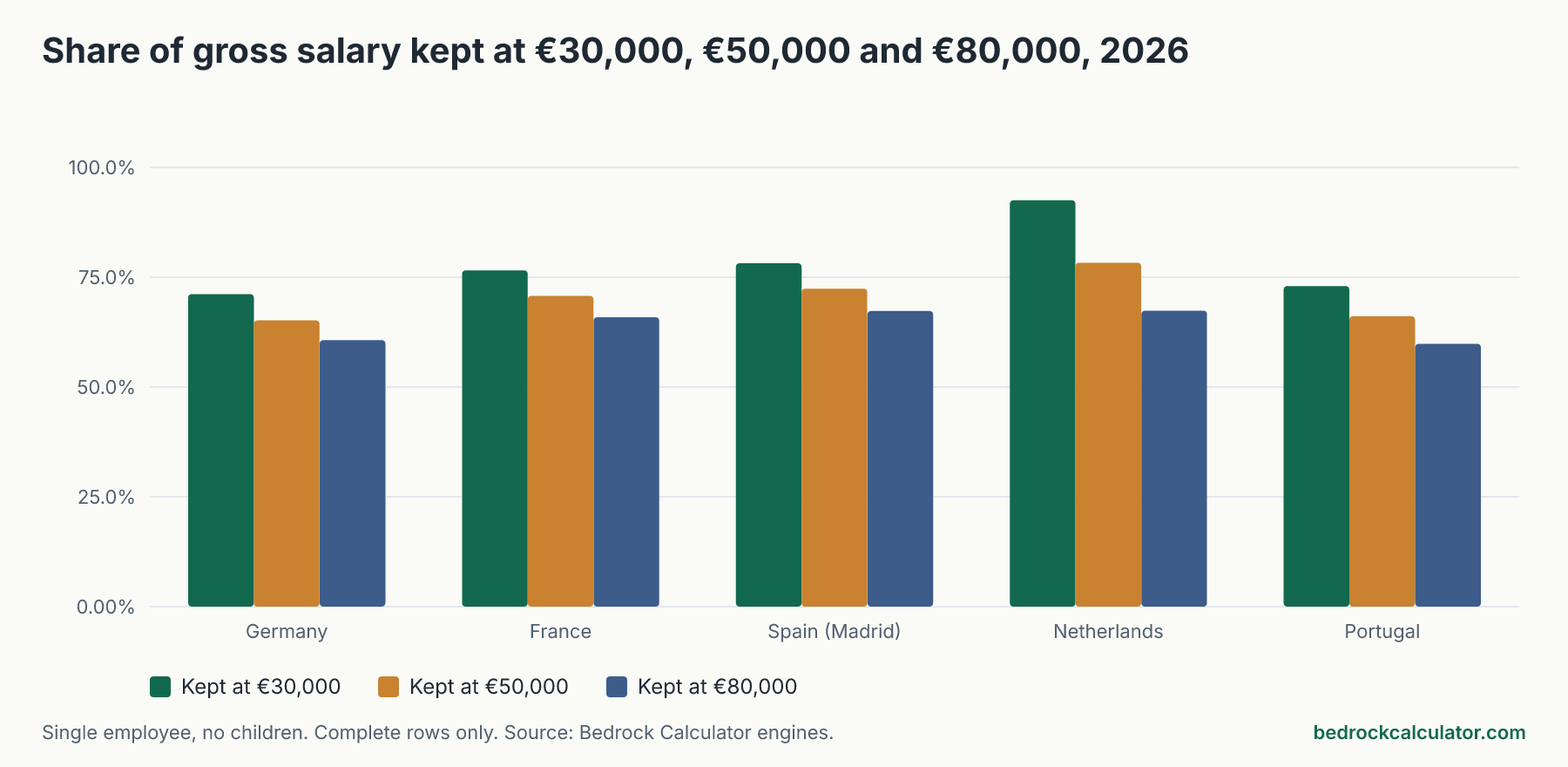
The Netherlands comes out on top at all three salaries we tested, although at €80,000 Spain finishes within a whisker of the Dutch figure. Germany is at the bottom on €30,000 and €50,000, with Portugal just above it. At €80,000 the two swap places: Portugal's 11% employee social security has no ceiling, and at €80,000 its income tax reaches the 44.6% bracket, which starts at €46,566 of taxable income.
How we worked out these numbers
Every figure comes from running this site's own calculators, so you can reproduce any of them. We used the same person everywhere: single, no children, a full year of salary from one employer, no pension top-ups, no company car and no church tax.
Each country needed a slightly different route:
- Germany: the Germany net salary calculator, set to North Rhine-Westphalia. It deducts income tax, the solidarity surcharge and the employee's share of pension, unemployment, health and long-term care insurance, including the care surcharge for people without children.
- France: two calculators chained the way a payslip works. The France social security calculator gives the employee's contributions for a non-cadre, CSG and CRDS included. We then add back the part of CSG that isn't deductible and the CRDS to get taxable salary, and run that through the France income tax calculator on one tax part, which applies the flat professional-expenses deduction and the scale.
- Spain: the Spain social security calculator for the employee's contributions on an indefinite contract, then the Spain income tax calculator on what's left, using Madrid's regional scale.
- Netherlands: the Netherlands income tax calculator. Box 1 tax there already includes the national insurance premiums, after the general tax credit and the labour tax credit.
- Portugal: the Portugal income tax calculator, which deducts IRS and the employee's 11% social security contribution. The specific deduction against salary is the larger of €4,587.09 and that contribution.
One country we couldn't compare in full. The Italy calculator works out IRPEF after INPS contributions and the employee tax credits, but it leaves out the regional and municipal surtaxes, so its net figure is too high. It appears in the table marked partial, and it isn't ranked or charted.
Every country, side by side
Sort by any column. The last column says exactly what each calculator takes off.
Net salary on €30,000, €50,000 and €80,000 in six European countries, 2026
Download CSVSingle employee, no children, euros a year. Complete rows deduct income tax and the employee's compulsory contributions. Partial rows leave out something compulsory (see the last column) and are not ranked. Spain uses the IRPF scale for 2025 income, the latest the calculator models.
| Netherlands | €27,754.13 | €39,140.33 | €53,912.89 | 78.3% | Complete | Box 1 income tax including national insurance premiums, after the general and labour tax credits |
| Spain (Madrid) | €23,451.98 | €36,190.24 | €53,852.58 | 72.4% | Complete | Employee social security, then state and Madrid IRPF |
| France | €22,960.47 | €35,370.27 | €52,705.48 | 70.7% | Complete | Employee social contributions including CSG and CRDS, then income tax on one part, after the décote |
| Italy | €24,021.37 | €33,620.16 | €49,073.84 | 67.2% | Partial | INPS at 9.19%, then IRPEF after the employee tax credits. No regional or municipal surtax |
| Portugal | €21,889.34 | €33,063.72 | €47,886.51 | 66.1% | Complete | IRS income tax and the 11% employee social security contribution |
| Germany | €21,350 | €32,586 | €48,543.87 | 65.2% | Complete | Income tax, solidarity surcharge, pension, unemployment, health and care insurance (NRW, no church tax) |
Why Germany ends up at the bottom
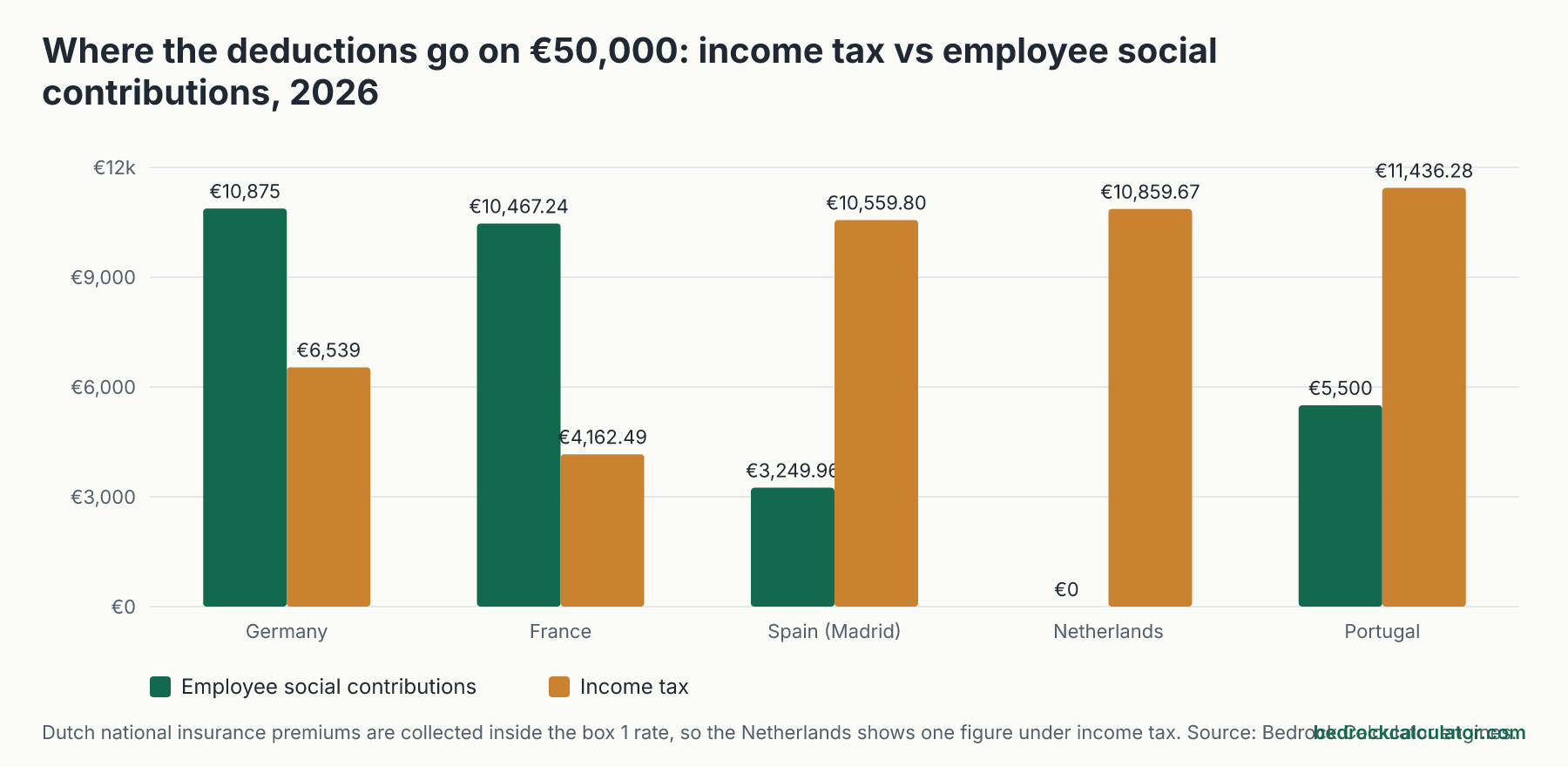
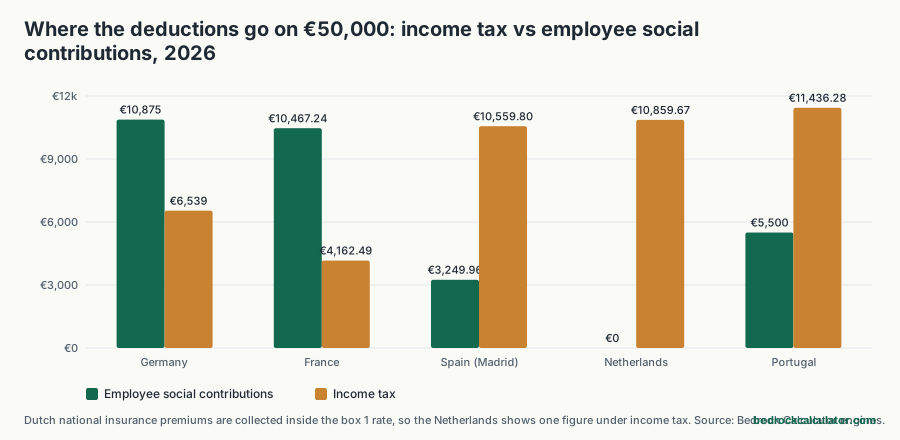
It isn't mainly income tax. On €50,000 a German employee pays €10,875 in social insurance before income tax even starts, and €6,539 in income tax and solidarity surcharge. Social insurance is the bigger of the two at that salary. Health insurance alone is a sizeable slice because the employee pays half of the general rate plus half of the average extra contribution.
France looks similar on the contributions side. A French employee on €50,000 pays €10,467 in social contributions, but only €4,162 in income tax, so France still ends up ahead of Germany.
Spain is the reverse. Employee social security on €50,000 is only €3,250, while Madrid IRPF takes €10,560. By €80,000 the Spanish tax bill is €22,130 against €4,017 in social security, because Spain caps the salary it charges contributions on.
The Netherlands bundles everything into one box 1 charge of €10,860 on €50,000. Dutch employers pay the income-related health insurance contribution, which is part of why the employee keeps more. Bear in mind that Dutch residents still buy compulsory basic health insurance privately, and that premium isn't a payroll deduction, so it's not in these figures.
How the share you keep changes with salary
Everywhere, you keep a smaller share as pay rises. In Germany the share falls from 71.2% at €30,000 to 60.7% at €80,000. In the Netherlands it drops from 92.5% to 67.4%, a steeper fall, because generous tax credits at lower incomes taper away as income grows. Spain moves from 78.2% to 67.3% and France from 76.5% to 65.9%.
The gap between the highest and lowest country is €6,404 at €30,000, €6,554 at €50,000 and €6,026 at €80,000.
At the lower end the French figure includes the décote, a reduction for people whose tax bill is small. At €30,000 it is worth €372. At €50,000 and above the tax is too high for the décote to apply.
What about Poland?
Poland pays in złoty, and this site has no exchange-rate table, so we haven't converted anything. Instead the second table shows an employment contract at three złoty salaries: PLN 100,000 leaves PLN 72,129 (72.1% of gross), PLN 150,000 leaves PLN 104,927, and PLN 250,000 leaves PLN 155,838 (62.3%).
Poland: net salary on an employment contract, in złoty, 2026
Download CSVUmowa o pracę, standard deductible costs, no under-26 relief. Amounts in Polish złoty (PLN), not converted to euros because the site has no exchange-rate table. Deducts ZUS social insurance, the 9% health contribution and PIT.
| 100,000 | 13,710 | 7,766.1 | 6,394.8 | 72,129.1 | 72.1% |
| 150,000 | 20,565 | 11,649.15 | 12,859.2 | 104,926.65 | 70.0% |
| 250,000 | 34,275 | 19,415.25 | 40,472 | 155,837.75 | 62.3% |
Those figures deduct ZUS pension, disability and sickness insurance, the health contribution and PIT, so they're complete in the same sense as the euro rows. Workers under 26 can pay much less PIT, which we cover in our article on Poland net salary and the under-26 relief.
What these numbers leave out
These are annual tax and contribution figures, not monthly payslips. Real payroll withholding is spread differently, and some countries pay salary in 13 or 14 instalments. Beyond that, each calculator has its own limits:
- Germany: no church tax, no company pension or other salary sacrifice, and statutory health insurance only.
- France: no tax credits, and no mutuelle or prévoyance, which most employees pay through their employer's scheme.
- Spain: only Madrid's regional scale, the IRPF scale for 2025 income (the latest the calculator has), no child or regional deductions, and no extra reduction for low earners.
- Netherlands: no expat tax ruling (the dertigprocentregeling), no mortgage interest deduction and no benefits such as zorgtoeslag. Many Dutch employees also pay into a sector pension fund under their collective agreement, and that contribution isn't deducted here.
- Italy: no regional or municipal surtax, as described above.
- Portugal: the general 11% social security rate, no dependants or other IRS deductions, and mainland rates only.
- Poland: standard deductible costs only, no PPK, and the full-year figure rather than month-by-month withholding.
Getting your own figure
Each calculator lets you change the details we fixed here. Try the Germany net salary calculator with your own Land and church status, or the Poland net salary calculator for a contract of mandate or self-employment. If you're comparing countries for a move, run your actual offer through each one, then add the costs these figures can't see, such as Dutch health insurance premiums and local rent.