What does $4,000 a year in an HSA become by 65?
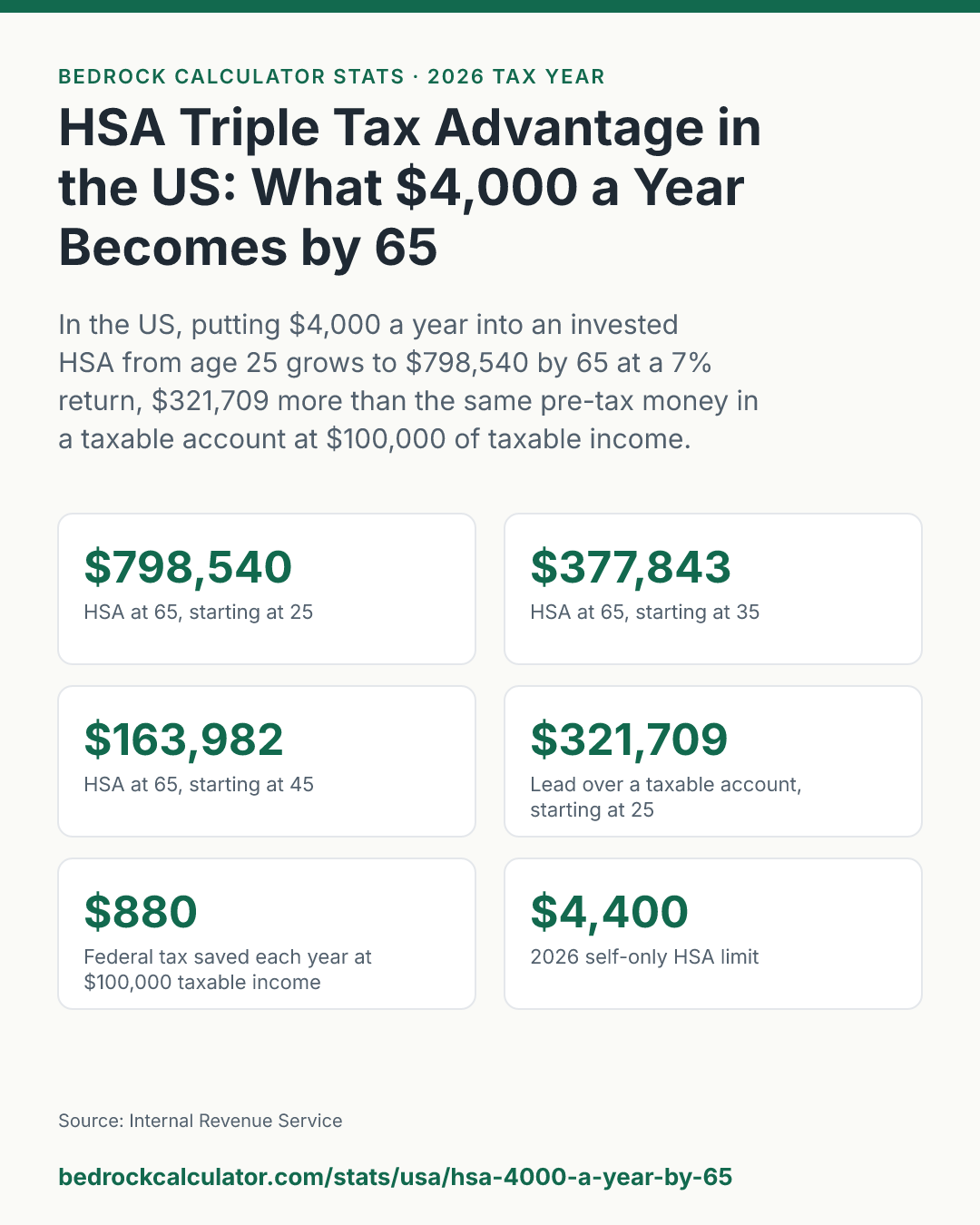
If you put $4,000 a year into a US health savings account, invest it, and leave it alone, it grows to $798,540 by 65 when you start at 25, assuming a 7% yearly return. Start at 35 and you get $377,843. Start at 45 and it's $163,982.
The same pre-tax money run through a regular taxable brokerage account ends well behind. For a single filer with $100,000 of taxable income who starts at 25, the HSA finishes $321,709 ahead. That gap is the HSA triple tax advantage, worked out in dollars.
What the triple tax advantage actually means
Most accounts give you one tax break. A 401(k) lets you skip tax going in. A Roth IRA lets you skip tax coming out. An HSA gives you three:
- The money you put in comes off your taxable income, so you pay less federal income tax this year.
- Whatever the account earns while invested is never taxed along the way.
- When you take it out for qualified medical costs, you pay nothing on it.
On $100,000 of taxable income, a single filer sits in the bracket where $4,000 going into the HSA saves $880 of federal income tax in the year it goes in. That's the first break. The other two show up slowly, and they're where most of the money is.
For 2026 the IRS lets you put in up to $4,400 with self-only coverage or $8,750 with family coverage, plus a $1,000 catch-up once you turn 55. A $4,000 contribution sits under the self-only cap, so nothing in these numbers gets cut off by the limit.
How we worked out these numbers
Every figure here comes from running the site's HSA investment calculator with one fixed set of inputs, changing only the starting age or the income:
- Self-only high-deductible health plan coverage, single filer
- $4,000 contributed every year until 65, invested, never withdrawn early
- A 7% annual return, applied each year before that year's contribution is added
- 2026 federal income tax brackets and long-term capital gains thresholds
The 7% figure is an assumption, not a forecast. It's the calculator's default and a common planning number for a stock-heavy portfolio over decades. Real returns move around a lot from year to year, and a lower average would shrink every balance on this page.
The taxable account is the calculator's own comparison. It starts with the same pre-tax dollars, takes out federal income tax at your marginal rate, and invests what's left. Each year, the growth in that account is taxed at your long-term capital gains rate. At $100,000 of taxable income that means the HSA invests the full $4,000, while the taxable account invests what's left after the $880 of tax.
There's one thing we did differently from the calculator's results screen. The calculator also shows a "total triple tax advantage" figure that adds the upfront tax savings on top of the gap between the two balances. Because the taxable account already started with less money for exactly that reason, adding the savings again counts them twice. So the "HSA ahead by" figures here are the plain difference between the two balances at 65.
What $4,000 a year becomes, by the age you start
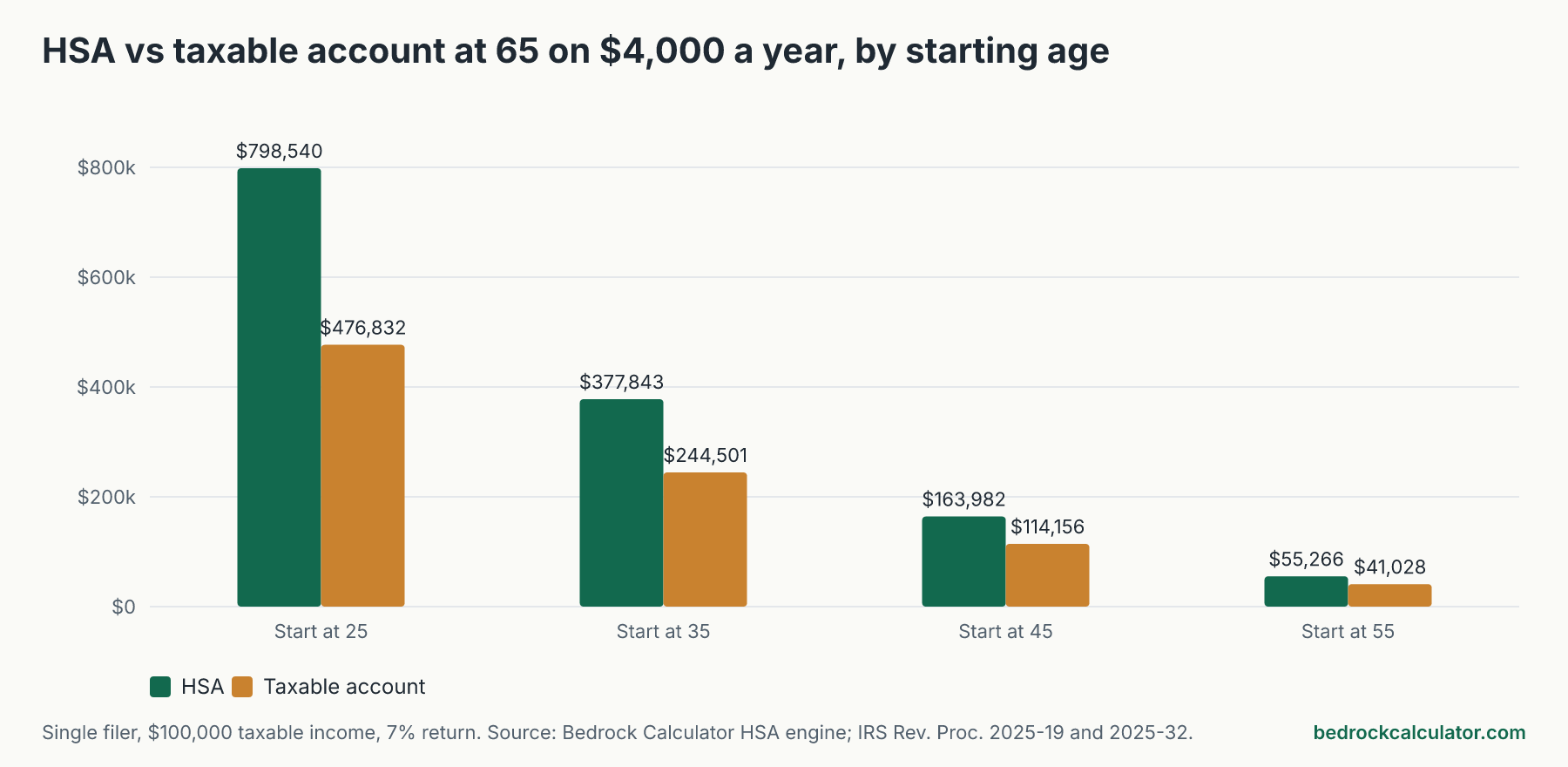
A $4,000 yearly HSA contribution at 65, by the age you start (US, 2026 rules)
Download CSVSelf-only coverage, single filer, 7% annual return, money invested and never withdrawn before 65. Taxable account: same pre-tax dollars after federal tax at $100,000 taxable income, return taxed yearly at the long-term capital gains rate.
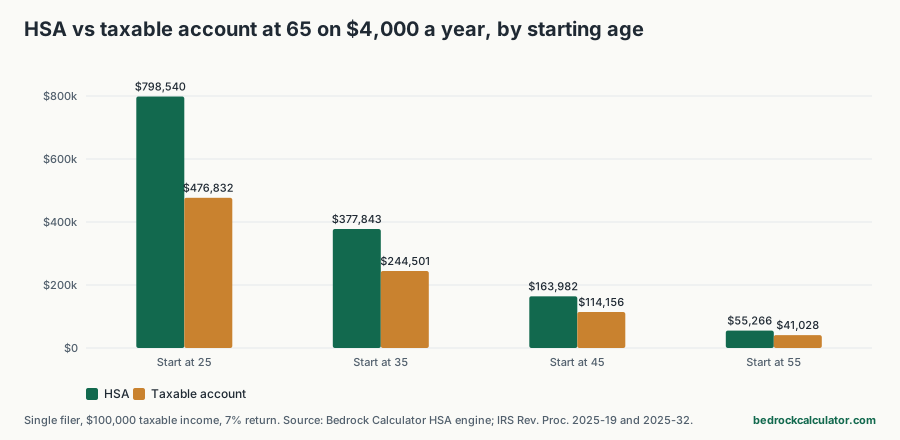
| 25 | 40 | $160,000 | $798,540 | $638,540 | $476,832 | $321,709 |
| 35 | 30 | $120,000 | $377,843 | $257,843 | $244,501 | $133,342 |
| 45 | 20 | $80,000 | $163,982 | $83,982 | $114,156 | $49,826 |
| 55 | 10 | $40,000 | $55,266 | $15,266 | $41,028 | $14,238 |
The pattern is the usual one with compounding, just stronger, because nothing leaks out to tax. Starting at 25 means $160,000 goes in over the years, and growth adds $638,540 on top. Growth makes up 80.0% of the final balance.
Start at 55 and you put in $40,000, and growth adds only $15,266. The account still beats the taxable route, by $14,238, but most of what you have at 65 is money you put in yourself.
The ten years between 25 and 35 are worth $420,697 on their own. That's not because the 25-year-old saves much more. It's because those early dollars get forty years to grow instead of thirty.
Does your tax bracket change the answer?
Yes, but less than you might guess. A higher bracket makes the upfront deduction worth more, so the taxable account starts each year with less money. At higher incomes still, the capital gains rate the taxable account pays every year also rises. Both widen the gap.
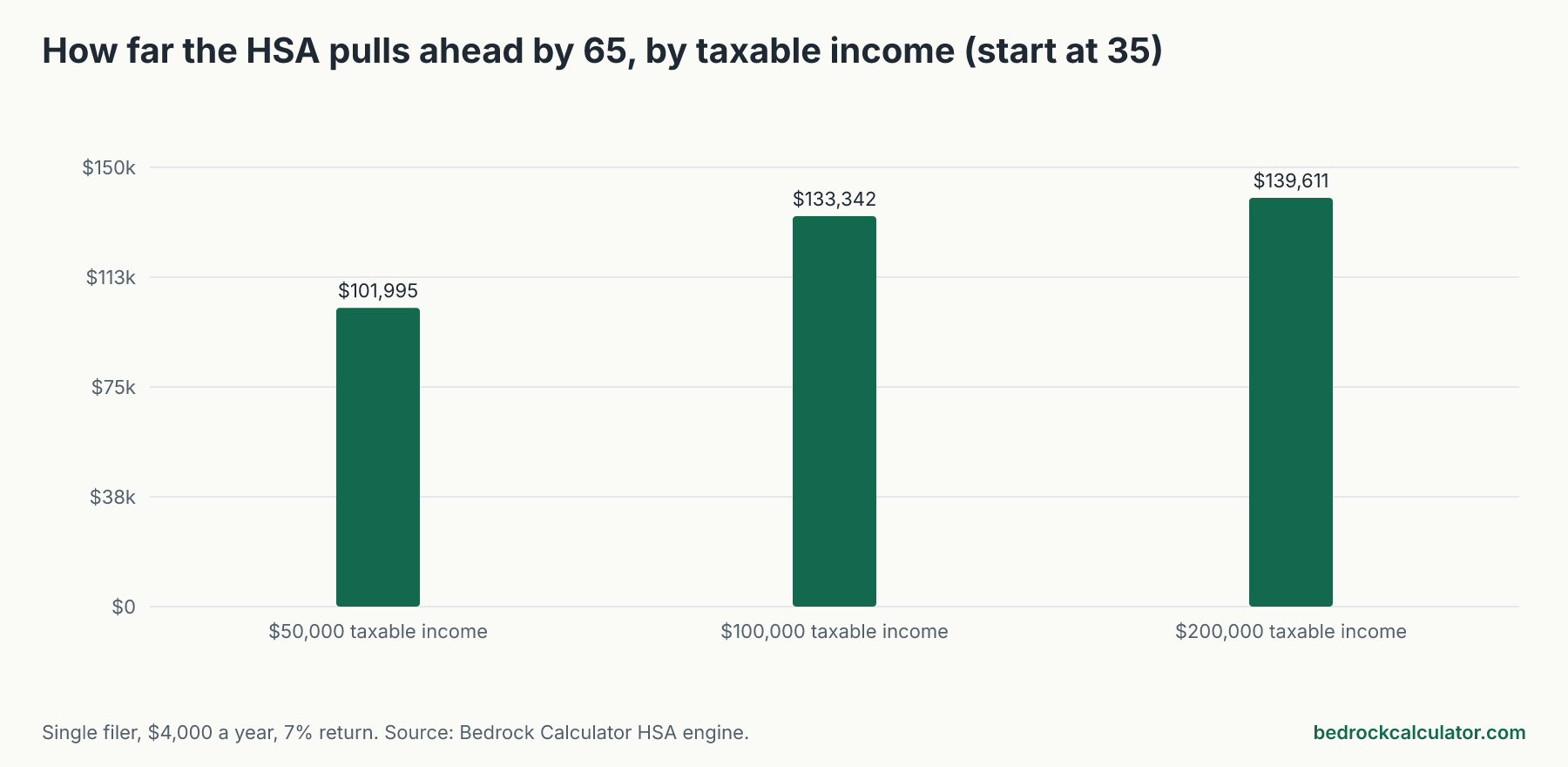
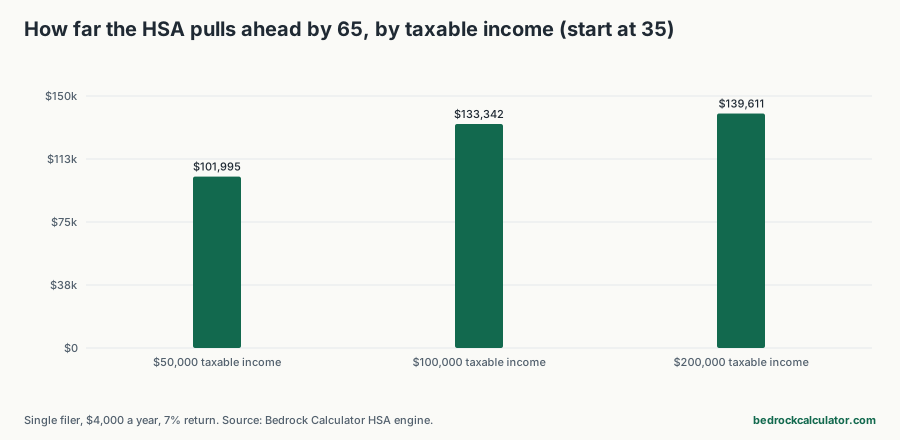
How your tax bracket changes the HSA edge (start at 35, single filer)
Download CSVFederal income tax only. Taxable income is income after deductions. 30 years at 7%.
| $50,000 | $480 | $377,843 | $275,848 | $101,995 |
| $100,000 | $880 | $377,843 | $244,501 | $133,342 |
| $200,000 | $960 | $377,843 | $238,232 | $139,611 |
For someone starting at 35, the HSA ends $101,995 ahead at $50,000 of taxable income, $133,342 ahead at $100,000, and $139,611 ahead at $200,000. The yearly tax saving on the way in climbs from $480 to $880 to $960.
The HSA balance at 65 is the same in every row. That's the point: inside the account, your tax bracket doesn't touch the growth. Only the taxable account changes.
What this leaves out
These are federal-only, single-scenario numbers, and a few things would move your real result:
- What you spend it on. The tax-free withdrawal only applies to qualified medical costs. After 65 you can take money out for anything, but non-medical withdrawals are taxed as ordinary income, much like a traditional IRA. Before 65, non-medical withdrawals also carry a penalty. These balances assume the money goes to medical bills, which is realistic for many retirees, since health costs tend to rise with age.
- State income tax. The calculator models federal tax only. California and New Jersey don't give HSAs the same treatment as the IRS, so residents there would see a smaller edge.
- Payroll tax. If your HSA contributions go through your employer's payroll, they usually skip Social Security and Medicare tax too. The calculator doesn't count that, so for payroll contributions the real edge is a bit bigger than shown.
- Fees. Many HSA providers charge account or investment fees, and some only let you invest above a minimum cash balance. None of that is modeled.
- A simplified taxable account. Real brokerage accounts don't realize all their gains every year. Some of the return is unrealized and only taxed when you sell, which makes the taxable account look a little worse here than it often is in practice.
- Your age as you go. The calculator doesn't add the age-55 catch-up as you get older. It only matters if you contribute more than the self-only limit, which these scenarios don't.
Making your HSA work like a retirement account
The big balances on this page only happen if the HSA is invested. Plenty of people leave theirs in the default cash option, where it earns close to nothing. If you can cover today's medical bills out of pocket and keep the receipts, you can let the account grow and pay yourself back years later.
To see your own number, open the HSA investment calculator and enter your coverage, income, contribution and expected return. If you're deciding where your next retirement dollar should go, compare it with the 401(k) calculator and the Roth IRA calculator. For how starting age plays out in a 401(k), see 401(k) balance at 65 by starting age, and for this year's account caps in one place, see US retirement contribution limits for 2026.