How much does long-term care cost, and how long will savings last?
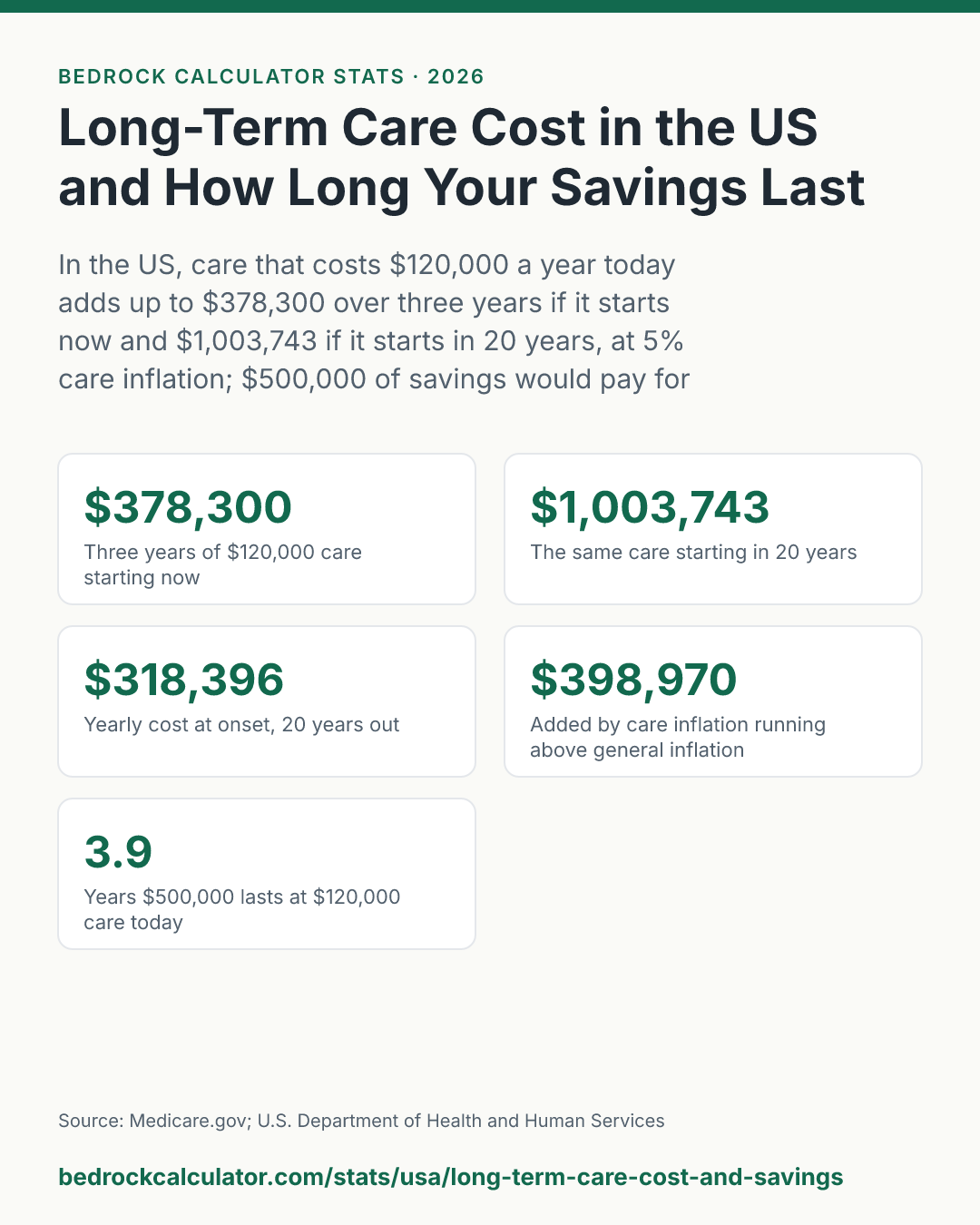
Long-term care in the US gets expensive fast, and it gets more expensive the further away it is. Care that costs $120,000 a year today adds up to $378,300 over three years if you needed it now. If the same care starts in 20 years and its price rises 5% a year, three years of it comes to $1,003,743.
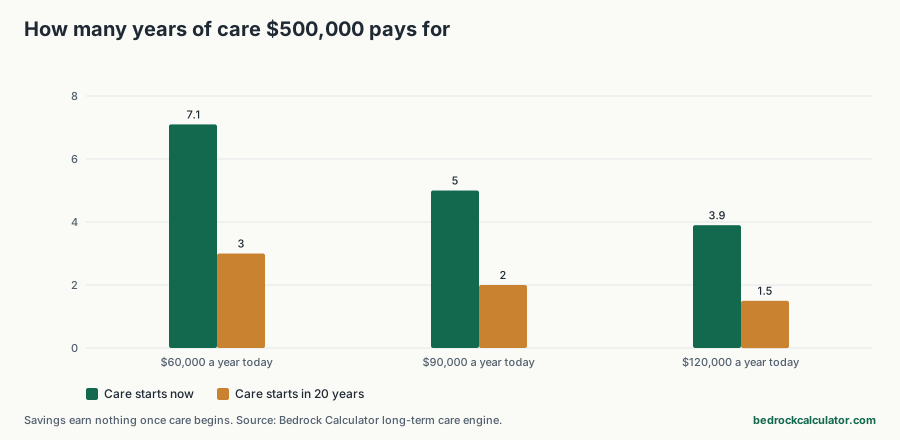
That's why savings that look plenty today can run out quickly. $500,000 pays for about 3.9 years of that care if it starts now, but only 1.5 years if it starts 20 years from now.
How we worked out these numbers
Every figure comes from the site's long-term care cost calculator. The calculator takes today's yearly price of care, grows it at a care inflation rate until care begins, and keeps growing it through each year of care.
We used three prices for care today: $60,000, $90,000 and $120,000 a year. These are scenario inputs, not survey averages. The calculator holds no price data of its own, because what care costs depends so much on the setting and the place. A few hours a day of home help, a room in assisted living and a private room in a nursing home can differ by a factor of three or more, and prices swing widely from state to state. Pick the row closest to a quote for the care you have in mind.
The other settings are the calculator's defaults:
- Care prices rise 5% a year
- General inflation is 2.5% a year, used only to restate future costs in today's dollars
- Care lasts 3 years in the first table
For the savings question, we took the calculator's year-by-year bill for a long stay and counted how many years a given balance covers. The balance is what you have on hand the day care starts, and we assume it earns nothing from then on. Partial years are shown as decimals.
What three years of long-term care costs
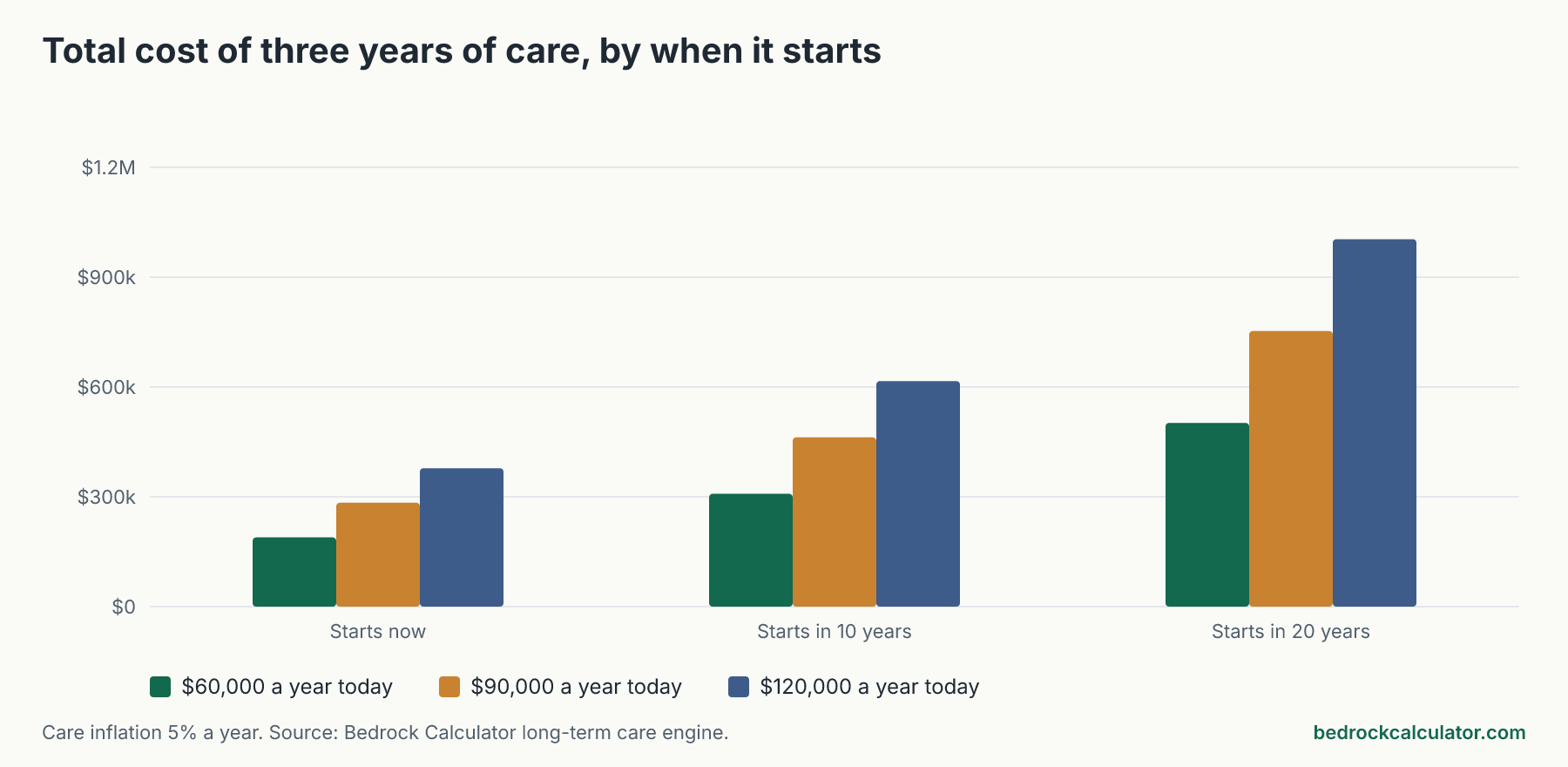
Total cost of three years of long-term care in the US, by price today and years until care starts
Download CSVCare costs rise 5% a year; today's purchasing power uses 2.5% general inflation. Prices today are scenario inputs, not survey data.
| $60,000 | $189,150 | $308,105 | $501,871 | $298,628 |
| $90,000 | $283,725 | $462,158 | $752,807 | $447,942 |
| $120,000 | $378,300 | $616,211 | $1,003,743 | $597,256 |
Starting now, three years of care runs $189,150 at $60,000 a year, $283,725 at $90,000 and $378,300 at $120,000. Even starting now, the total is more than three times the first year's price, because the price keeps rising during the stay.
Push the start date out and the bill grows quickly. Ten years from now, three years of $90,000 care costs $462,158. Twenty years from now, it's $752,807.
Why care inflation matters so much
The price of care has tended to rise faster than prices in general, and that gap does most of the damage. If care costing $120,000 today only rose with general inflation, three years of it starting in 20 years would cost $604,772. At 5% it costs $1,003,743. The difference, $398,970, comes purely from care prices outrunning everything else.
Put another way: in 20 years the first year of that care would cost $318,396, about 2.7 times today's price. In today's money, the three-year total is still $597,256, well above the $378,300 it would cost now. A plan built on a single inflation rate for every expense understates this bill.
How long your savings last in long-term care
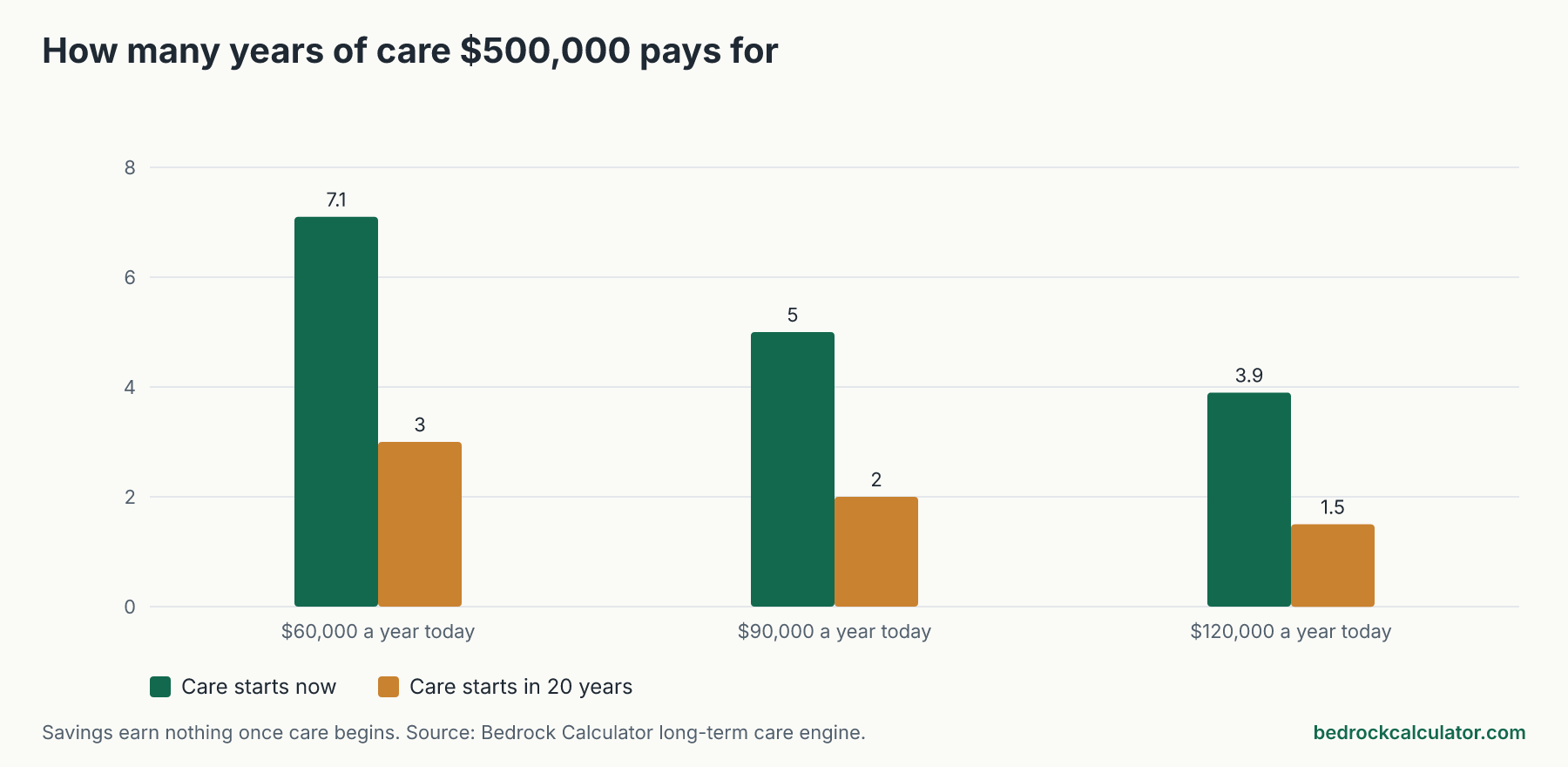
Years of long-term care that savings pay for, by care price and start date
Download CSVSavings are the balance on hand when care begins and are assumed to earn nothing. Care costs rise 5% a year from today's price.
| $60,000 | 3.9 | 7.1 | 1.5 | 3 |
| $90,000 | 2.7 | 5 | 1 | 2 |
| $120,000 | 2 | 3.9 | 0.8 | 1.5 |
If care starts now, $250,000 covers about 3.9 years at $60,000 a year and 2 years at $120,000. $500,000 stretches to 7.1 and 3.9 years.
Twenty years out, the same balances cover far less. $500,000 pays for 3 years of care that costs $60,000 today, and 1.5 years of care that costs $120,000 today.
That doesn't mean your savings will be worth the same in 20 years. If you're 50 now, your nest egg should grow too. The point is that a long-term care fund has to be measured against future care prices, not today's. A target of "three years of care at today's price" will fall short.
How long does long-term care usually last?
Nobody knows how long their own care will last, and that uncertainty is the hardest part of planning for it. Many people need little or no paid care, while a smaller group needs it for years, often for dementia. The federal government's LongTermCare.gov site has a useful overview of how needs vary.
Running the calculator at a short and a long stay is the honest way to plan: the long one shows what you'd need to be safe, and the short one shows what's more likely.
What this leaves out
- Medicare and Medicaid. Medicare pays only for limited skilled nursing after a qualifying hospital stay, not for ongoing help with daily living. Medicaid pays for long-term care once your assets are spent down to a low level. Neither is counted here.
- Family care. Most long-term care in the US is given unpaid by family members. The calculator assumes every hour is paid for.
- Growth on your savings. We assume the money set aside earns nothing once care begins. If it stays invested, it lasts somewhat longer.
- Taxes. Some long-term care costs count as deductible medical expenses, and withdrawals from a traditional IRA or 401(k) to pay for care are taxed as income. None of that is included.
- Insurance. The calculator can also compare a long-term care policy with paying yourself, but that comparison assumes the care is certainly needed, which flatters the policy. This page sticks to the cost of care itself.
Planning for your own numbers
Get a quote for the kind of care you'd want in the area you'd live in. Then open the long-term care cost calculator, enter that price, your years until care and a few different stay lengths, and see the total.
To check whether your savings could absorb it, run the retirement calculator with the care bill included. If you have a health savings account, money in it can pay qualified long-term care costs tax-free; see what steady HSA saving becomes by 65. And for a sense of how long retirement itself might run, see US life expectancy by age.