How much tax does a Roth conversion cost at each income?
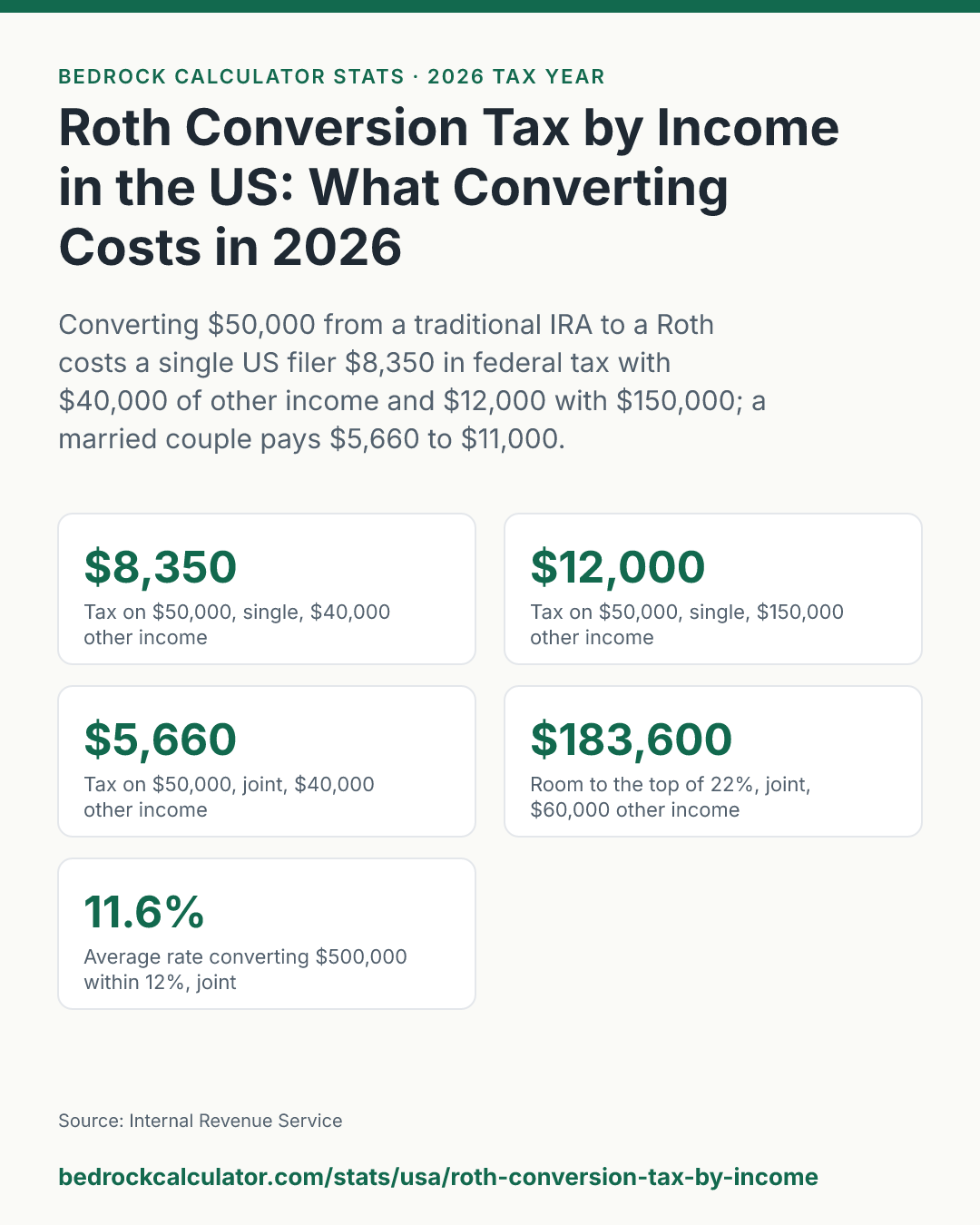
A Roth conversion is taxed as ordinary income on top of whatever else you earn that year, so the same conversion costs very different amounts depending on your other income. Converting $50,000 from a traditional IRA to a Roth costs a single US filer $8,350 in federal income tax with $40,000 of other income, and $12,000 with $150,000.
Married couples filing jointly get wider brackets and pay less on the same conversion: $5,660 with $40,000 of other income, $11,000 with $150,000.
How we worked out these numbers
Every figure comes from the site's Roth conversion ladder calculator. For each year, it adds the conversion to your other income, takes off the 2026 standard deduction, runs the result through the 2026 federal brackets and records how much more tax you owe than you would without the conversion. That difference is the tax cost of converting.
"Other income" here means gross income from everything else: a pension, part-time work, Social Security that's taxable, interest and so on, before the standard deduction. We used five levels from $40,000 to $150,000, for a single filer and for a married couple filing jointly.
We started at $40,000 because of how the calculator works out bracket room. When other income is below the standard deduction, it doesn't count the unused part of the deduction as extra room, so it understates how much you can convert at low incomes. All five incomes here are above the deduction for both filers, so that doesn't affect any number on this page.
What a $50,000 Roth conversion costs at each income
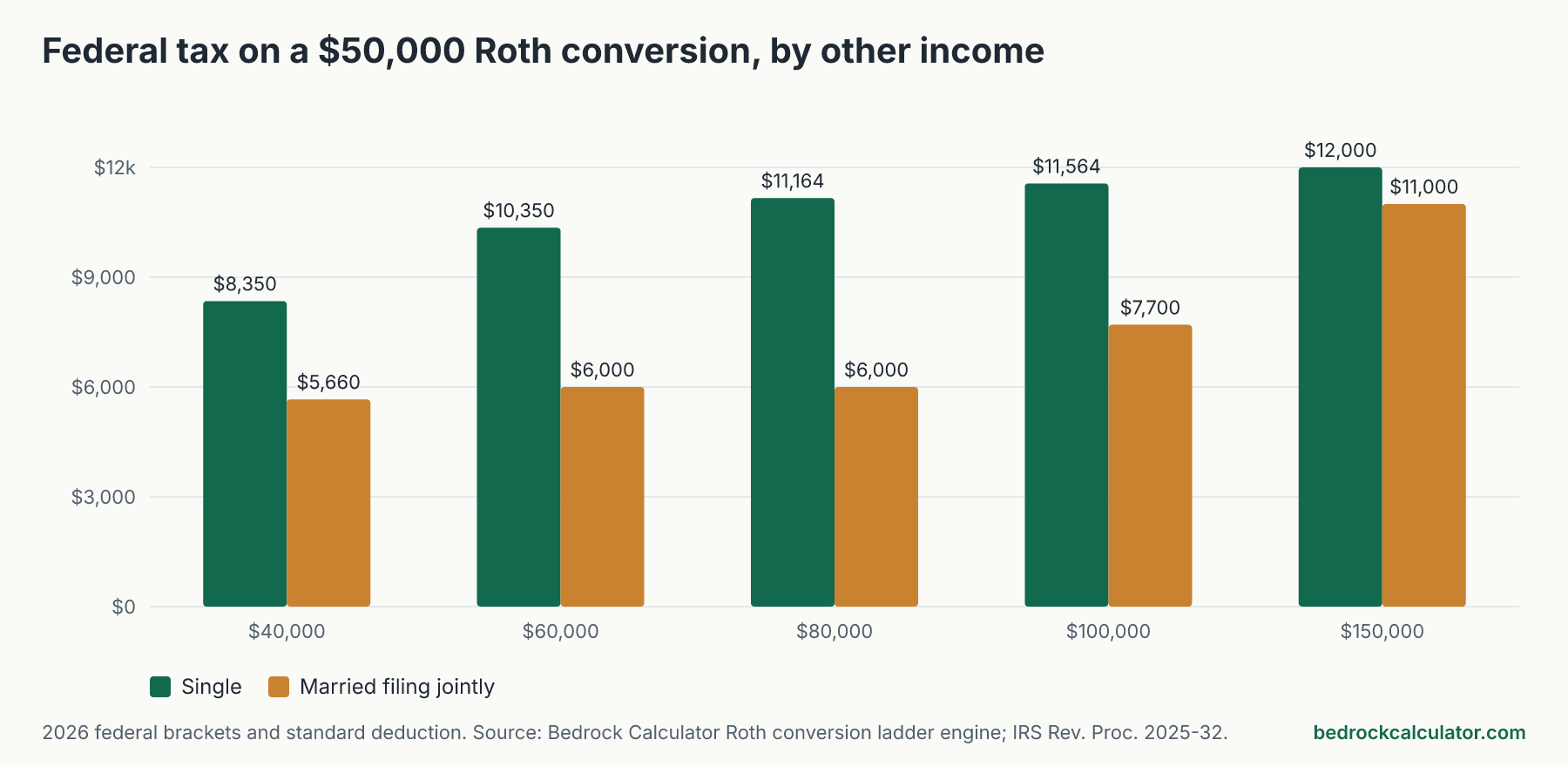
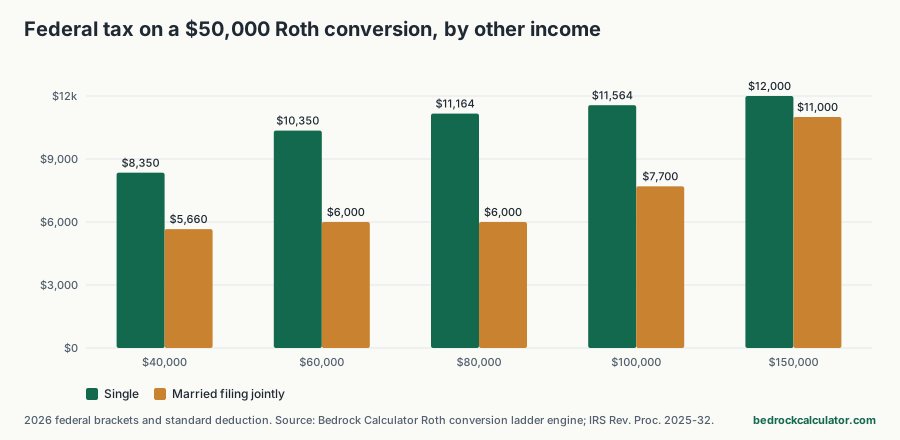
Federal tax on a $50,000 Roth conversion by other income (US, 2026)
Download CSVOther income is gross income before the 2026 standard deduction. Federal income tax only; state tax, IRMAA and ACA credits not included.
| $40,000 | $8,350 | 16.7% | $5,660 | 11.3% |
| $60,000 | $10,350 | 20.7% | $6,000 | 12.0% |
| $80,000 | $11,164 | 22.3% | $6,000 | 12.0% |
| $100,000 | $11,564 | 23.1% | $7,700 | 15.4% |
| $150,000 | $12,000 | 24.0% | $11,000 | 22.0% |
For a single filer, the rate on the conversion rises from 16.7% at $40,000 of other income to 24.0% at $150,000. At $40,000 part of the conversion still lands in the 12% bracket. By $80,000 your other income has already filled it, so nearly all of the conversion is taxed at 22% or more.
Married couples have twice the bracket width, so the picture shifts. With $60,000 or $80,000 of other income, a joint conversion of $50,000 costs $6,000, a flat 12.0%, because the whole amount fits inside the 12% bracket. At $150,000, it's $11,000.
How much can you convert and stay in the 12% or 22% bracket?
Most people running a Roth conversion ladder don't pick a round number. They convert just enough each year to reach the top of a chosen bracket, so none of it gets taxed at a higher rate.
How much you can convert before leaving the 12% or 22% bracket, and the tax on it
Download CSVOne year, 2026 brackets and standard deduction. $0 means other income already fills that bracket.
| $40,000 | $26,500 | $81,800 | $15,346 | $93,000 | $203,600 | $35,152 |
| $60,000 | $6,500 | $61,800 | $12,946 | $73,000 | $183,600 | $33,092 |
| $80,000 | $0 | $41,800 | $9,196 | $53,000 | $163,600 | $30,692 |
| $100,000 | $0 | $21,800 | $4,796 | $33,000 | $143,600 | $28,292 |
| $150,000 | $0 | $0 | $0 | $0 | $93,600 | $20,592 |
For a married couple with $40,000 of other income, that means up to $93,000 at 12% or $203,600 at 22%. Filling the 22% bracket costs them $35,152 of federal tax that year.
A single filer with $60,000 of other income has only $6,500 left in the 12% bracket, but $61,800 of room up to the top of 22%, costing $12,946.
At $150,000, a single filer is already past the top of the 22% bracket, so there's no room at all. A couple at the same income still has $93,600 of room in 22%.
What a full Roth conversion ladder costs
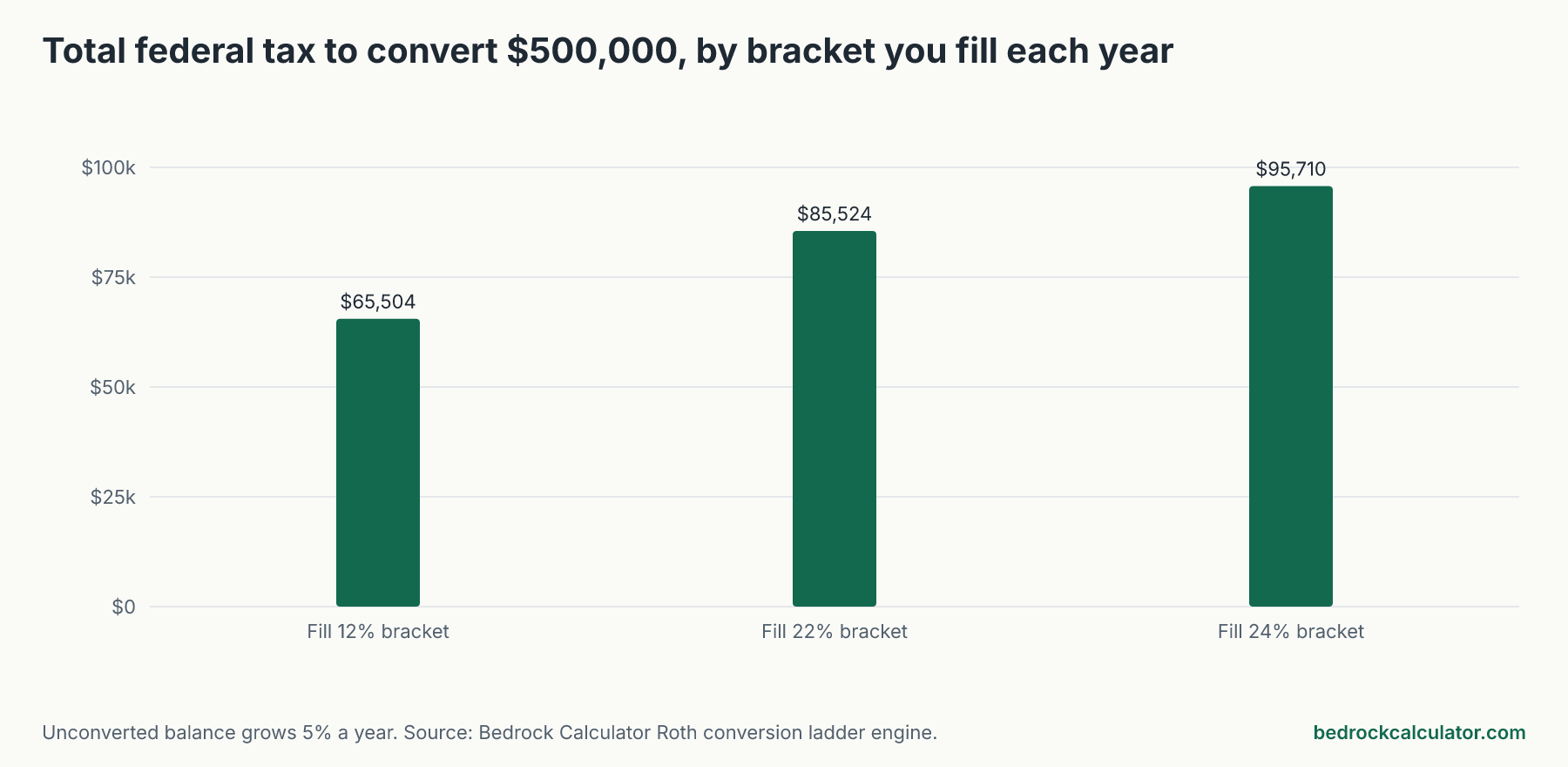
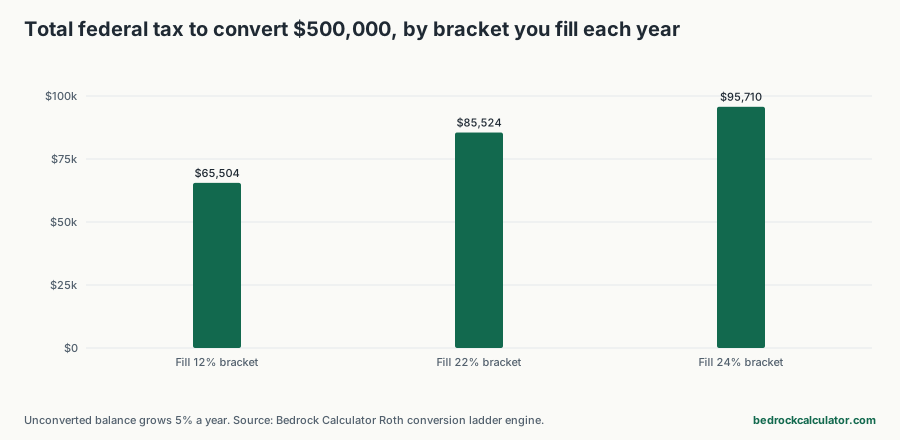
To see how the bracket choice plays out over several years, we ran a married couple with $500,000 in a traditional IRA and $40,000 of other income, with the unconverted balance growing 5% a year.
- Filling the 12% bracket: 7 years, $65,504 of total federal tax, an average of 11.6% on the $563,841 converted.
- Filling the 22% bracket: 3 years, $85,524 of tax, an average of 16.4%.
- Filling the 24% bracket: 2 years, $95,710 of tax, an average of 18.9%.
Going slow at 12% saves $30,206 of tax compared with the 24% route. The catch is time. The slower ladder converts more dollars in total, $563,841, because the balance keeps growing while you wait, and each year's conversion starts its own five-year clock before it can come out penalty-free if you're under 59 and a half.
Which pace is right depends on what you expect your tax rate to be later. If required minimum distributions and Social Security would push you into the 22% or 24% bracket anyway, converting at 22% now can still come out ahead. If you expect a low income in retirement, filling only the 12% bracket is the cheaper path. The Roth vs traditional by tax bracket page works through that trade-off.
What this leaves out
The calculator handles federal income tax brackets and the standard deduction, and nothing else. A conversion raises your income, and that can cost you in other ways:
- State income tax. Most states tax Roth conversions as income. That isn't included.
- Medicare IRMAA. A large conversion at 63 or older can push you into a higher Medicare premium tier two years later. See Medicare IRMAA brackets for 2026 and the IRMAA calculator.
- ACA health insurance credits. If you buy coverage on the marketplace before 65, conversion income can shrink your premium tax credit, sometimes by more than the tax itself.
- Taxation of Social Security and capital gains. Extra income can make more of your Social Security benefit taxable and push long-term gains into a higher rate. The calculator doesn't model either.
- Nondeductible contributions. The calculator treats the whole balance as pre-tax. If you've made nondeductible IRA contributions, part of every conversion is tax-free under the pro-rata rule on IRS Form 8606, and your tax would be lower.
- Brackets that change. The ladder holds 2026 brackets, the standard deduction and your other income fixed for every year.
Running your own conversion
Open the Roth conversion ladder calculator, enter your traditional balance, your other income and filing status, and choose the bracket you want to fill. It shows how much fits each year, the tax on each conversion and how long the whole ladder takes. To see your full federal bill for the year, run the federal income tax calculator with the conversion included, and the Roth IRA calculator shows what the converted money could grow to.