Which saves tax best in India, ELSS, PPF or NPS?
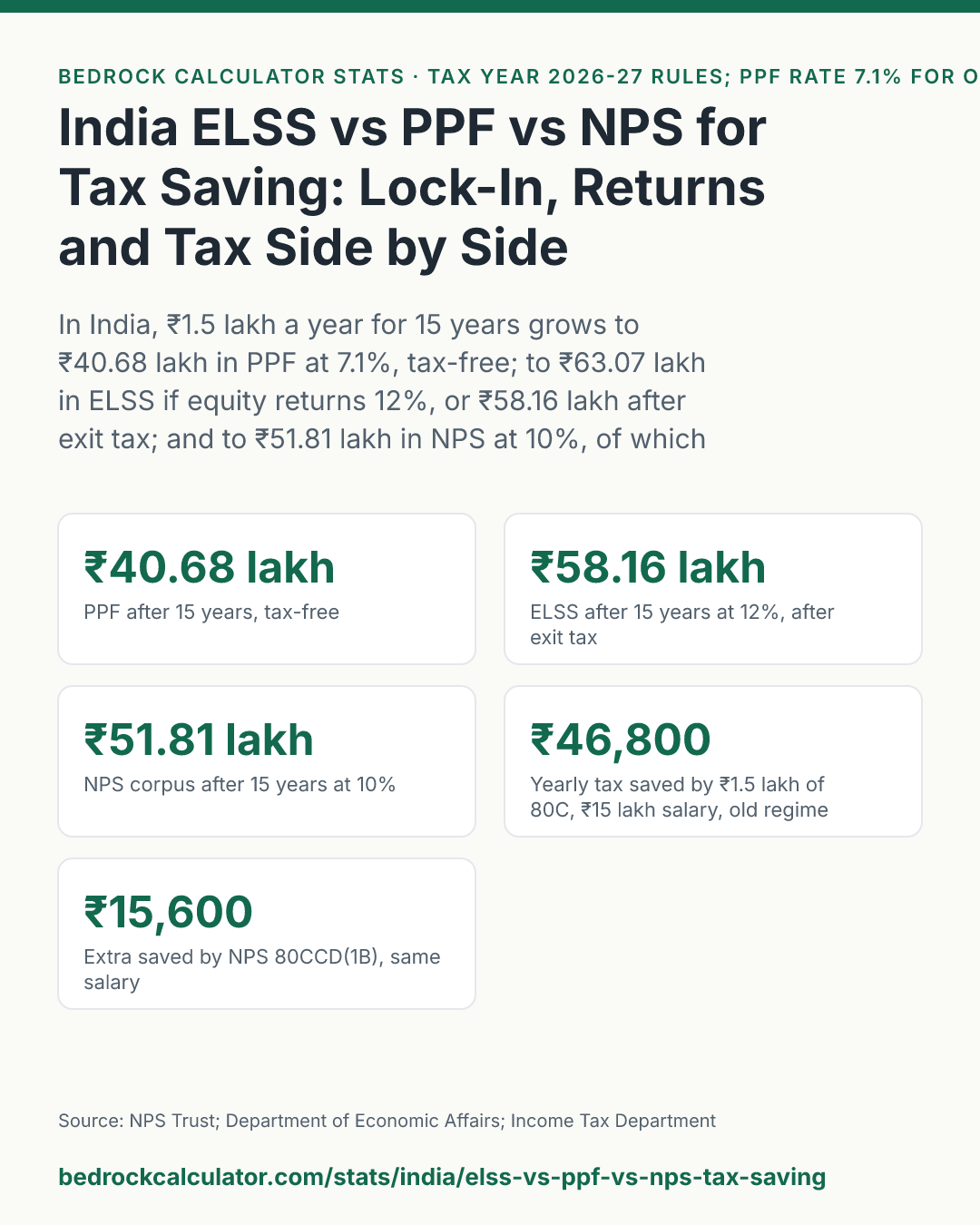
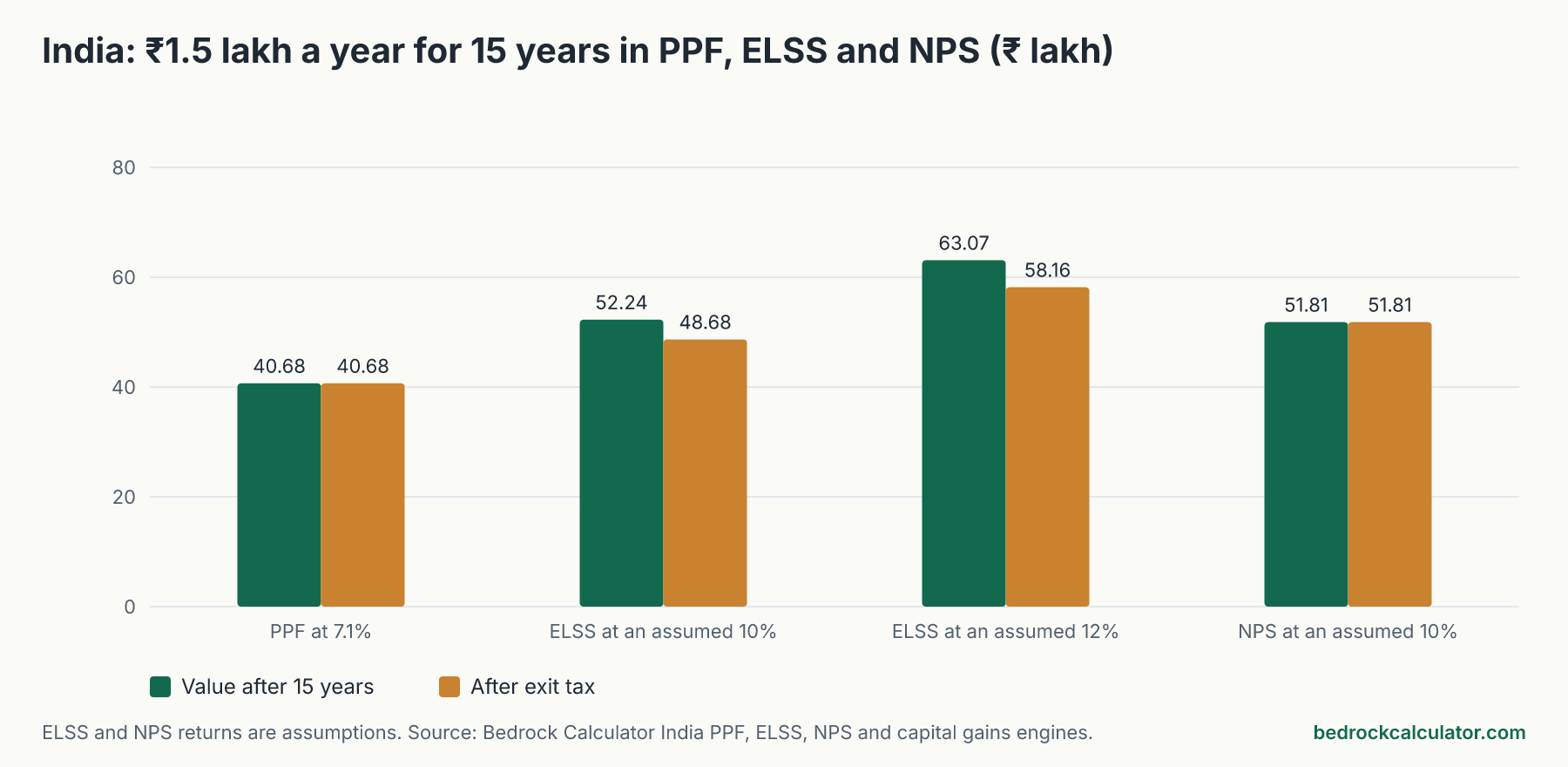
Put ₹1.5 lakh a year for 15 years into each of India's three most popular tax-saving products and you'd end up with roughly:
- PPF: ₹40.68 lakh at the current 7.1% rate, all tax-free
- ELSS: ₹58.16 lakh after exit tax if equity funds return 12% a year, or ₹48.68 lakh at 10%
- NPS: ₹51.81 lakh at an assumed 10% return, but locked until 60, and ₹10.36 lakh of it must buy an annuity
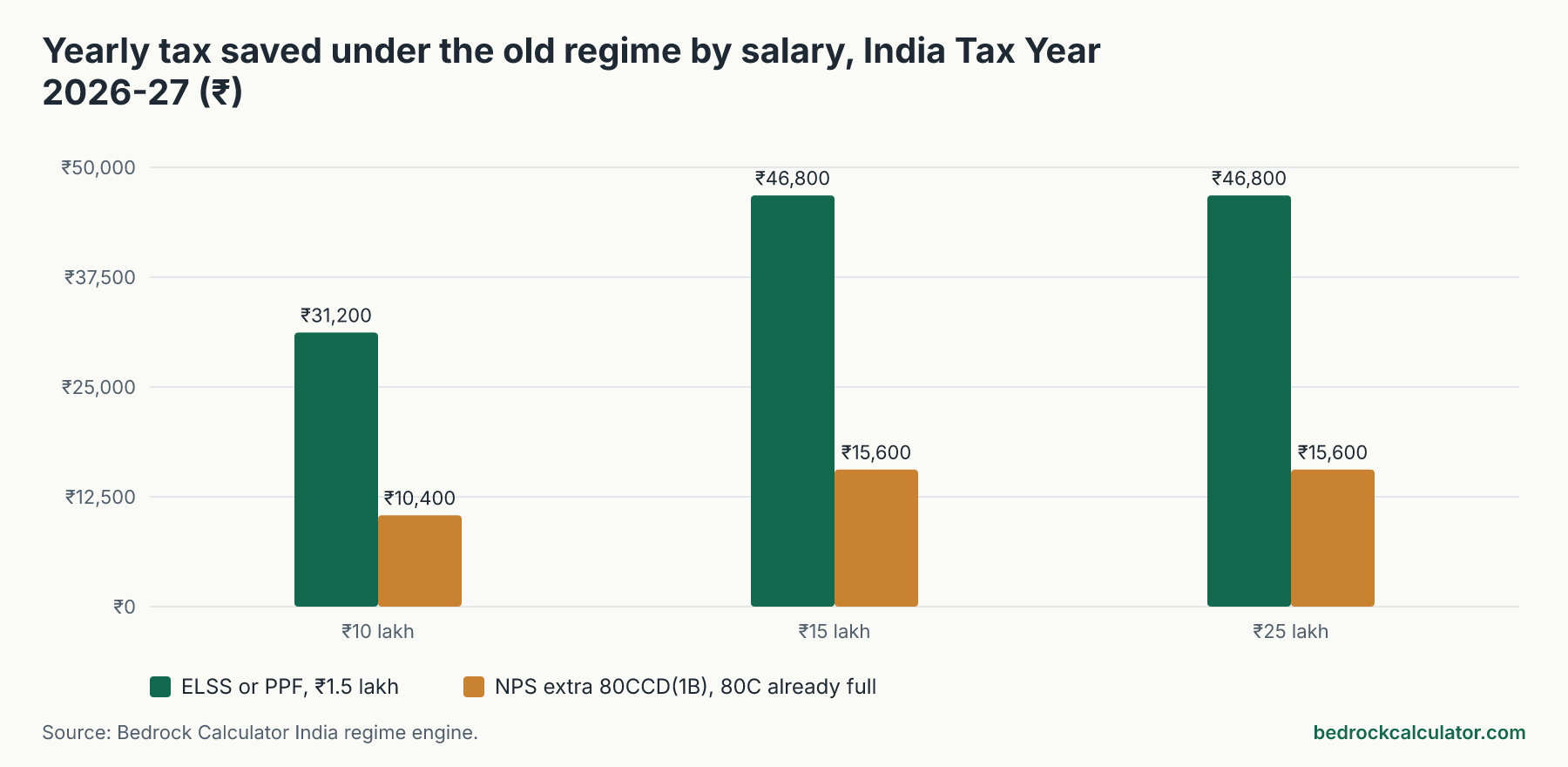
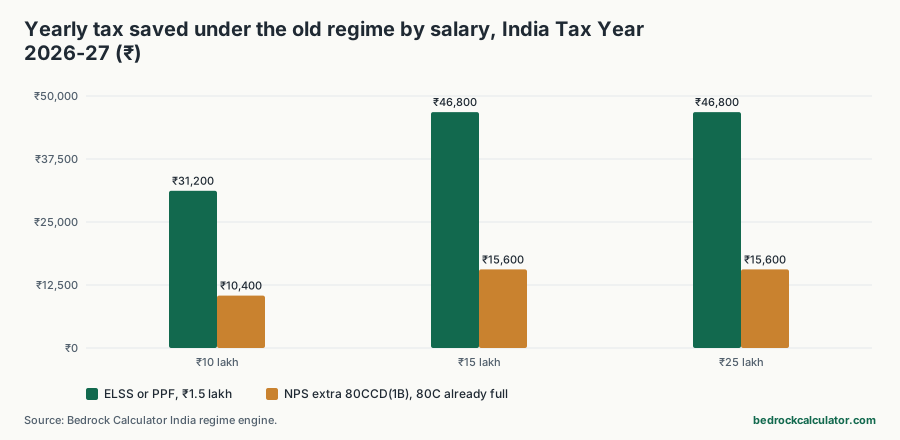
All three save the same income tax on the first ₹1.5 lakh under the old regime: ₹46,800 a year on a ₹15 lakh salary. NPS is the only one that can save more, through an extra ₹50,000 deduction.
The assumptions behind this comparison
PPF's rate is set by the government, so its figure is close to what you'd actually get if the rate holds. ELSS and NPS are market-linked, so their figures depend entirely on the return you assume. We've used:
- PPF: 7.1%, the rate notified for July to September 2026 and kept for October to December 2026, held for all 15 years
- ELSS: 10% and 12% a year, with the ₹1.5 lakh invested as a monthly SIP
- NPS: 10% a year, the NPS calculator's default, also paid monthly, running from age 45 to 60 so the 15-year term ends at the normal exit age
These are illustrations, not forecasts. Equity can return much more or much less than this over 15 years.
Each figure comes from its own calculator on this site: the PPF calculator, the ELSS calculator and the NPS calculator. Exit tax on ELSS comes from the equity capital gains calculator, and the yearly tax saving from the old vs new regime calculator.
ELSS vs PPF vs NPS side by side
Values in lakh rupees; exit tax in rupees. Click a column heading to sort.
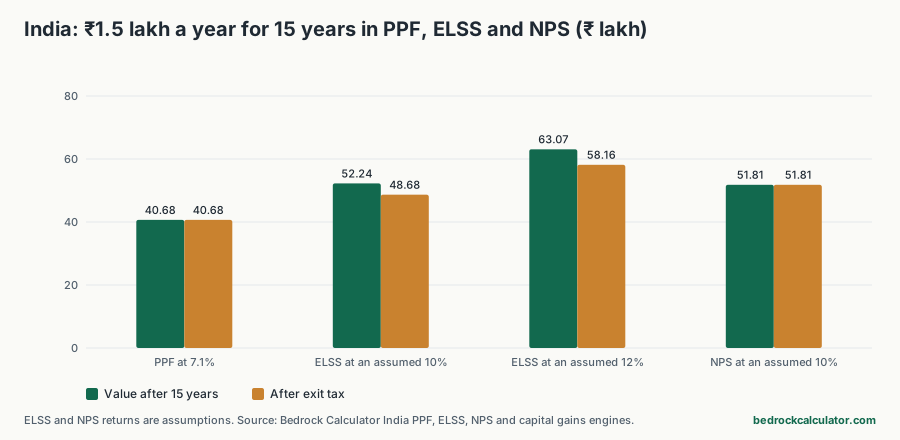
India ELSS vs PPF vs NPS: ₹1.5 lakh a year for 15 years (₹ lakh)
Download CSVDeposits of ₹1.5 lakh a year. ELSS and NPS paid monthly; PPF at the start of each year. ELSS exit tax assumes all gains are taken in one year. NPS run from 45 to 60. Return rates for ELSS and NPS are assumptions. Lakh rupees except exit tax.
| ELSS at an assumed 12% | 3 years per instalment | 63.07 | ₹4,91,525 | 58.16 | 12.5% on gains above ₹1.25 lakh a year |
| NPS at an assumed 10% | Until 60 | 51.81 | ₹0 | 51.81 | Up to 80% lump sum; annuity income taxed |
| ELSS at an assumed 10% | 3 years per instalment | 52.24 | ₹3,56,132 | 48.68 | 12.5% on gains above ₹1.25 lakh a year |
| PPF at 7.1% | 15 years | 40.68 | ₹0 | 40.68 | Tax-free |
Lock-in: how long your money is tied up
This is where the three differ most.
ELSS has the shortest lock-in, 3 years, but it applies to each instalment separately. With a monthly SIP, every month's money unlocks three years after that month. At the end of our 15 years, the last three years of instalments would still be locked.
PPF runs for 15 years. You can take loans in the early years and make limited withdrawals from the seventh year, but the full balance isn't yours until maturity.
NPS is locked until 60, with only limited partial withdrawals before then. It's a retirement account first and a tax saver second.
How each is taxed when you take the money out
PPF is tax-free all the way through. Nothing is taxed on the interest or at maturity.
ELSS gains are long-term capital gains. Gains above ₹1.25 lakh a year are taxed at 12.5%. If you took all the gains in one year after 15 years, the tax would be ₹3,56,132 at a 10% return or ₹4,91,525 at 12%. That's what the table assumes. In practice you can redeem a slice each year to use the ₹1.25 lakh allowance repeatedly, which would cut the tax.
NPS lets you take up to 80% as a lump sum at 60, which the calculator treats as tax-free, though whether the exemption covers the full 80% hadn't been confirmed when it was built. The other 20%, ₹10.36 lakh here, has to buy an annuity. At an assumed 6% annuity rate that pays about ₹5,181 a month, and the pension is taxed as income.
So the NPS figure in the table isn't directly comparable with the others. You can't take it all as cash.
How much tax each one saves
All three products share the same Section 80C limit of ₹1.5 lakh. So if you put ₹1.5 lakh into any one of them, the tax saving is the same.
India: yearly income tax saved by the deposit, old regime, Tax Year 2026-27 (₹)
Download CSVSalaried, below 60, no other deductions. ELSS and PPF use Section 80C up to ₹1.5 lakh. The last column is NPS's extra ₹50,000 under Section 80CCD(1B) when EPF or other investments already fill 80C. New regime tax shown for comparison; it allows none of these. Includes cess.
| ₹10,00,000 | ₹31,200 | ₹31,200 | ₹10,400 | ₹75,400 | ₹0 |
| ₹15,00,000 | ₹46,800 | ₹46,800 | ₹15,600 | ₹2,10,600 | ₹97,500 |
| ₹25,00,000 | ₹46,800 | ₹46,800 | ₹15,600 | ₹5,22,600 | ₹3,19,800 |
On a ₹10 lakh salary the saving is ₹31,200 a year. From ₹15 lakh it's ₹46,800.
NPS has one advantage here. Most salaried people already fill much of their 80C limit with EPF contributions. Once 80C is full, ELSS and PPF save no more tax. NPS still gets the separate ₹50,000 Section 80CCD(1B) deduction, which saves ₹15,600 a year at ₹15 lakh.
The catch: the new regime
None of this applies under the new tax regime, which allows no deduction for ELSS, PPF or your own NPS contributions. And the new regime is often cheaper anyway. On ₹15 lakh, the old regime with the full ₹1.5 lakh of 80C still charges ₹2,10,600, against ₹97,500 under the new regime. Our new vs old regime comparison goes through when the old regime is worth it.
If you're on the new regime, choose between these three on returns, lock-in and how you want the money back, not on tax saving. PPF and ELSS are still useful investments. NPS still gets the employer contribution deduction under Section 80CCD(2) in both regimes.
What the calculators leave out
- Market risk. ELSS and NPS returns are assumed constant. Real returns vary year to year and can be negative.
- Fund costs. ELSS expense ratios and NPS charges reduce returns. Use a net-of-cost return when you run your own figures.
- Locked ELSS units. The ELSS figures are values at year 15, but the final three years of SIP instalments couldn't be redeemed until later.
- Smarter ELSS exits. Redeeming gradually to use the yearly exemption would lower the exit tax shown.
- Rate changes for PPF. The 7.1% rate is reviewed every quarter.
- Inflation. All figures are in future rupees.
Picking between them
If you want certainty and tax-free money, PPF does the job. If you can take equity risk and want the higher expected return, ELSS has the shortest lock-in. If your 80C is already full from EPF and you're on the old regime, NPS is the only one of the three that still cuts your tax. Run your own numbers through the 80C and 80D deduction optimizer to see how much room you have left.