How much monthly debt can you carry at each income?
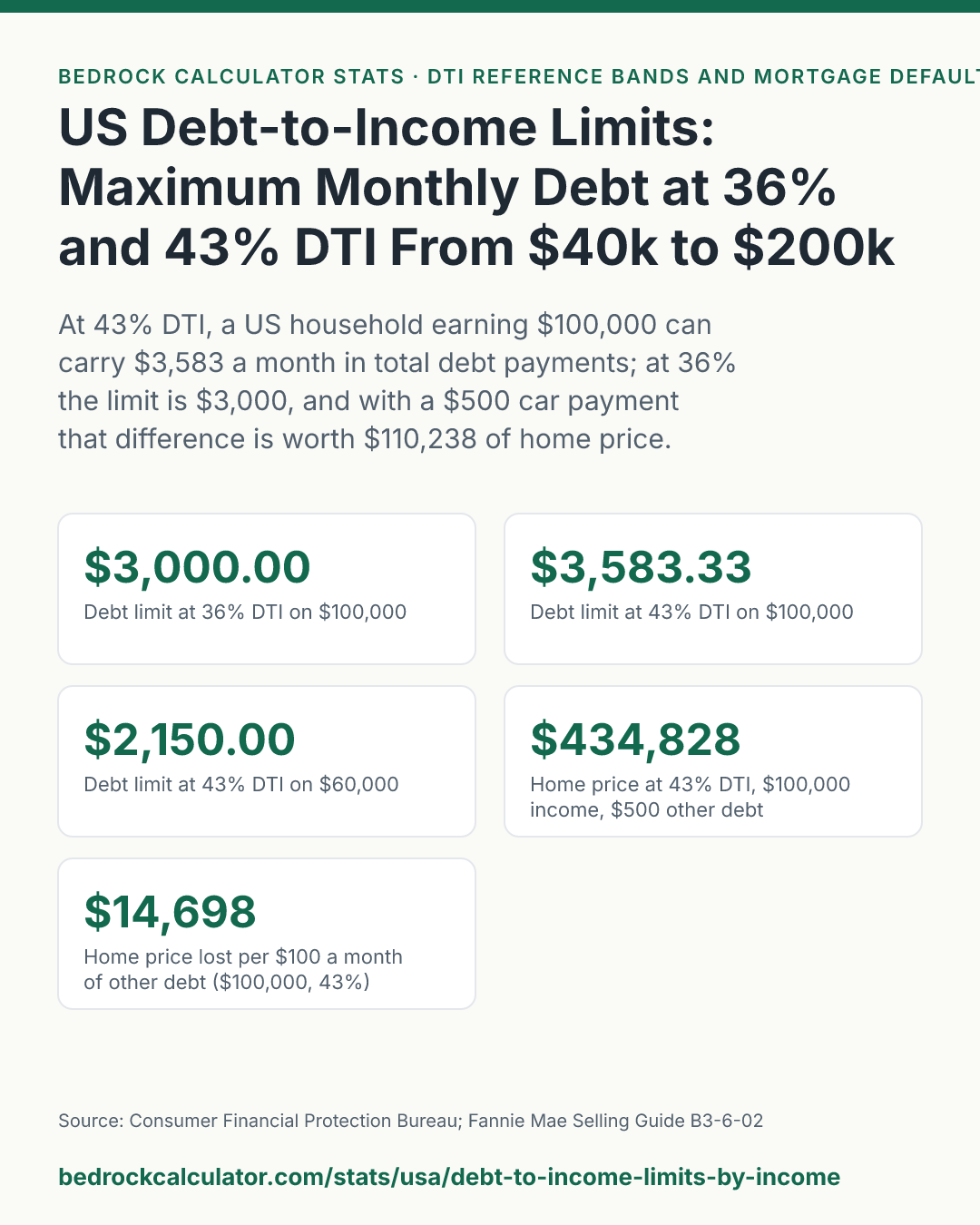
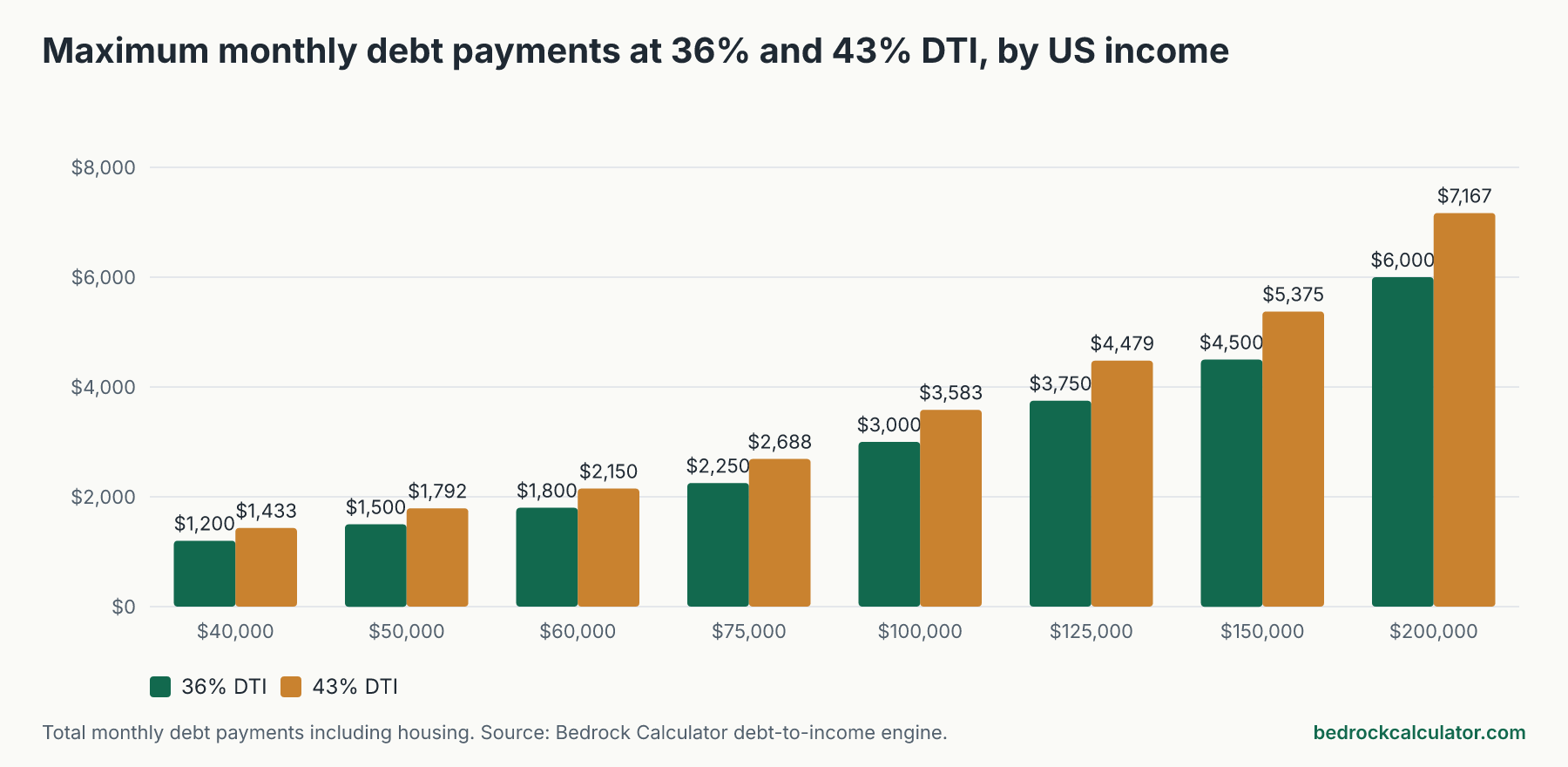
A US household earning $100,000 a year can carry $3,000.00 a month in total debt payments at a 36% debt-to-income ratio, or $3,583.33 at 43%. That total includes the mortgage. On $60,000 the limits are $1,800.00 and $2,150.00.
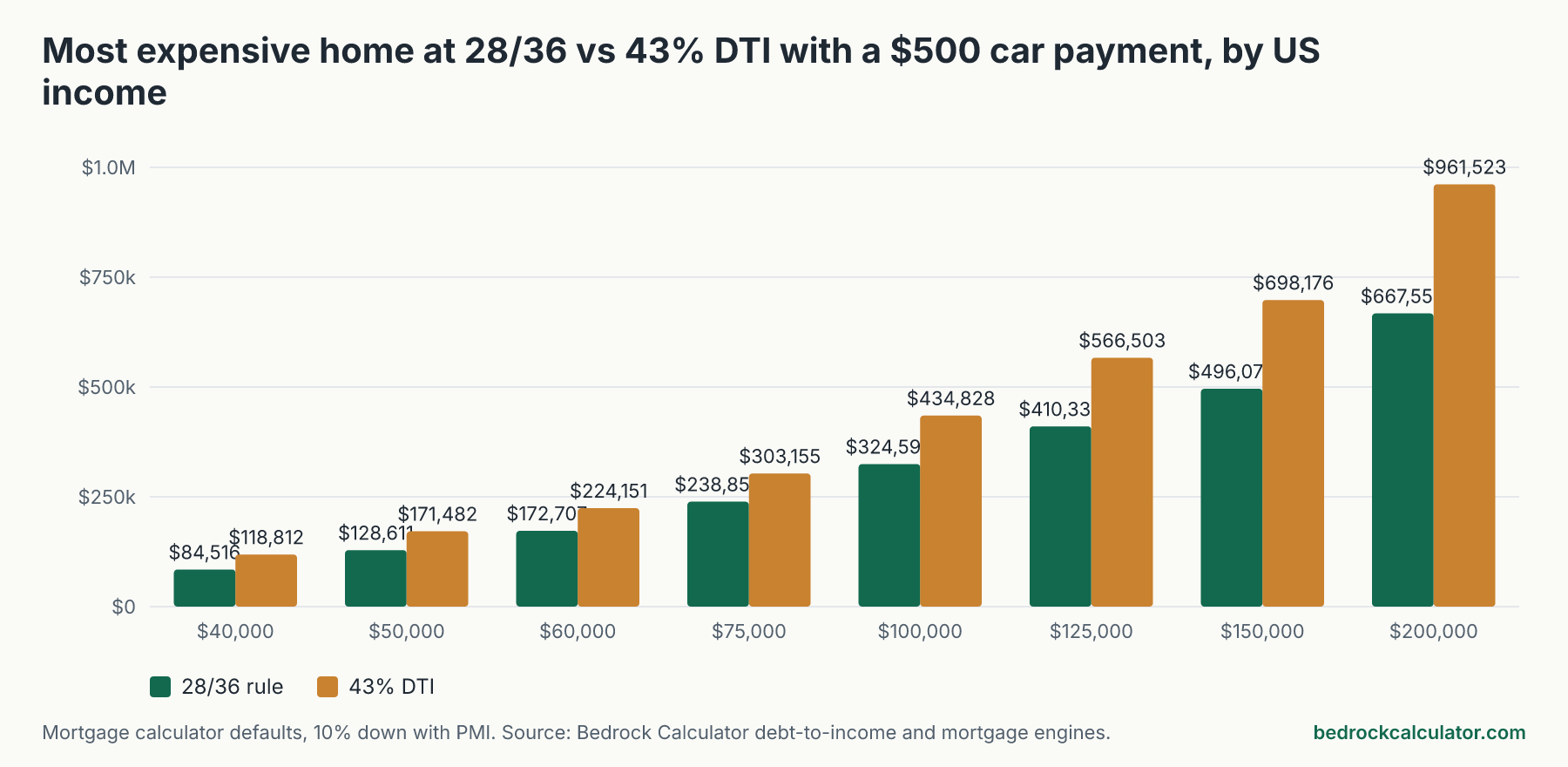
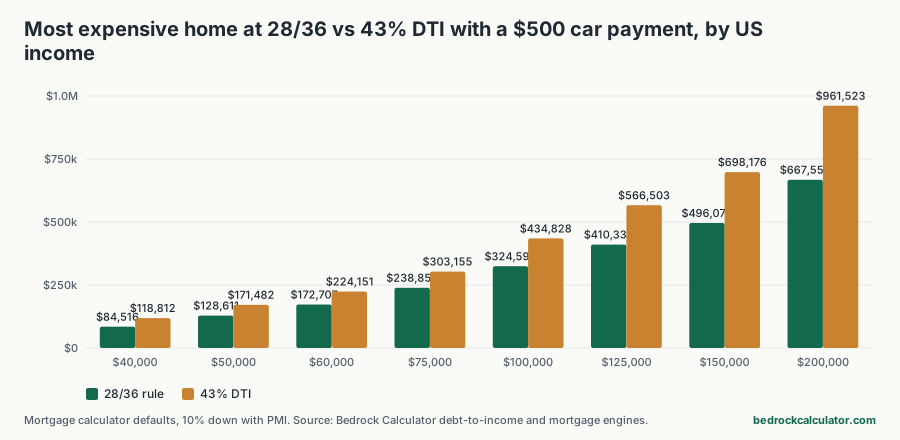
What that means for a home depends on what else you owe. With a $500 car payment, $100,000 of income supports a home of about $324,590 under the traditional 28/36 rule and $434,828 at 43%, a difference of $110,238.
What debt-to-income actually measures
Your debt-to-income ratio, or DTI, is your monthly debt payments divided by your gross monthly income, before tax. Mortgage lenders look at two versions.
- Front-end DTI counts only the housing payment: principal, interest, property tax, homeowners insurance, and any mortgage insurance and HOA dues.
- Back-end DTI adds every other recurring debt payment to that: car loans, student loans, minimum credit card payments, personal loans, and child support or alimony.
Groceries, utilities, phone bills and insurance premiums other than homeowners aren't debt and don't count. Lenders also use the minimum payment due on a credit card, not what you actually pay.
When people talk about a DTI limit, they almost always mean back-end. That's what this page is built on.
Where the 36% and 43% figures come from
The 36% figure is the back half of the old 28/36 rule of thumb: no more than 28% of gross income on housing and 36% on all debt. Fannie Mae still uses 36% as the baseline for manually underwritten loans, and allows more when credit and cash reserves are strong.
The 43% figure was the ceiling for a Qualified Mortgage under the CFPB's rules until the General QM rule replaced it with a test based on the loan's price. It survives as a common rule of thumb, and FHA's standard guideline uses the same 43% back-end figure alongside a 31% housing limit. Automated underwriting at Fannie Mae and Freddie Mac can approve higher ratios for strong borrowers, so neither number is a hard wall.
Maximum monthly debt payment at every income
The limits are simple to compute but easy to misread. Each one is the total of all your debt payments, housing included, not the room left after your mortgage.
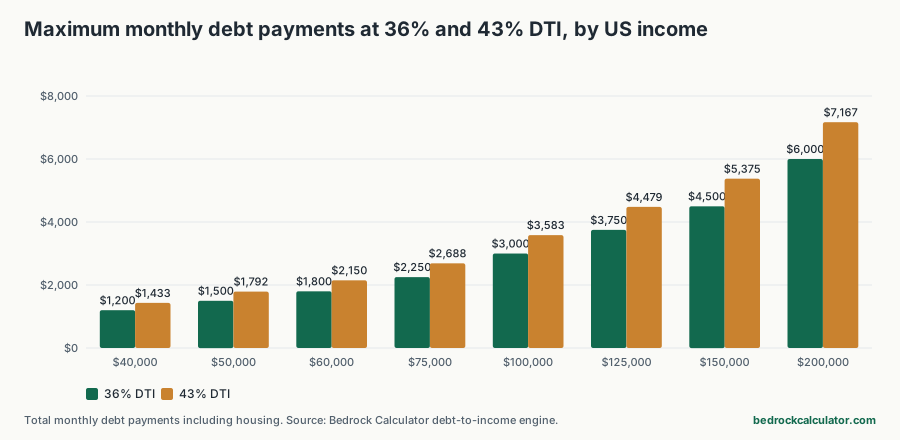
Maximum monthly debt payments at 36% and 43% DTI, by US household income
Download CSVBack-end DTI: all monthly debt payments, including the housing payment, divided by gross monthly income.
| $40,000 | $3,333.33 | $1,200.00 | $1,433.33 | $700.00 | $933.33 |
| $50,000 | $4,166.67 | $1,500.00 | $1,791.67 | $1,000.00 | $1,291.67 |
| $60,000 | $5,000.00 | $1,800.00 | $2,150.00 | $1,300.00 | $1,650.00 |
| $75,000 | $6,250.00 | $2,250.00 | $2,687.50 | $1,750.00 | $2,187.50 |
| $100,000 | $8,333.33 | $3,000.00 | $3,583.33 | $2,333.33 | $3,083.33 |
| $125,000 | $10,416.67 | $3,750.00 | $4,479.17 | $2,916.67 | $3,979.17 |
| $150,000 | $12,500.00 | $4,500.00 | $5,375.00 | $3,500.00 | $4,875.00 |
| $200,000 | $16,666.67 | $6,000.00 | $7,166.67 | $4,666.67 | $6,666.67 |
On $40,000 a year the limit is $1,200.00 at 36% and $1,433.33 at 43%. On $75,000 it's $2,250.00 and $2,687.50. On $150,000 it's $4,500.00 and $5,375.00, and on $200,000 it reaches $6,000.00 and $7,166.67.
The two housing room columns assume you already pay $500 a month on other debt, a typical car or student loan payment. Under the 28/36 rule the housing payment is the lower of 28% of income or the 36% limit minus that $500. At the lower incomes the 36% limit is the one that binds. From $100,000 up, the 28% housing cap is tighter, which is why the 28/36 room grows more slowly than the 43% room at the top of the table.
How we worked out these numbers
The DTI percentages are the reference bands built into the debt-to-income ratio calculator on this site. For each income we multiplied gross monthly income by the band, then ran each result back through that calculator to confirm it lands exactly on 36% or 43%.
For the home price, we handed each housing payment to the mortgage calculator and asked for the most expensive home that payment covers. We used the calculator's own defaults for everything except the down payment: a 6.5% fixed rate over 30 years, property tax at 0.89% of the price a year, which is the average of the 50 state effective rates, $1,500 a year of homeowners insurance, and PMI at 0.5% of the loan a year. We set the down payment at 10%, so PMI is part of the payment.
What these figures leave out:
- Lender overlays and credit. Lenders can be stricter than these limits. A ratio that's fine with a high score and savings can be declined without them.
- How your student loans are counted. Deferred and income-driven loans are often counted at a percentage of the balance rather than at your actual payment.
- Closing costs and the cash to close. The price figures assume you have the down payment; they don't check it.
- Your local property tax and insurance. In a high-tax county the same payment buys noticeably less house.
- VA residual income. VA loans weigh what's left after taxes and living costs, which a DTI ratio doesn't capture.
What 36% vs 43% means for the house you can buy
The jump from the 28/36 rule to 43% is large. At $60,000 of income it moves the price from $172,707 to $224,151. At $150,000 it moves it from $496,072 to $698,176.
What the housing room buys: most expensive home at 36% vs 43% DTI
Download CSVMortgage calculator defaults for rate, term, property tax, insurance and PMI; 10% down; $500 a month of other debt.
| $40,000 | $84,516 | $118,812 | $34,296 | 36.0% | 21.0% |
| $50,000 | $128,611 | $171,482 | $42,871 | 36.0% | 24.0% |
| $60,000 | $172,707 | $224,151 | $51,445 | 36.0% | 26.0% |
| $75,000 | $238,850 | $303,155 | $64,306 | 36.0% | 28.0% |
| $100,000 | $324,590 | $434,828 | $110,238 | 34.0% | 28.0% |
| $125,000 | $410,332 | $566,503 | $156,171 | 32.8% | 28.0% |
| $150,000 | $496,072 | $698,176 | $202,103 | 32.0% | 28.0% |
| $200,000 | $667,554 | $961,523 | $293,969 | 31.0% | 28.0% |
That's the lender's view. Whether a payment at 43% of gross is comfortable is a different question. After federal and state tax and FICA, a 43% DTI can mean more than half of your take-home pay goes to debt. Our page on how much house you can afford by salary works through the more conservative 36% approach at several rates.
Why a car payment costs you more house than you think
Every dollar of monthly debt comes straight out of the housing room. At $100,000 of income and 43% DTI, each extra $100 a month of car, student loan or card payments lowers the most expensive home you can buy by about $14,698. Paying off a car loan before you apply, or not taking one on, can do more for your buying power than a raise.
If you're carrying card balances, our page on credit card payoff time shows how long the minimum takes, and the debt snowball vs avalanche example shows how to clear several debts faster.
Work out your own DTI
Add up your monthly debt payments and your proposed housing payment, then enter them with your gross monthly income in the debt-to-income ratio calculator. It shows both ratios and where you fall against the common guidelines. To see what payment a particular home would bring, use the mortgage calculator, or start from your income with the house affordability calculator. If you're looking at a low down payment loan, the FHA loan calculator adds FHA's mortgage insurance.